Double-barred Finch

Double-barred Finch

Taeniopygia bichenovii

Silhouette: Jim Bendon (photography) and T. Michael Keesey (vectorization) · PhyloPic

LCLeast ConcernNTVUENCR
Daily sighting probability ~30% · Possible
at Nitmiluk National Park

In 3 days ~70% in a week ~90%

141 Verified sightings at Nitmiluk National Park From 2019 to 2026
764 In all 6 parks
August Best month
☀️ Diurnal When it's spotted

About the Double-barred Finch

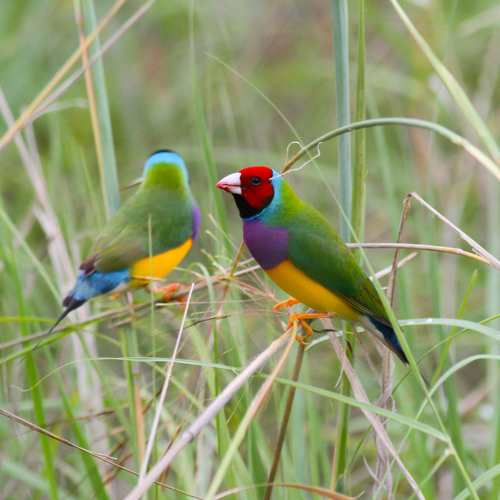
The double-barred finch (Stizoptera bichenovii) is an estrildid finch found in dry savannah, tropical (lowland) dry grassland and shrubland habitats in northern and eastern Australia. It is sometimes referred to as Bicheno's finch or as the owl finch, the latter of which owing to the dark ring of feathers around the face. It is the only species placed in the genus Stizoptera.

The double-barred finch was formally described in 1827 by the naturalists Nicholas Vigors and Thomas Horsfield from specimens collected near Shoalwater Bay and Broad Sound in Queensland, Australia. They coined the binomial name Fringilla bichenovii. The species was formerly placed in the genus Taeniopygia. A molecular phylogenetic study of the Estrildidae published in 2020 found that the genus Taeniopygia was not monophyletic. In the reorganization to create monophyletic genera, the double-barred finch was moved to the resurrected genus Stizoptera that had been introduced in 1899 by the American ornithologist Harry C. Oberholser. The genus name combines the Ancient Greek stizō meaning "to tattoo" with pteron meaning "wing". The specific epithet commemorates James Ebenezer Bicheno, a colonial secretary... Wikipedia →

Sounds

Recording0:31

Australia · 2023

© deborod · iNaturalist · CC BY-NC 4.0

Recording0:41

Australia · 2023

© sandra · iNaturalist · CC BY-NC 4.0

Recording0:08

Australia · 2026

© halobaena · iNaturalist · CC BY-NC 4.0

Global Distribution

Parks Where Found

# Park Country Daily sighting probability
1 Nitmiluk National Park 🇦🇺 Australia
~30%
2 Kakadu National Park 🇦🇺 Australia
~30%
3 Litchfield National Park 🇦🇺 Australia
~10%
4 Noosa National Park 🇦🇺 Australia
<5%
5 Blue Mountains National Park 🇦🇺 Australia
<5%
6 Lamington National Park 🇦🇺 Australia
<5%

Cities Where Found

# City Country Daily sighting probability
1 Brisbane 🇦🇺 Australia
~10%
2 Sydney 🇦🇺 Australia
<5%

Zoos & Centres Where Found

# Zoo / Centre Country
1 San Diego Zoo 🇺🇸 United States In captivity
2 Bronx Zoo 🇺🇸 United States In captivity
3 Berlin Zoological Garden 🇩🇪 Germany In captivity
4 Indianapolis Zoo 🇺🇸 United States In captivity
5 Taronga Zoo 🇦🇺 Australia In captivity
6 Ueno Zoo 🇯🇵 Japan In captivity
7 Featherdale Sydney Wildlife Park 🇦🇺 Australia In captivity
8 Helsingborgs Djur- och Lekpark 🇸🇪 Sweden In captivity
9 National Aviary 🇺🇸 United States In captivity
10 Aquarium Berlin 🇩🇪 Germany In captivity
11 Key West Butterfly and Nature Conservatory 🇺🇸 United States In captivity
12 Butterfly World 🇺🇸 United States In captivity

Before you go

What are the chances of seeing a Double-barred Finch in Nitmiluk National Park?

Possible

About 30% of wildlife watchers report a Double-barred Finch sighting in Nitmiluk National Park on a given day, based on 141 verified sightings from GBIF citizen-science data from 2019 to 2026. It is the 26th most-seen of the 103 birds we can rate there. Over three days the chance rises to about 70%, and over a week to about 90%, if each day is a fresh chance.

When is the best time to see a Double-barred Finch in Nitmiluk National Park?

May–June and August

In those months about 40% of wildlife watchers report a Double-barred Finch in Nitmiluk National Park on a given day, against about 20% in January, July and November, the lowest months. Those are among Nitmiluk National Park's driest months, with almost no rain against 270 mm in January.

What time of day is best to see a Double-barred Finch?

Between 8 and 11 am

Across all the parks we cover, that three-hour window holds the most Double-barred Finch sightings with a recorded time, and about 9 in 10 of them come between 6 am and 6 pm: it is a daytime animal.

Is Nitmiluk National Park the best place to see a Double-barred Finch?

Yes

Of the 6 parks where we can rate Double-barred Finch sightings, Nitmiluk National Park has the highest daily chance: about 30%. Next come Kakadu National Park (Australia, about 30%) and Litchfield National Park (Australia, about 10%).

Which relatives of the Double-barred Finch live in Nitmiluk National Park?

Same family: Estrildidae

The closest relatives of the Double-barred Finch that you can see in Nitmiluk National Park (family Estrildidae, Waxbills and Allies) are Crimson Finch (about 10%), Masked Finch (about 10%) and Gouldian Finch (about 10%), with each one's daily chance of a sighting.

Where does the Double-barred Finch sighting chance come from?

GBIF citizen-science records

It is estimated from how often the Double-barred Finch is recorded against all the birds logged in Nitmiluk National Park (141 verified sightings from 2019 to 2026), calibrated against known sighting rates. Figures are rounded to the nearest 10% because citizen-science data supports honest approximations, not decimals, and months with records from fewer than five people show "—". How it works.

← Back to Nitmiluk National Park