African Hobby

African Hobby

Falco cuvierii

Silhouette: Shyamal · PhyloPic

LCLeast ConcernNTVUENCR
Daily sighting probability <5% · Rare
at Nyungwe National Park

In 3 days <5% in a week ~10%

20 Verified sightings at Nyungwe National Park From 2019 to 2026
192 In all 14 parks
December Best month
☀️ Diurnal When it's spotted

About the African Hobby

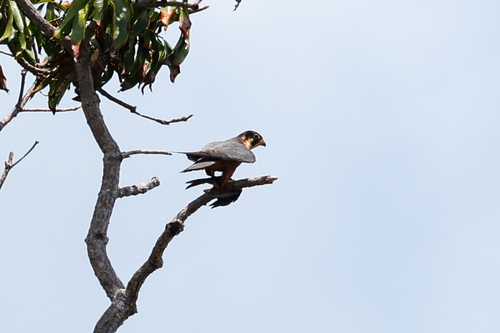
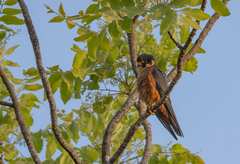
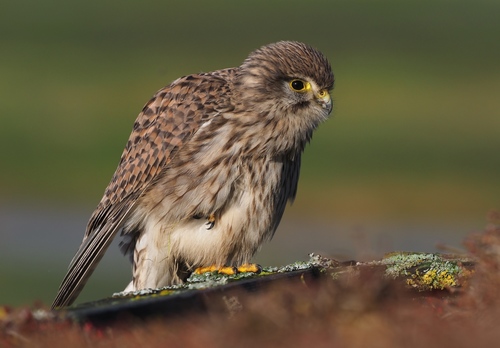
The African hobby (Falco cuvierii) is a small species of bird of prey in the family Falconidae. A small, slim falcon with blackish upperparts and deep rufous underparts with rufous cheek, nape and throat. At close range black streaks can be seen on the throat and flanks. The facial skin and feet are yellow. Juvenile birds are browner above with heavier streaking on the underparts and paler on cheek, nape and throat. Their length is 20 centimetres (7.9 in) and wing span 70 centimetres (28 in).

They are mostly found in the edge of moist woodlands and forests, commonest in palm savannah and gallery forest in west and western regions of East Africa. They are less common in central Africa and north-eastern Africa.

Hunts on the wing, mainly at dawn and dusk. When not breeding the African hobby is thought to feed almost entirely on flying insects: termite alates, grasshoppers, locusts, beetles and cicadas have all been recorded. Feeding concentrations of up to 30 birds have been recorded when termite alates or locusts are swarming. When breeding a high proportion of small birds such as weavers, estrildid finches and swallows up to the... Wikipedia →

Sounds

Call0:14

Guinea · 2022

© Paul Lenrumé · XC710685 · CC BY-NC-SA 4.0

Global Distribution

Parks Where Found

# Park Country Daily sighting probability
1 Kafue National Park 🇿🇲 Zambia
<5%
2 Niokolo-Koba National Park 🇸🇳 Senegal
<5%
3 Mikumi National Park 🇹🇿 Tanzania
<5%
4 Queen Elizabeth National Park 🇺🇬 Uganda
<5%
5 Murchison Falls National Park 🇺🇬 Uganda
<5%
6 Arusha National Park 🇹🇿 Tanzania
<5%
7 Nyungwe National Park 🇷🇼 Rwanda
<5%
8 Volcanoes National Park 🇷🇼 Rwanda
<5%
9 Ngorongoro Conservation Area 🇹🇿 Tanzania
<5%
10 Akagera National Park 🇷🇼 Rwanda
<5%
11 Lake Mburo National Park 🇺🇬 Uganda
<5%
12 Kibale National Park 🇺🇬 Uganda
<5%
13 Serengeti National Park 🇹🇿 Tanzania
<5%
14 Bwindi Impenetrable National Park 🇺🇬 Uganda
<5%

Cities Where Found

# City Country Daily sighting probability
1 Kampala 🇺🇬 Uganda
~20%
2 Accra 🇬🇭 Ghana
<5%
3 Kigali 🇷🇼 Rwanda
<5%

Before you go

What are the chances of seeing an African Hobby in Nyungwe National Park?

Rare

Under 5% of wildlife watchers report an African Hobby sighting in Nyungwe National Park on a given day, based on 20 verified sightings from GBIF citizen-science data from 2019 to 2026. It is the 179th most-seen of the 252 birds we can rate there. Over three days the chance rises to under 5%, and over a week to about 10%, if each day is a fresh chance.

When is the best time to see an African Hobby in Nyungwe National Park?

December

In that month about 10% of wildlife watchers report an African Hobby in Nyungwe National Park on a given day, against under 5% in January to November, the lowest months. That is one of Nyungwe National Park's wettest months, with about 550 mm of rain against 30 mm in July.

What time of day is best to see an African Hobby?

Between 7 and 10 am

Across all the parks we cover, that three-hour window holds the most African Hobby sightings with a recorded time, and about 8 in 10 of them come between 6 am and 6 pm: it is a daytime animal.

Is Nyungwe National Park the best place to see an African Hobby?

Among the best

Of the 14 parks where we can rate African Hobby sightings, Nyungwe National Park ranks 7th at under 5%, level with the leaders once rounded. The best odds are in Kafue National Park (Zambia, under 5%), Niokolo-Koba National Park (Senegal, under 5%) and Mikumi National Park (Tanzania, under 5%).

Where does the African Hobby sighting chance come from?

GBIF citizen-science records

It is estimated from how often the African Hobby is recorded against all the birds logged in Nyungwe National Park (20 verified sightings from 2019 to 2026), calibrated against known sighting rates. Figures are rounded to the nearest 10% because citizen-science data supports honest approximations, not decimals, and months with records from fewer than five people show "—". How it works.

← Back to Nyungwe National Park