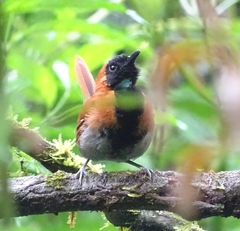
Black-faced Rufous-Warbler

Black-faced Rufous-Warbler

Bathmocercus rufus

Silhouette: Sheatherius · PhyloPic

LCLeast ConcernNTVUENCR
Daily sighting probability ~20% · Possible
at Nyungwe National Park

In 3 days ~40% in a week ~70%

209 Verified sightings at Nyungwe National Park From 2019 to 2026
1,126 In all 5 parks
December Best month
☀️ Diurnal When it's spotted

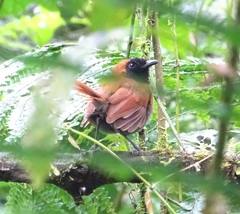
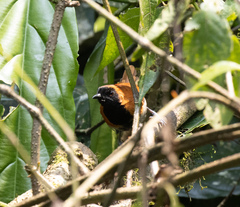
About the Black-faced Rufous-Warbler

The black-faced rufous warbler (Bathmocercus rufus) is a species of bird in the family Cisticolidae. It is found in Cameroon, Central African Republic, Republic of the Congo, Democratic Republic of the Congo, Equatorial Guinea, Gabon, Kenya, Rwanda, South Sudan, Tanzania, and Uganda.

Its natural habitats are subtropical or tropical moist lowland forest and subtropical or tropical moist montane forest. Ryan, Peter (2006). Family Cisticolidae (Cisticolas and allies). pp. 378–492 in del Hoyo J., Elliott A. & Christie D.A. (2006) Handbook of the Birds of the World. Volume 11. Old World Flycatchers to Old World Warblers Lynx Edicions, Barcelona ISBN 978-84-96553-06-4

Nguembock B.; Fjeldsa J.; Tillier A.; Pasquet E. (2007): A phylogeny for the Cisticolidae (Aves: Passeriformes) based on nuclear and mitochondrial DNA sequence data, and a re-interpretation of a unique nest-building specialization. Molecular Phylogenetics and Evolution 42: 272–286. Wikipedia →

Sounds

Song0:36

Kenya · 2025

© isaac kilusu · XC1052719 · CC BY-NC-SA 4.0

Call0:29

Uganda · 2022

© Peter Boesman · XC739429 · CC BY-NC-ND 4.0

Song0:21

Kenya · 2018

© Frank Lambert · XC453431 · CC BY-NC-ND 4.0

Global Distribution

Parks Where Found

# Park Country Daily sighting probability
1 Bwindi Impenetrable National Park 🇺🇬 Uganda
~40%
2 Nyungwe National Park 🇷🇼 Rwanda
~20%
3 Kibale National Park 🇺🇬 Uganda
~10%
4 Virunga National Park 🇨🇩 Democratic Republic of the Congo
<5%
5 Volcanoes National Park 🇷🇼 Rwanda
<5%

Before you go

What are the chances of seeing a Black-faced Rufous-Warbler in Nyungwe National Park?

Possible

About 20% of wildlife watchers report a Black-faced Rufous-Warbler sighting in Nyungwe National Park on a given day, based on 209 verified sightings from GBIF citizen-science data from 2019 to 2026. It is the 79th most-seen of the 252 birds we can rate there. Over three days the chance rises to about 40%, and over a week to about 70%, if each day is a fresh chance.

When is the best time to see a Black-faced Rufous-Warbler in Nyungwe National Park?

December

In that month about 30% of wildlife watchers report a Black-faced Rufous-Warbler in Nyungwe National Park on a given day, against under 5% in April, the lowest month. That is one of Nyungwe National Park's wettest months, with about 550 mm of rain against 30 mm in July.

What time of day is best to see a Black-faced Rufous-Warbler?

Between 7 and 10 am

Across all the parks we cover, that three-hour window holds the most Black-faced Rufous-Warbler sightings with a recorded time, and about 8 in 10 of them come between 6 am and 6 pm: it is a daytime animal.

Is Nyungwe National Park the best place to see a Black-faced Rufous-Warbler?

2nd of 5

Of the 5 parks where we can rate Black-faced Rufous-Warbler sightings, Nyungwe National Park ranks 2nd at about 20%. The best odds are in Bwindi Impenetrable National Park (Uganda, about 40%).

Which relatives of the Black-faced Rufous-Warbler live in Nyungwe National Park?

Same family: Cisticolidae

The closest relatives of the Black-faced Rufous-Warbler that you can see in Nyungwe National Park (family Cisticolidae, Cisticolas and Allies) are Chubb's Cisticola (about 70%), Black-faced Apalis (about 50%) and Chestnut-throated Apalis (about 30%), with each one's daily chance of a sighting.

Where does the Black-faced Rufous-Warbler sighting chance come from?

GBIF citizen-science records

It is estimated from how often the Black-faced Rufous-Warbler is recorded against all the birds logged in Nyungwe National Park (209 verified sightings from 2019 to 2026), calibrated against known sighting rates. Figures are rounded to the nearest 10% because citizen-science data supports honest approximations, not decimals, and months with records from fewer than five people show "—". How it works.

← Back to Nyungwe National Park