Blue Malkoha

Blue Malkoha

Ceuthmochares aereus

Silhouette: Nicolas Huet le Jeune and Jean-Gabriel Prêtre (vectorized by T. Michael Keesey) · PhyloPic

LCLeast ConcernNTVUENCR
Daily sighting probability ~20% · Possible
at Odzala-Kokoua National Park

In 3 days ~50% in a week ~80%

13 Verified sightings at Odzala-Kokoua National Park From 2019 to 2026
726 In all 10 parks
September Best month
☀️ Diurnal When it's spotted

About the Blue Malkoha

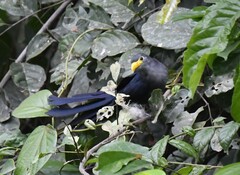
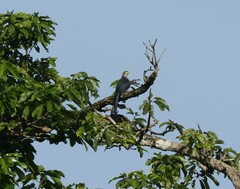
The blue malkoha or chattering yellowbill (Ceuthmochares aereus) is a species of cuckoo in the family Cuculidae. It was formerly conspecific with the green malkoha until split in 2016. It is widely distributed across the African tropical rainforest.

The blue malkoha has a greyish belly, head and throat and a heavy yellow bill but subspecies display some differences in plumage colouration. C. aereus aereus has a greenish and blue tail, wings and back, while C. aereus flavirostris has a blue tail, wings and back.

The blue malkoha feeds primarily on insects, particularly caterpillars, beetles, grasshoppers and crickets; it will also take frogs, slugs, fruit, seeds and leaves. It moves through the tangled vegetation with a series of small hops, snatching prey as it travels. It will accompany other birds and squirrels, taking the insects flushed by them.

Unlike some other cuckoos the blue malkoha is not a brood parasite, instead it cares for its own young. Two white and creamy eggs are laid in a nest that is a rough mass of sticks suspended around 2–5 m above the ground. Both parents care for the young.

The blue malkoha is an uncommon species and rarely observed due to... Wikipedia →

Sounds

Song0:16

Gabon · 2024

© Paul Lenrumé · XC939856 · CC BY-NC-SA 4.0

Subsong0:35

Liberia · 2023

© Marc Languy · XC778556 · CC BY-NC-SA 4.0

Call0:06

Ghana · 2022

© Peter Boesman · XC718967 · CC BY-NC-ND 4.0

Global Distribution

Parks Where Found

# Park Country Daily sighting probability
1 Odzala-Kokoua National Park 🇨🇬 Republic of the Congo
~20%
2 Semuliki National Park 🇺🇬 Uganda
~20%
3 Kibale National Park 🇺🇬 Uganda
~20%
4 Taï National Park 🇨🇮 Ivory Coast
~10%
5 Nyungwe National Park 🇷🇼 Rwanda
~10%
6 Bwindi Impenetrable National Park 🇺🇬 Uganda
~10%
7 Murchison Falls National Park 🇺🇬 Uganda
<5%
8 Virunga National Park 🇨🇩 Democratic Republic of the Congo
<5%
9 Queen Elizabeth National Park 🇺🇬 Uganda
<5%
10 Lake Mburo National Park 🇺🇬 Uganda
<5%

Cities Where Found

# City Country Daily sighting probability
1 Abidjan 🇨🇮 Côte d'Ivoire
~10%

Before you go

What are the chances of seeing a Blue Malkoha in Odzala-Kokoua National Park?

Possible

About 20% of wildlife watchers report a Blue Malkoha sighting in Odzala-Kokoua National Park on a given day, based on 13 verified sightings from GBIF citizen-science data from 2019 to 2026. It is the 35th most-seen of the 72 birds we can rate there. Over three days the chance rises to about 50%, and over a week to about 80%, if each day is a fresh chance.

What time of day is best to see a Blue Malkoha?

Between 7 and 10 am

Across all the parks we cover, that three-hour window holds the most Blue Malkoha sightings with a recorded time, and about 9 in 10 of them come between 6 am and 6 pm: it is a daytime animal.

Is Odzala-Kokoua National Park the best place to see a Blue Malkoha?

Yes

Of the 10 parks where we can rate Blue Malkoha sightings, Odzala-Kokoua National Park has the highest daily chance: about 20%. Next come Semuliki National Park (Uganda, about 20%) and Kibale National Park (Uganda, about 20%).

Which relatives of the Blue Malkoha live in Odzala-Kokoua National Park?

Same family: Cuculidae

The closest relatives of the Blue Malkoha that you can see in Odzala-Kokoua National Park (family Cuculidae, Cuckoos) are Red-chested Cuckoo (about 30%), Senegal Coucal (about 20%) and Klaas's Cuckoo (about 20%), with each one's daily chance of a sighting.

Where does the Blue Malkoha sighting chance come from?

GBIF citizen-science records

It is estimated from how often the Blue Malkoha is recorded against all the birds logged in Odzala-Kokoua National Park (13 verified sightings from 2019 to 2026), calibrated against known sighting rates. Figures are rounded to the nearest 10% because citizen-science data supports honest approximations, not decimals, and months with records from fewer than five people show "—". How it works.

← Back to Odzala-Kokoua National Park