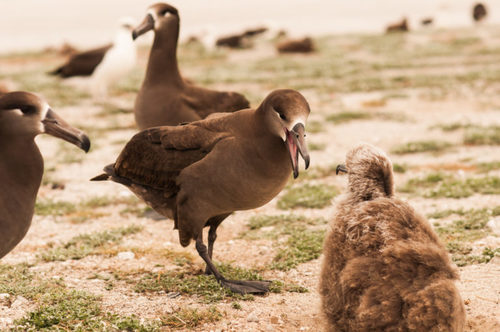
Northern Fulmar

Northern Fulmar

Fulmarus glacialis

Silhouette: Bennet McComish, photo by Avenue · PhyloPic

LCLeast ConcernNTVUENCR
Daily sighting probability <5% · Rare
at Olympic National Park

In 3 days <5% in a week ~10%

45 Verified sightings at Olympic National Park From 2019 to 2026
3,269 In all 8 parks
November Best month
☀️ Diurnal When it's spotted

About the Northern Fulmar

The northern fulmar, Arctic fulmar, or simply fulmar (Fulmarus glacialis) is an abundant seabird found primarily in subarctic regions of the North Atlantic and North Pacific oceans. There has been one confirmed sighting in the Southern Hemisphere, with a single bird seen south of New Zealand. Fulmars come in one of two colour morphs; a light one in temperate populations, with white head and body and grey wings and tail, and a dark one in arctic populations, which is uniformly grey; intermediate birds are common. Though similar in appearance to gulls, fulmars are in fact members of the family Procellariidae, which includes petrels and shearwaters.

The northern fulmar and its sister species, the southern fulmar (Fulmarus glacialoides), are the only extant members of the genus Fulmarus. The fulmars are in turn a member of the order Procellariiformes, and they all share certain identifying features. First, they have nasal passages that attach to the upper bill called naricorns; however, nostrils on albatrosses are on the sides of the bill, as opposed to the rest of the order, including fulmars, which have nostrils on top of the upper bill. The bills of Procellariiformes are also unique in that they are split into between seven and nine horny plates. One of these plates makes up the hooked portion of the upper bill, called the maxillary unguis. They produce a stomach oil made up of wax esters and triglycerides that is stored in the proventriculus. This can be sprayed out of their mouths as a defense against predators from a very early age, and as an energy rich food source for chicks and for the adults during their long flights. It will mat the plumage of avian predators, and can lead to their death. Finally, they also have a salt gland that is situated above the nasal passage that helps desalinate their bodies, due to the high amount of ocean water that they imbibe. This gland excretes a high saline solution from their nose.

The northern fulmar was first described as Procellaria glacialis by Carl Linnaeus in 1761, based on a specimen from within the Arctic Circle, on Spitsbergen. The Mallemuk Mountain in Northeastern Greenland is named after the northern fulmar (Danish: Mallemuk). Wikipedia →

Sounds

Duet0:20

United Kingdom · 2025

© David Tattersley · XC1005446 · CC BY-NC-SA 4.0

Call0:09

United Kingdom · 2022

© Bram Vogels · XC733518 · CC BY-NC-SA 4.0

Recording0:15

Ireland · 2021

© Mr Mark Shorten · XC638469 · CC BY-NC-SA 4.0

Global Distribution

Parks Where Found

# Park Country Daily sighting probability
1 Svalbard 🇳🇴 Norway
~80%
2 Vatnajokull National Park 🇮🇸 Iceland
~60%
3 Kenai Fjords National Park 🇺🇸 United States
~10%
4 Channel Islands National Park 🇺🇸 United States
<5%
5 Great Bear Rainforest 🇨🇦 Canada
<5%
6 Olympic National Park 🇺🇸 United States
<5%
7 Wadden Sea National Park 🇩🇪 Germany
<5%
8 Acadia National Park 🇺🇸 United States
<5%

Cities Where Found

# City Country Daily sighting probability
1 Dublin 🇮🇪 Ireland
<5%
2 San Diego 🇺🇸 United States
<5%
3 Los Angeles 🇺🇸 United States
<5%

Zoos & Centres Where Found

# Zoo / Centre Country
1 Mountainaire Avian Rescue Society 🇨🇦 Canada In captivity
2 Nordsøen Oceanarium 🇩🇰 Denmark In captivity

Before you go

What are the chances of seeing a Northern Fulmar in Olympic National Park?

Rare

Under 5% of wildlife watchers report a Northern Fulmar sighting in Olympic National Park on a given day, based on 45 verified sightings from GBIF citizen-science data from 2019 to 2026. It is the 163rd most-seen of the 216 birds we can rate there. Over three days the chance rises to under 5%, and over a week to about 10%, if each day is a fresh chance.

When is the best time to see a Northern Fulmar in Olympic National Park?

November and December

In those months about 10% of wildlife watchers report a Northern Fulmar in Olympic National Park on a given day, against under 5% in January to October, the lowest months. Those are among Olympic National Park's wettest months, with about 370 mm of rain a month against 35 mm in July.

What time of day is best to see a Northern Fulmar?

Between 9 am and noon

Across all the parks we cover, that three-hour window holds the most Northern Fulmar sightings with a recorded time, and about 9 in 10 of them come between 6 am and 6 pm: it is a daytime animal.

Is Olympic National Park the best place to see a Northern Fulmar?

6th of 8

Of the 8 parks where we can rate Northern Fulmar sightings, Olympic National Park ranks 6th at under 5%. The best odds are in Svalbard (Norway, about 80%), Vatnajokull National Park (Iceland, about 60%) and Kenai Fjords National Park (United States, about 10%).

Where does the Northern Fulmar sighting chance come from?

GBIF citizen-science records

It is estimated from how often the Northern Fulmar is recorded against all the birds logged in Olympic National Park (45 verified sightings from 2019 to 2026), calibrated against known sighting rates. Figures are rounded to the nearest 10% because citizen-science data supports honest approximations, not decimals, and months with records from fewer than five people show "—". How it works.

← Back to Olympic National Park