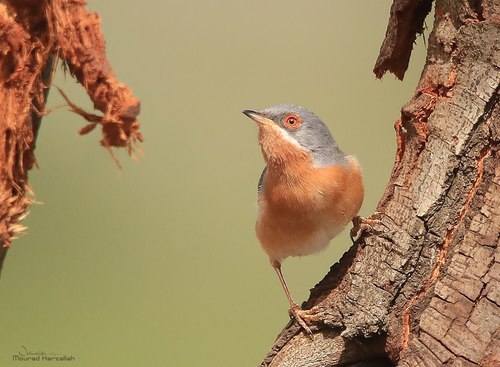
Orphean Warbler

Orphean Warbler

Sylvia hortensis

Silhouette: Martin Bulla, based on John Cox's illustration · PhyloPic

Daily sighting probability <5% · Rare
at Ordesa y Monte Perdido National Park

In 3 days ~10%

9 Verified sightings at Ordesa y Monte Perdido National Park From 2019 to 2026
768 In all 6 parks
June Best month
☀️ Diurnal When it's spotted

About the Orphean Warbler

The western Orphean warbler (Curruca hortensis) is an Old World warbler of the genus Curruca. This species occurs in summer around the Mediterranean, through western Europe and extending into northwest Africa. It is migratory, wintering in Sub-Saharan Africa. It is a rare vagrant to northern and north-western Europe.

The English name refers to the mythical musician and singer Orpheus. The specific hortensis is Latin for "of a garden", from hortus, "garden". Two subspecies are unequivocally accepted, but they are now usually considered separate species.

The western Orphean warbler is probably most closely allied to the Arabian warbler, as well as the brown warbler and Yemen warblers which are sometimes placed in Parisoma. They together with the lesser whitethroat group seem to form a distinct clade of typical warblers. The species therein do not appear much alike at first glance, but they all have prominent white throats, lack rufous wing-patches, and usually having dark sides to the head.

At 15–16 centimetres (6–6+1⁄4 in) in length – somewhat larger than a blackcap – this is one of the largest species of typical warblers. The adult males... Wikipedia →

Sounds

Recording0:13

Spain · 2024

© Daniel Gaona Carrilero · iNaturalist · CC BY-NC 4.0

Recording0:04

France · 2025

© Denis Forzy · iNaturalist · CC BY 4.0

Recording0:31

Morocco · 2025

© Ila France · iNaturalist · CC BY-NC 4.0

Global Distribution

Parks Where Found

# Park Country Daily sighting probability
1 Monfragüe National Park 🇪🇸 Spain
~10%
2 Sierra de Guadarrama National Park 🇪🇸 Spain
~10%
3 Sierra Nevada National Park 🇪🇸 Spain
<5%
4 Cévennes National Park 🇫🇷 France
<5%
5 Ordesa y Monte Perdido National Park 🇪🇸 Spain
<5%
6 Pyrénées National Park 🇫🇷 France
<5%

Cities Where Found

# City Country Daily sighting probability
1 Marrakesh 🇲🇦 Morocco
<5%
2 Madrid 🇪🇸 Spain
<5%
3 Valencia 🇪🇸 Spain
<5%
4 Barcelona 🇪🇸 Spain
<5%

Before you go

What are the chances of seeing an Orphean Warbler in Ordesa y Monte Perdido National Park?

Rare

Under 5% of wildlife watchers report an Orphean Warbler sighting in Ordesa y Monte Perdido National Park on a given day, based on 9 verified sightings from GBIF citizen-science data from 2019 to 2026. It is the 93rd most-seen of the 105 birds we can rate there. Over three days the chance rises to about 10%, if each day is a fresh chance.

When is the best time to see an Orphean Warbler in Ordesa y Monte Perdido National Park?

June

In that month about 10% of wildlife watchers report an Orphean Warbler in Ordesa y Monte Perdido National Park on a given day, against under 5% in July to May, the lowest months.

What time of day is best to see an Orphean Warbler?

Between 8 and 11 am

Across all the parks we cover, that three-hour window holds the most Orphean Warbler sightings with a recorded time, and about 8 in 10 of them come between 6 am and 6 pm: it is a daytime animal.

Which relatives of the Orphean Warbler live in Ordesa y Monte Perdido National Park?

Same genus: Sylvia

The closest relatives of the Orphean Warbler that you can see in Ordesa y Monte Perdido National Park (genus Sylvia, Sylvia Warblers) are Blackcap (about 40%), Garden Warbler (about 10%) and Dartford Warbler (about 10%), with each one's daily chance of a sighting.

Where does the Orphean Warbler sighting chance come from?

GBIF citizen-science records

It is estimated from how often the Orphean Warbler is recorded against all the birds logged in Ordesa y Monte Perdido National Park (9 verified sightings from 2019 to 2026), calibrated against known sighting rates. Figures are rounded to the nearest 10% because citizen-science data supports honest approximations, not decimals, and months with records from fewer than five people show "—". How it works.

← Back to Ordesa y Monte Perdido National Park