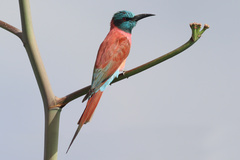
Northern Carmine Bee-eater

Northern Carmine Bee-eater

Merops nubicus

Silhouette: Sheatherius · PhyloPic

LCLeast ConcernNTVUENCR
Daily sighting probability ~30% · Possible
at Pendjari National Park

In 3 days ~70% in a week ~90%

10 Verified sightings at Pendjari National Park From 2019 to 2026
1,027 In all 10 parks
November Best month
☀️ Diurnal When it's spotted

About the Northern Carmine Bee-eater

The northern carmine bee-eater (Merops nubicus) is a brightly-coloured bird in the bee-eater family, Meropidae. It is found across northern tropical Africa, from Senegal eastwards to Somalia, Ethiopia and Kenya. It was formerly considered to be conspecific with the southern carmine bee-eater which has a carmine coloured throat rather than the blue throat of the northern species.

The northern carmine bee-eater was formally described in 1788 by the German naturalist Johann Friedrich Gmelin in his revised and expanded edition of Carl Linnaeus's Systema Naturae. He placed it with the other bee-eaters in the genus Merops and coined the binomial name Merops nubicus. Gmelin based his description on "Le guépier rouge à tête bleu" or "Guépier de Nubie" that had been described and illustrated in 1779 by French polymath Comte de Buffon in his multi-volume book Histoire Naturelle des Oiseaux. Buffon had been provided with a picture drawn by the Scottish traveller and writer James Bruce who had visited Nubia in 1770–1771. It is monotypic: no subspecies are recognised. The northern carmine bee-eater was formerly treated as conspecific with the southern carmine bee-eater (Merops nubicoides...

Wikipedia →

Sounds

Call0:16

Tanzania · 2018

© Stein Ø. Nilsen · XC462427 · CC BY-NC-SA 4.0

Recording0:41

Ethiopia · 2019

© Aladdin · XC504019 · CC BY-NC-SA 4.0

Flight call0:13

Niger · 2018

© Étienne Leroy · XC447383 · CC BY-NC-SA 4.0

Global Distribution

Parks Where Found

# Park Country Daily sighting probability
1 Awash National Park 🇪🇹 Ethiopia
~60%
2 Niokolo-Koba National Park 🇸🇳 Senegal
~40%
3 Murchison Falls National Park 🇺🇬 Uganda
~40%
4 Pendjari National Park 🇧🇯 Benin
~30%
5 Tsavo East National Park 🇰🇪 Kenya
~20%
6 Mole National Park 🇬🇭 Ghana
~10%
7 Mkomazi National Park 🇹🇿 Tanzania
~10%
8 Mikumi National Park 🇹🇿 Tanzania
<5%
9 Tsavo West National Park 🇰🇪 Kenya
<5%
10 Queen Elizabeth National Park 🇺🇬 Uganda
<5%

Cities Where Found

# City Country Daily sighting probability
1 Maiduguri 🇳🇬 Nigeria
~10%
2 Mombasa 🇰🇪 Kenya
~10%

Zoos & Centres Where Found

# Zoo / Centre Country
1 Disney's Animal Kingdom 🇺🇸 United States In captivity
2 San Diego Zoo 🇺🇸 United States In captivity
3 Basel Zoo 🇨🇭 Switzerland In captivity
4 Zoorasia 🇯🇵 Japan In captivity
5 Walsrode World Bird Park 🇩🇪 Germany In captivity
6 Columbus Zoo and Aquarium 🇺🇸 United States In captivity
7 Bronx Zoo 🇺🇸 United States In captivity
8 Saint Louis Zoo 🇺🇸 United States In captivity
9 Tierpark Hagenbeck 🇩🇪 Germany In captivity
10 Cologne Zoological Garden 🇩🇪 Germany In captivity
11 Bird Paradise 🇸🇬 Singapore In captivity
12 Rainforest Wild Asia 🇸🇬 Singapore In captivity
13 Kobe Animal Kingdom 🇯🇵 Japan In captivity
14 National Aviary 🇺🇸 United States In captivity
15 Cologne Zoo Aquarium 🇩🇪 Germany In captivity

Before you go

What are the chances of seeing a Northern Carmine Bee-eater in Pendjari National Park?

Possible

About 30% of wildlife watchers report a Northern Carmine Bee-eater sighting in Pendjari National Park on a given day, based on 10 verified sightings from GBIF citizen-science data from 2019 to 2026. It is the 3rd most-seen of the 15 birds we can rate there. Over three days the chance rises to about 70%, and over a week to about 90%, if each day is a fresh chance.

When is the best time to see a Northern Carmine Bee-eater in Pendjari National Park?

November and December

In those months about 60% of wildlife watchers report a Northern Carmine Bee-eater in Pendjari National Park on a given day, against under 5% in February, the lowest month. Those are among Pendjari National Park's driest months, with almost no rain against 190 mm in August.

What time of day is best to see a Northern Carmine Bee-eater?

Between 9 am and noon

Across all the parks we cover, that three-hour window holds the most Northern Carmine Bee-eater sightings with a recorded time, and about 9 in 10 of them come between 6 am and 6 pm: it is a daytime animal.

Where does the Northern Carmine Bee-eater sighting chance come from?

GBIF citizen-science records

It is estimated from how often the Northern Carmine Bee-eater is recorded against all the birds logged in Pendjari National Park (10 verified sightings from 2019 to 2026), calibrated against known sighting rates. Figures are rounded to the nearest 10% because citizen-science data supports honest approximations, not decimals, and months with records from fewer than five people show "—". How it works.

← Back to Pendjari National Park