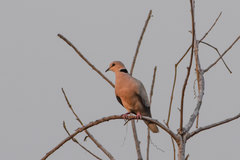
The vinaceous dove (Streptopelia vinacea) is a bird species in the pigeon family Columbidae that widely resident across northern Sub-Saharan Africa. The vinaceous dove was formally described in 1789 by German naturalist Johann Friedrich Gmelin in his revised and expanded edition of Carl Linnaeus's Systema Naturae. He placed it with all the other doves and pigeons in the genus Columba and coined the binomial name Columba vinacea. Gmelin based his description on the earlier publications by French ornithologists Mathurin Jacques Brisson and Georges-Louis Leclerc, Comte de Buffon. The vinaceous dove is now placed with 14 other species in the genus Streptopelia that was introduced in 1855 by French ornithologist Charles Lucien Bonaparte. The genus name is from the Ancient Greek στρεπτός (streptós) – literal meaning "twisted", but by extension, "wearing a torc" (i.e., twisted metal collar) – and πέλεια (péleia) meaning "wild dove". The specific vinacea is from Latin vinaceus, meaning "of wine" or "vinaceous". The species is monotypic; no subspecies are recognized.
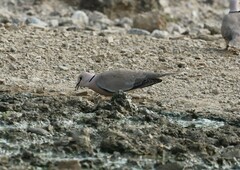
The vinaceous dove is a small, stocky pigeon, typically 26 to 30 centimeters (10.2 to 11.8 inches...