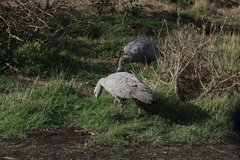
The Cape Barren goose (Cereopsis novaehollandiae), sometimes also known as the pig goose, is a species of goose endemic to southern Australia. It is a distinctive large, grey bird that is mostly terrestrial and is not closely related to other extant members of the subfamily Anserinae.
The Indigenous Jardwadjali people of western Victoria refer to this species as toolka. The Noongar people of south-western Western Australia use the name bibib. The common name "Cape Barren goose" was first ascribed to this species by shipwreck survivors in 1797. When Sydney Cove was wrecked off Preservation Island, south of Cape Barren Island, the sailors who survived the wreck used the geese as one of few sources of food on the island, and named it after Cape Barren, which was the name of the south-eastern tip of the island at that time, named by Tobias Furneaux in 1773.
The Cape Barren goose was first formally described by English ornithologist John Latham in 1801 as Cereopsis N. Hollandiae. The species had been earlier reported from the Bass Strait by George Bass and Matthew Flinders in 1798, who referred to it as a "Brent or Barnacle Goose".
The taxonomic placement of this...