The chestnut teal (Anas castanea) is a dabbling duck found in Australia. It is protected under the National Parks and Wildlife Act 1974. The chestnut teal was described by the English naturalist Thomas Campbell Eyton in 1838 under the binomial name Mareca castanea. The specific epithet castanea is from the Latin castaneus for "chestnut-coloured" or "chestnut-brown".
A large molecular phylogentic study that compared mitochondrial DNA sequences from ducks, geese and swans in the family Anatidae found that the chestnut teal is a sister species to the Sunda teal (Anas gibberifrons) that is endemic to Indonesia.
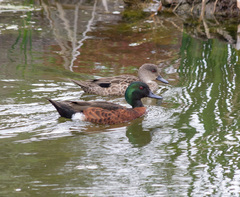
The chestnut teal is darker and a slightly bigger bird than the grey teal. The male has a distinctive green coloured head and mottled brown body. The female has a brown head and mottled brown body. The female is almost identical in appearance to the grey teal.
The female chestnut teal has a loud penetrating "laughing" quack repeated rapidly nine times or more. The chestnut teal is commonly distributed in south-eastern and south-western Australia, while vagrants may occur elsewhere. Tasmania and southern Victoria are...