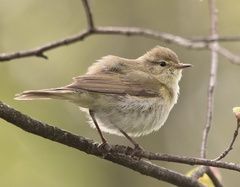
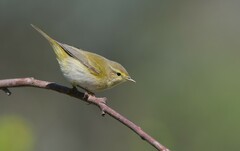
Iberian Chiffchaff

Iberian Chiffchaff

Phylloscopus ibericus

Silhouette: Jiekun He · PhyloPic

LCLeast ConcernNTVUENCR
Daily sighting probability ~10% · With luck
at Picos de Europa National Park

In 3 days ~30% in a week ~50%

109 Verified sightings at Picos de Europa National Park From 2019 to 2026
381 In all 6 parks
March Best month
☀️ Diurnal When it's spotted

About the Iberian Chiffchaff

The Iberian chiffchaff (Phylloscopus ibericus) is a species of passerine belonging to the family Phylloscopidae, the leaf warblers. This species is found as a breeding bird in southwestern Europe and northwestern Africa. It winters in western Africa south of the Sahara Desert.

However, when the holotype of P. c. brehmi was re-examined it was found to actually be an example of common chiffchaff which rendered Homeyer's name invalid. As of 2016, it is recognised as a separate species under the name Phylloscopus ibericus

The genus name Phylloscopus is from Ancient Greek phullon, "leaf", and skopos, "seeker" (from skopeo, "to watch"). The specific ibericus is Latin for "Iberian". The name "chiffchaff" is onomatopoeic, referring to the repetitive chiff-chaff song... Wikipedia →

Sounds

Song0:31

Germany · 2026

© Emil Lundahl · XC1152304 · CC BY-NC-SA 4.0

Call0:51

Spain · 2026

© Marcos Prada Arias · XC1142089 · CC BY-NC-SA 4.0

Subsong0:47

Belgium · 2025

© Kelle Moreau · XC993715 · CC BY-NC-SA 4.0

Global Distribution

Parks Where Found

# Park Country Daily sighting probability
1 Picos de Europa National Park 🇪🇸 Spain
~10%
2 Doñana National Park 🇪🇸 Spain
<5%
3 Sierra Nevada National Park 🇪🇸 Spain
<5%
4 Monfragüe National Park 🇪🇸 Spain
<5%
5 Sierra de Guadarrama National Park 🇪🇸 Spain
<5%
6 Pyrénées National Park 🇫🇷 France
<5%

Cities Where Found

# City Country Daily sighting probability
1 Ouagadougou 🇧🇫 Burkina Faso
~20%
2 Lisbon 🇵🇹 Portugal
<5%
3 Marrakesh 🇲🇦 Morocco
<5%
4 Porto 🇵🇹 Portugal
<5%
5 Madrid 🇪🇸 Spain
<5%

Before you go

What are the chances of seeing an Iberian Chiffchaff in Picos de Europa National Park?

With luck

About 10% of wildlife watchers report an Iberian Chiffchaff sighting in Picos de Europa National Park on a given day, based on 109 verified sightings from GBIF citizen-science data from 2019 to 2026. It is the 61st most-seen of the 112 birds we can rate there. Over three days the chance rises to about 30%, and over a week to about 50%, if each day is a fresh chance.

When is the best time to see an Iberian Chiffchaff in Picos de Europa National Park?

March–April and June

In those months about 20% of wildlife watchers report an Iberian Chiffchaff in Picos de Europa National Park on a given day, against under 5% in September to February, the lowest months.

What time of day is best to see an Iberian Chiffchaff?

Between 10 am and 1 pm

Across all the parks we cover, that three-hour window holds the most Iberian Chiffchaff sightings with a recorded time, and about 9 in 10 of them come between 6 am and 6 pm: it is a daytime animal.

Is Picos de Europa National Park the best place to see an Iberian Chiffchaff?

Yes

Of the 6 parks where we can rate Iberian Chiffchaff sightings, Picos de Europa National Park has the highest daily chance: about 10%. Next come Doñana National Park (Spain, under 5%) and Sierra Nevada National Park (Spain, under 5%).

Which relatives of the Iberian Chiffchaff live in Picos de Europa National Park?

Same genus: Phylloscopus

The closest relatives of the Iberian Chiffchaff that you can see in Picos de Europa National Park (genus Phylloscopus, Leaf Warblers) are Western Bonelli's Warbler (about 10%) and Common Chiffchaff (about 10%), with each one's daily chance of a sighting.

Where does the Iberian Chiffchaff sighting chance come from?

GBIF citizen-science records

It is estimated from how often the Iberian Chiffchaff is recorded against all the birds logged in Picos de Europa National Park (109 verified sightings from 2019 to 2026), calibrated against known sighting rates. Figures are rounded to the nearest 10% because citizen-science data supports honest approximations, not decimals, and months with records from fewer than five people show "—". How it works.

← Back to Picos de Europa National Park