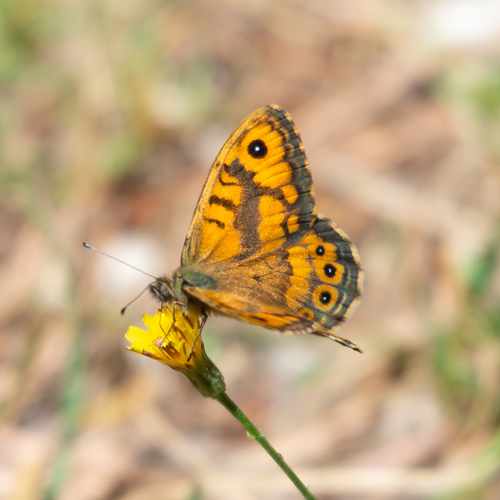
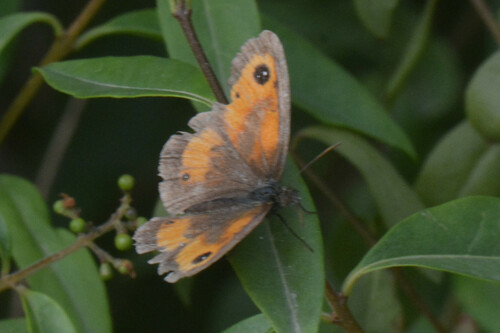
Large Wall Brown

Large Wall Brown

Lasiommata maera

Daily sighting probability ~40% · Likely
at Picos de Europa National Park

In 3 days ~70% in a week >90%

33 Verified sightings at Picos de Europa National Park From 2019 to 2026
649 In all 14 parks
September Best month
☀️ Diurnal When it's spotted

About the Large Wall Brown

Lasiommata maera, the large wall brown, is a butterfly in the family Nymphalidae. Lasiommata maera maera Lasiommata maera abastumana (Sheljuzhko, 1937) (Caucasus) Lasiommata maera adrasta (Hübner, [1823-1824]) (from south western Europe to Morocco and Algeria)

The species is common in continental Europe. It is also present in the Urals, south western Siberia, Asia Minor, Syria, Iran, Central Asia and the Himalayas. It is absent from the United Kingdom. Its preferred habitats are edges of the forest, unmanaged clearings on forested areas, rocky dry areas and stony slopes, at an elevation of 0–2,000 metres (0–6,562 ft) above sea level.

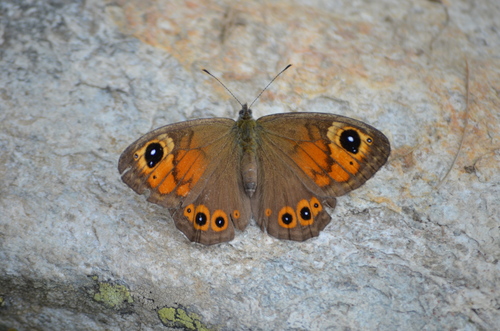
Lasiommata maera has a wingspan of 44–56 millimetres (1.7–2.2 in). These large butterflies are quite variable in color and pattern. Usually the upperside is orange in the forewings and mostly brown in the hindwings. The forewings... Wikipedia →
Global Distribution

Parks Where Found

# Park Country Daily sighting probability
1 Aigüestortes National Park 🇪🇸 Spain
~40%
2 Picos de Europa National Park 🇪🇸 Spain
~40%
3 Vanoise National Park 🇫🇷 France
~30%
4 Mercantour National Park 🇫🇷 France
~30%
5 Ordesa y Monte Perdido National Park 🇪🇸 Spain
~30%
6 Triglav National Park 🇸🇮 Slovenia
~30%
7 Ecrins National Park 🇫🇷 France
~20%
8 Hohe Tauern National Park 🇦🇹 Austria
~20%
9 Pyrénées National Park 🇫🇷 France
~20%
10 Tatra National Park 🇸🇰 Slovakia
~20%
11 Bavarian Forest National Park 🇩🇪 Germany
~10%
12 Cévennes National Park 🇫🇷 France
~10%
13 Sierra Nevada National Park 🇪🇸 Spain
~10%
14 Sierra de Guadarrama National Park 🇪🇸 Spain
~10%

Cities Where Found

# City Country Daily sighting probability
1 Jerusalem 🇮🇱 Israel
~30%
2 Paris 🇫🇷 France
~20%
3 Kharkiv 🇺🇦 Ukraine
~10%
4 Kyiv 🇺🇦 Ukraine
<5%

Before you go

What are the chances of seeing a Large Wall Brown in Picos de Europa National Park?

Likely

About 40% of wildlife watchers report a Large Wall Brown sighting in Picos de Europa National Park on a given day, based on 33 verified sightings from GBIF citizen-science data from 2019 to 2026. It is the 7th most-seen of the 118 insects we can rate there. Over three days the chance rises to about 70%, and over a week to over 90%, if each day is a fresh chance.

When is the best time to see a Large Wall Brown in Picos de Europa National Park?

September

In that month about 50% of wildlife watchers report a Large Wall Brown in Picos de Europa National Park on a given day, against under 5% in March–May and October–November, the lowest months.

What time of day is best to see a Large Wall Brown?

Between 11 am and 2 pm

Across all the parks we cover, that three-hour window holds the most Large Wall Brown sightings with a recorded time, and about 9 in 10 of them come between 6 am and 6 pm: it is a daytime animal.

Is Picos de Europa National Park the best place to see a Large Wall Brown?

Among the best

Of the 14 parks where we can rate Large Wall Brown sightings, Picos de Europa National Park ranks 2nd at about 40%, level with the leaders once rounded. The best odds are in Aigüestortes National Park (Spain, about 40%). All parks ranked.

Which relatives of the Large Wall Brown live in Picos de Europa National Park?

Same genus: Pararge

The closest relatives of the Large Wall Brown that you can see in Picos de Europa National Park (genus Pararge) are Speckled Wood (about 50%) and Wall Brown (about 30%), with each one's daily chance of a sighting.

Where does the Large Wall Brown sighting chance come from?

GBIF citizen-science records

It is estimated from how often the Large Wall Brown is recorded against all the insects logged in Picos de Europa National Park (33 verified sightings from 2019 to 2026), calibrated against known sighting rates. Figures are rounded to the nearest 10% because citizen-science data supports honest approximations, not decimals, and months with records from fewer than five people show "—". How it works.

← Back to Picos de Europa National Park