African Snipe

African Snipe

Gallinago nigripennis

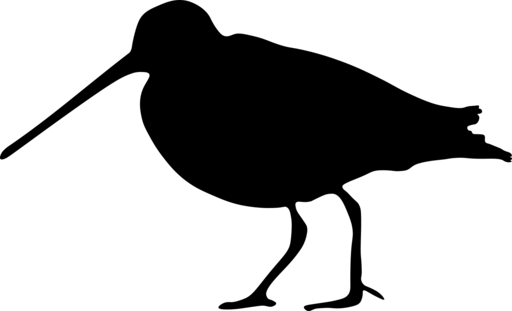
Silhouette: Jamie Whitehouse · PhyloPic

LCLeast ConcernNTVUENCR
Daily sighting probability ~10% · With luck
at Pilanesberg National Park

In 3 days ~20% in a week ~30%

20 Verified sightings at Pilanesberg National Park From 2019 to 2026
319 In all 13 parks
December Best month
☀️ Diurnal When it's spotted

About the African Snipe

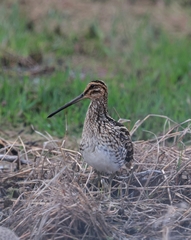
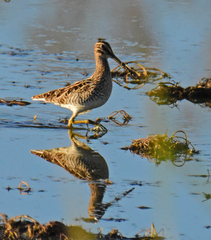
The African snipe (Gallinago nigripennis) also known as the Ethiopian snipe, is a small stocky wader. It breeds in eastern and southern Africa in wet mountain moorland and swamps at altitudes of 1,700–4,000 m (5,600–13,100 ft). When not breeding it disperses widely, including into coastal lowlands.

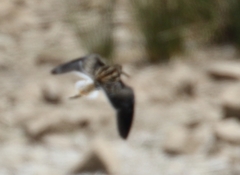
This 30–32 cm (12–13 in) long snipe has a stocky body and relatively short legs for a wader. Its upperparts, head and neck are streaked and patterned with bold dark brown stripes and gold edges to the feathers forming lines down its back. The belly is white, with some brown barring on the flanks but never on the belly. The pinkish-brown bill is very long, straight and fairly robust. The legs and feet are yellowish-olive to greenish-grey. The sexes are similar, and immatures differ only in showing pale fringes on the wing coverts.

The African snipe makes a hleep call as it takes off, and has a far carrying kip call when breeding. It shows white trailing edges on the wings and white tail corners in flight. The African snipe can only be confused with the three migrant snipes that occur in its range, common, pin-tailed and great snipe. Great snipe is obviously larger, darker... Wikipedia →

Sounds

Call0:40

South Africa · 2019

© Tony Archer · XC495341 · CC BY-NC-SA 4.0

Song0:41

Mozambique · 2022

© Olivier Hamerlynck · XC701493 · CC BY-NC-SA 4.0

Song0:27

Zambia · 2020

© Dries Van de Loock · XC584708 · CC BY-NC-SA 4.0

Global Distribution

Parks Where Found

# Park Country Daily sighting probability
1 Bale Mountains National Park 🇪🇹 Ethiopia
~20%
2 Aberdare National Park 🇰🇪 Kenya
~10%
3 Chobe National Park 🇧🇼 Botswana
~10%
4 Pilanesberg National Park 🇿🇦 South Africa
~10%
5 Moremi Game Reserve 🇧🇼 Botswana
<5%
6 Liwonde National Park 🇲🇼 Malawi
<5%
7 iSimangaliso Wetland Park 🇿🇦 South Africa
<5%
8 Murchison Falls National Park 🇺🇬 Uganda
<5%
9 Ngorongoro Conservation Area 🇹🇿 Tanzania
<5%
10 Serengeti National Park 🇹🇿 Tanzania
<5%
11 West Coast National Park 🇿🇦 South Africa
<5%
12 Queen Elizabeth National Park 🇺🇬 Uganda
<5%
13 Kruger National Park 🇿🇦 South Africa
<5%

Cities Where Found

# City Country Daily sighting probability
1 Johannesburg 🇿🇦 South Africa
<5%
2 Cape Town 🇿🇦 South Africa
<5%

Before you go

What are the chances of seeing an African Snipe in Pilanesberg National Park?

With luck

About 10% of wildlife watchers report an African Snipe sighting in Pilanesberg National Park on a given day, based on 20 verified sightings from GBIF citizen-science data from 2019 to 2026. It is the 159th most-seen of the 233 birds we can rate there. Over three days the chance rises to about 20%, and over a week to about 30%, if each day is a fresh chance.

When is the best time to see an African Snipe in Pilanesberg National Park?

March and September–December

In those months about 10% of wildlife watchers report an African Snipe in Pilanesberg National Park on a given day, against under 5% in January–February and April–August, the lowest months.

What time of day is best to see an African Snipe?

Between 7 and 10 am

Across all the parks we cover, that three-hour window holds the most African Snipe sightings with a recorded time, and about 9 in 10 of them come between 6 am and 6 pm: it is a daytime animal.

Is Pilanesberg National Park the best place to see an African Snipe?

4th of 13

Of the 13 parks where we can rate African Snipe sightings, Pilanesberg National Park ranks 4th at about 10%. The best odds are in Bale Mountains National Park (Ethiopia, about 20%), Aberdare National Park (Kenya, about 10%) and Chobe National Park (Botswana, about 10%).

Where does the African Snipe sighting chance come from?

GBIF citizen-science records

It is estimated from how often the African Snipe is recorded against all the birds logged in Pilanesberg National Park (20 verified sightings from 2019 to 2026), calibrated against known sighting rates. Figures are rounded to the nearest 10% because citizen-science data supports honest approximations, not decimals, and months with records from fewer than five people show "—". How it works.

← Back to Pilanesberg National Park