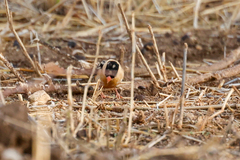
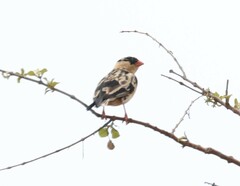
Shaft-tailed Whydah

Shaft-tailed Whydah

Vidua regia

Silhouette: Sheatherius · PhyloPic

LCLeast ConcernNTVUENCR
Daily sighting probability ~10% · With luck
at Pilanesberg National Park

In 3 days ~20% in a week ~30%

34 Verified sightings at Pilanesberg National Park From 2019 to 2026
467 In all 8 parks
March Best month
☀️ Diurnal When it's spotted

About the Shaft-tailed Whydah

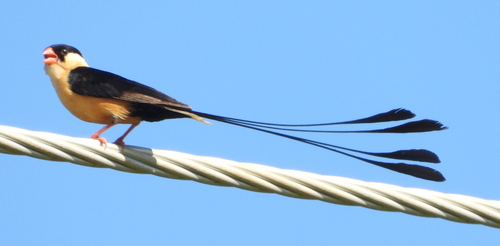
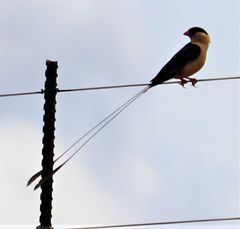
The shaft-tailed whydah or queen whydah (Vidua regia) is a small, sparrow-like bird in the genus Vidua. During the breeding season the male has black crown and upper body plumage, golden breast and four elongated black tail shaft feathers with expanded tips. After the breeding season is over, the male sheds its long tail and grows olive brown female-like plumage.

The shaft-tailed whydah is distributed in open habitats and grasslands of Southern Africa, from south Angola to south Mozambique. It is a brood parasite to the violet-eared waxbill. The diet consists mainly of seeds. Widespread and a common species throughout its large habitat range, the shaft-tailed whydah is evaluated as least concern on the IUCN Red List of Threatened Species.

In 1760 the French zoologist Mathurin Jacques Brisson included a description of the shaft-tailed whydah in his Ornithologie based on a specimen collected from the African coast. He used the French name La veuve de la côte d'Afrique and the Latin Vidua Riparia Africana. Although Brisson coined Latin names, these do not conform to the binomial system and are not recognised by the International Commission on Zoological Nomenclature. When... Wikipedia →
Sounds

Call0:25

South Africa · 2021

© Tony Archer · XC622267 · CC BY-NC-SA 4.0

Song0:14

South Africa · 2024

© Niall Perrins · XC863398 · CC BY-NC-SA 4.0

Song0:17

Namibia · 2016

© Peter Boesman · XC347174 · CC BY-NC-ND 4.0

Global Distribution

Parks Where Found

# Park Country Daily sighting probability
1 Hwange National Park 🇿🇼 Zimbabwe
~10%
2 Waterberg Plateau Park 🇳🇦 Namibia
~10%
3 Etosha National Park 🇳🇦 Namibia
~10%
4 Pilanesberg National Park 🇿🇦 South Africa
~10%
5 Kgalagadi Transfrontier Park 🇿🇦 South Africa
~10%
6 Chobe National Park 🇧🇼 Botswana
<5%
7 Moremi Game Reserve 🇧🇼 Botswana
<5%
8 Kruger National Park 🇿🇦 South Africa
<5%

Zoos & Centres Where Found

# Zoo / Centre Country
1 African Dawn Bird and Wildlife Sanctuary 🇿🇦 South Africa In captivity

Before you go

What are the chances of seeing a Shaft-tailed Whydah in Pilanesberg National Park?

With luck

About 10% of wildlife watchers report a Shaft-tailed Whydah sighting in Pilanesberg National Park on a given day, based on 34 verified sightings from GBIF citizen-science data from 2019 to 2026. It is the 159th most-seen of the 233 birds we can rate there. Over three days the chance rises to about 20%, and over a week to about 30%, if each day is a fresh chance.

When is the best time to see a Shaft-tailed Whydah in Pilanesberg National Park?

March

In that month about 20% of wildlife watchers report a Shaft-tailed Whydah in Pilanesberg National Park on a given day, against under 5% in February and May–October, the lowest months.

What time of day is best to see a Shaft-tailed Whydah?

Between 8 and 11 am

Across all the parks we cover, that three-hour window holds the most Shaft-tailed Whydah sightings with a recorded time, and about 9 in 10 of them come between 6 am and 6 pm: it is a daytime animal.

Is Pilanesberg National Park the best place to see a Shaft-tailed Whydah?

Among the best

Of the 8 parks where we can rate Shaft-tailed Whydah sightings, Pilanesberg National Park ranks 4th at about 10%, level with the leaders once rounded. The best odds are in Hwange National Park (Zimbabwe, about 10%), Waterberg Plateau Park (Namibia, about 10%) and Etosha National Park (Namibia, about 10%).

Where does the Shaft-tailed Whydah sighting chance come from?

GBIF citizen-science records

It is estimated from how often the Shaft-tailed Whydah is recorded against all the birds logged in Pilanesberg National Park (34 verified sightings from 2019 to 2026), calibrated against known sighting rates. Figures are rounded to the nearest 10% because citizen-science data supports honest approximations, not decimals, and months with records from fewer than five people show "—". How it works.

← Back to Pilanesberg National Park