Smith's Bush Squirrel

Smith's Bush Squirrel

Paraxerus cepapi

Silhouette: Joseph Smit · PhyloPic

LCLeast ConcernNTVUENCR
Daily sighting probability ~30% · Possible
at Pilanesberg National Park

In 3 days ~60% in a week ~90%

30 Verified sightings at Pilanesberg National Park From 2019 to 2026
1,027 In all 12 parks
July Best month
☀️ Diurnal When it's spotted

About the Smith's Bush Squirrel

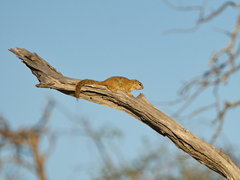
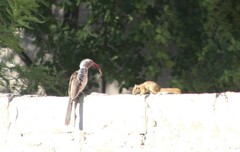
Smith's bush squirrel (Paraxerus cepapi), also known as the yellow-footed squirrel or tree squirrel, is an African bush squirrel which is native to woodlands of the southern Afrotropics. It is found in Angola, Botswana, the DRCongo, Malawi, Mozambique, Namibia, South Africa, Tanzania, Zambia, and Zimbabwe. It is a common rodent which is diurnal by nature.

Its total length is 350 mm (14 in), half of which is tail; weight 200 g (7.1 oz). The coat colour varies throughout the region. In the western and arid parts of its range, it is pale grey, and in the eastern localities, more brown. Its head and legs are a rusty colour. Colouration on the chest varies from yellowish to buff in the east, to white in the west. This squirrel's belly is white. These alert and ever busy creatures carry their long tails extended backwards.

Smith's bush squirrels are primarily vegetarian, but like most rodents, they take insect prey and use their front feet to manipulate food items when feeding. They scatter-hoard seeds next to tree trunks or grass tufts, thereby facilitating tree regeneration.

Essentially arboreal animals, they also spend a great deal... Wikipedia →

Sounds

Call1:10

Botswana · 2023

© Marc Anderson · XC1080570 · CC BY-NC-ND 4.0

Recording1:04

South Africa · 2026

© Sascha Schumann · iNaturalist · CC BY-NC 4.0

Recording0:11

Botswana · 2019

© Dewald du Plessis · iNaturalist · CC BY-NC 4.0

Global Distribution

Parks Where Found

# Park Country Daily sighting probability
1 Liwonde National Park 🇲🇼 Malawi
~50%
2 Hwange National Park 🇿🇼 Zimbabwe
~50%
3 Lower Zambezi National Park 🇿🇲 Zambia
~50%
4 Moremi Game Reserve 🇧🇼 Botswana
~50%
5 Etosha National Park 🇳🇦 Namibia
~50%
6 Mana Pools National Park 🇿🇼 Zimbabwe
~40%
7 Gonarezhou National Park 🇿🇼 Zimbabwe
~40%
8 Kruger National Park 🇿🇦 South Africa
~40%
9 South Luangwa National Park 🇿🇲 Zambia
~40%
10 Kafue National Park 🇿🇲 Zambia
~30%
11 Chobe National Park 🇧🇼 Botswana
~30%
12 Pilanesberg National Park 🇿🇦 South Africa
~30%

Zoos & Centres Where Found

# Zoo / Centre Country
1 Zoo Pilsen 🇨🇿 Czechia In captivity
2 Chester Zoo 🇬🇧 United Kingdom In captivity
3 Hartbeespoort Dam Snake and Animal Park 🇿🇦 South Africa In captivity

Before you go

What are the chances of seeing a Smith's Bush Squirrel in Pilanesberg National Park?

Possible

About 30% of wildlife watchers report a Smith's Bush Squirrel sighting in Pilanesberg National Park on a given day, based on 30 verified sightings from GBIF citizen-science data from 2019 to 2026. It is the 23rd most-seen of the 31 mammals we can rate there. Over three days the chance rises to about 60%, and over a week to about 90%, if each day is a fresh chance.

When is the best time to see a Smith's Bush Squirrel in Pilanesberg National Park?

July

In that month about 40% of wildlife watchers report a Smith's Bush Squirrel in Pilanesberg National Park on a given day, against under 5% in September and November, the lowest months. That is one of Pilanesberg National Park's driest months, with about 5 mm of rain against 130 mm in December.

What time of day is best to see a Smith's Bush Squirrel?

Between 2 and 5 pm

Across all the parks we cover, that three-hour window holds the most Smith's Bush Squirrel sightings with a recorded time, and about 9 in 10 of them come between 6 am and 6 pm: it is a daytime animal.

Where does the Smith's Bush Squirrel sighting chance come from?

GBIF citizen-science records

It is estimated from how often the Smith's Bush Squirrel is recorded against all the mammals logged in Pilanesberg National Park (30 verified sightings from 2019 to 2026), calibrated against known sighting rates. Figures are rounded to the nearest 10% because citizen-science data supports honest approximations, not decimals, and months with records from fewer than five people show "—". How it works.

← Back to Pilanesberg National Park