



Completed



Common Hippopotamus
Hippopotamus amphibius
Silhouette: Evan Boucher · PhyloPic
- KingdomAnimalia (Animals)
- PhylumChordata (Chordates)
- ClassMammalia (Mammals)
- OrderArtiodactyla (Even-toed Ungulates and Cetaceans)
- FamilyHippopotamidae (Hippopotamuses)
- GenusHippopotamus (Nile Hippopotamuses)
- SpeciesHippopotamus amphibius (Common Hippopotamus)
In 3 days ~90% in a week >90%
198 Verified sightings at Pilanesberg National Park From 2019 to 2026
5,741 In all 39 parks
September Best month
☀️ Diurnal When it's spotted


Completed


Completed
About the Common Hippopotamus
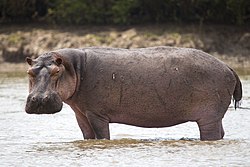
The hippopotamus (Hippopotamus amphibius;; pl.: hippopotamuses or hippopotami), often shortened to hippo (pl.: hippos), further qualified as the common hippopotamus, Nile hippopotamus and river hippopotamus, is a large semiaquatic mammal native to sub-Saharan Africa. It is one of only two extant species in the family Hippopotamidae, the other being the pygmy hippopotamus (Choeropsis liberiensis or Hexaprotodon liberiensis). Its name comes from the Ancient Greek for "river horse" (ἱπποπόταμος).
After elephants and rhinoceroses, the hippopotamus is the next largest land mammal. It is also the largest extant land artiodactyl. Despite their physical resemblance to pigs and other terrestrial even-toed ungulates, the closest living relatives of the hippopotamids are cetaceans (whales, dolphins, porpoises, etc.), from which they diverged about 55 million years ago. Hippos are recognisable for their barrel-shaped torsos, wide-opening mouths with large canine tusks, nearly hairless bodies, short legs, and large size: adults average 1.5 t (1.7 short tons) for bulls (males) and 1.3 t (1.4 short tons) for cows (females).
Hippos inhabit rivers, lakes, and mangrove swamps. Territorial bulls each preside over a stretch of water and a group of five to thirty cows and calves. Mating and birth both occur in the water. During the day, hippos remain cool by staying in water or mud, emerging at dusk to graze on grasses. While hippos rest near each other in the water, grazing is a solitary activity and hippos typically do not display territorial behaviour on land. Hippos are among the most dangerous animals in the world due to their aggressive and unpredictable nature. They are threatened by habitat loss and poaching for their meat and ivory (canine teeth). Wikipedia →
Recent sightings of Common Hippopotamus in Pilanesberg National Park
LIVEiNaturalistGlobal Distribution
Parks Where Found
Cities Where Found
| # | City | Country | Daily sighting probability |
|---|---|---|---|
| 1 | Cape Town | 🇿🇦 South Africa |
Zoos & Centres Where Found
Closest Relatives at Pilanesberg National Park





Before you go
What are the chances of seeing a Common Hippopotamus in Pilanesberg National Park?
Likely
About 60% of wildlife watchers report a Common Hippopotamus sighting in Pilanesberg National Park on a given day, based on 198 verified sightings from GBIF citizen-science data from 2019 to 2026. It is the 5th most-seen of the 31 mammals we can rate there. Over three days the chance rises to about 90%, and over a week to over 90%, if each day is a fresh chance.
When is the best time to see a Common Hippopotamus in Pilanesberg National Park?
June and September
In those months about 70% of wildlife watchers report a Common Hippopotamus in Pilanesberg National Park on a given day, against about 40% in December, the lowest month. Those are among Pilanesberg National Park's driest months, with about 5 mm of rain a month against 130 mm in December.
What time of day is best to see a Common Hippopotamus?
Between 10 am and 1 pm
Across all the parks we cover, that three-hour window holds the most Common Hippopotamus sightings with a recorded time, and about 9 in 10 of them come between 6 am and 6 pm: it is a daytime animal.
Is Pilanesberg National Park the best place to see a Common Hippopotamus?
14th of 39
Of the 39 parks where we can rate Common Hippopotamus sightings, Pilanesberg National Park ranks 14th at about 60%. The best odds are in Akagera National Park (Rwanda, about 80%), South Luangwa National Park (Zambia, about 80%) and Murchison Falls National Park (Uganda, about 70%). All parks ranked.
Which relatives of the Common Hippopotamus live in Pilanesberg National Park?
Same order: Artiodactyla
The closest relatives of the Common Hippopotamus that you can see in Pilanesberg National Park (order Artiodactyla, Even-toed Ungulates and Cetaceans) are Southern Giraffe (about 60%), Impala (about 60%) and Blue Wildebeest (about 60%), with each one's daily chance of a sighting.
Where does the Common Hippopotamus sighting chance come from?
GBIF citizen-science records
It is estimated from how often the Common Hippopotamus is recorded against all the mammals logged in Pilanesberg National Park (198 verified sightings from 2019 to 2026), calibrated against known sighting rates. Figures are rounded to the nearest 10% because citizen-science data supports honest approximations, not decimals, and months with records from fewer than five people show "—". How it works.
