Andean Cock-of-the-rock

Andean Cock-of-the-rock

Rupicola peruvianus

Silhouette: Gargominy O. · PhyloPic

LCLeast ConcernNTVUENCR
Daily sighting probability ~20% · Possible
at Podocarpus National Park

In 3 days ~40% in a week ~70%

279 Verified sightings at Podocarpus National Park From 2019 to 2026
1,305 In all 5 parks
October Best month
☀️ Diurnal When it's spotted

About the Andean Cock-of-the-rock

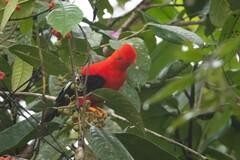
[[|thumb]] The Andean cock-of-the-rock (Rupicola peruvianus), also known as tunki (Quechua), is a large passerine bird of the cotinga family native to Andean cloud forests in South America. It is the national bird of Peru. It has four subspecies and its closest relative is the Guianan cock-of-the-rock.

The Andean cock-of-the-rock exhibits marked sexual dimorphism; the male has a large disk-like crest and scarlet or brilliant orange plumage, while the female is significantly darker and browner. Gatherings of males compete for breeding females with each male displaying his colourful plumage, bobbing and hopping, and making a variety of calls. After mating, the female makes a nest under a rocky overhang, incubates the eggs, and rears the young by herself.

The Andean cock-of-the-rock eats a diet of fruit, supplemented by insect, amphibian, reptile, and smaller mice. It is distributed all across the cloud forest of the Andes, having a range of around 260,000 km2 (100,000 sq mi). Even though it is being affected by the destruction of its habitat, the Andean cock-of-the-rock is not classified as threatened.

One of two species in the genus Rupicola, the other being... Wikipedia →

Sounds

Call0:17

Ecuador · 2025

© Manuel Sánchez-Nivicela · XC1145222 · CC BY-NC-ND 4.0

Lekking0:38

Ecuador · 2024

© Scott Olmstead · XC936838 · CC BY-NC-SA 4.0

Song0:27

Ecuador · 2024

© Sue Riffe · XC933419 · CC BY-NC-SA 4.0

Global Distribution

Parks Where Found

# Park Country Daily sighting probability
1 Farallones de Cali National Natural Park 🇨🇴 Colombia
~30%
2 Podocarpus National Park 🇪🇨 Ecuador
~20%
3 Chingaza National Natural Park 🇨🇴 Colombia
<5%
4 Los Nevados National Natural Park 🇨🇴 Colombia
<5%
5 Sierra de la Macarena National Park 🇨🇴 Colombia
<5%

Zoos & Centres Where Found

# Zoo / Centre Country
1 San Diego Zoo 🇺🇸 United States In captivity
2 Parc des oiseaux 🇫🇷 France In captivity
3 San Diego Zoo Safari Park 🇺🇸 United States In captivity
4 Bronx Zoo 🇺🇸 United States In captivity
5 Brookfield Zoo 🇺🇸 United States In captivity
6 Woodland Park Zoo 🇺🇸 United States In captivity
7 Edinburgh Zoo 🇬🇧 United Kingdom In captivity
8 Houston Zoo 🇺🇸 United States In captivity
9 Ueno Zoo 🇯🇵 Japan In captivity
10 Bird Paradise 🇸🇬 Singapore In captivity
11 Faunia 🇪🇸 Spain In captivity
12 Rainforest Wild Asia 🇸🇬 Singapore In captivity
13 Parque de las Leyendas 🇵🇪 Peru In captivity
14 Aviario Nacional de Colombia 🇨🇴 Colombia In captivity
15 Oasi Naturalistica di Sant'Alessio 🇮🇹 Italy In captivity
16 Ueno Zoological Gardens (West Garden) 🇯🇵 Japan In captivity
17 Parque de la Conservación 🇨🇴 Colombia In captivity
18 National Aviary 🇺🇸 United States In captivity
19 Ralph Perkins II Wildlife Center and Woods Garden 🇺🇸 United States In captivity
20 Dallas World Aquarium 🇺🇸 United States In captivity
21 Cali Zoo 🇨🇴 Colombia In captivity

Before you go

What are the chances of seeing an Andean Cock-of-the-rock in Podocarpus National Park?

Possible

About 20% of wildlife watchers report an Andean Cock-of-the-rock sighting in Podocarpus National Park on a given day, based on 279 verified sightings from GBIF citizen-science data from 2019 to 2026. It is the 77th most-seen of the 446 birds we can rate there. Over three days the chance rises to about 40%, and over a week to about 70%, if each day is a fresh chance.

When is the best time to see an Andean Cock-of-the-rock in Podocarpus National Park?

September to February

In those months about 20% of wildlife watchers report an Andean Cock-of-the-rock in Podocarpus National Park on a given day, against under 5% in August, the lowest month.

What time of day is best to see an Andean Cock-of-the-rock?

Between 3 and 6 pm

Across all the parks we cover, that three-hour window holds the most Andean Cock-of-the-rock sightings with a recorded time, and about 9 in 10 of them come between 6 am and 6 pm: it is a daytime animal.

Is Podocarpus National Park the best place to see an Andean Cock-of-the-rock?

2nd of 5

Of the 5 parks where we can rate Andean Cock-of-the-rock sightings, Podocarpus National Park ranks 2nd at about 20%. The best odds are in Farallones de Cali National Natural Park (Colombia, about 30%).

Which relatives of the Andean Cock-of-the-rock live in Podocarpus National Park?

Same family: Cotingidae

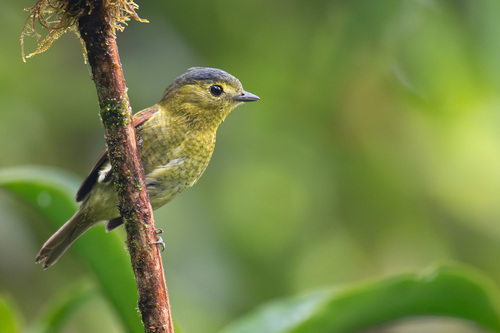
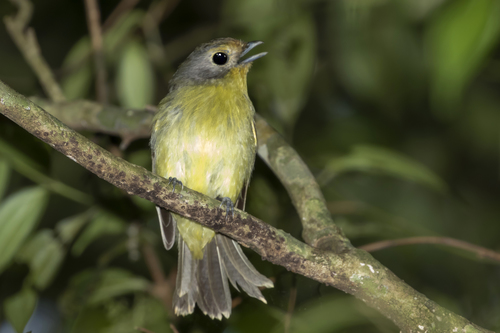
The closest relatives of the Andean Cock-of-the-rock that you can see in Podocarpus National Park (family Cotingidae, Cotingas) are Barred Fruiteater (about 30%), Green-and-black Fruiteater (about 20%) and Barred Becard (about 10%), with each one's daily chance of a sighting.

Where does the Andean Cock-of-the-rock sighting chance come from?

GBIF citizen-science records

It is estimated from how often the Andean Cock-of-the-rock is recorded against all the birds logged in Podocarpus National Park (279 verified sightings from 2019 to 2026), calibrated against known sighting rates. Figures are rounded to the nearest 10% because citizen-science data supports honest approximations, not decimals, and months with records from fewer than five people show "—". How it works.

← Back to Podocarpus National Park