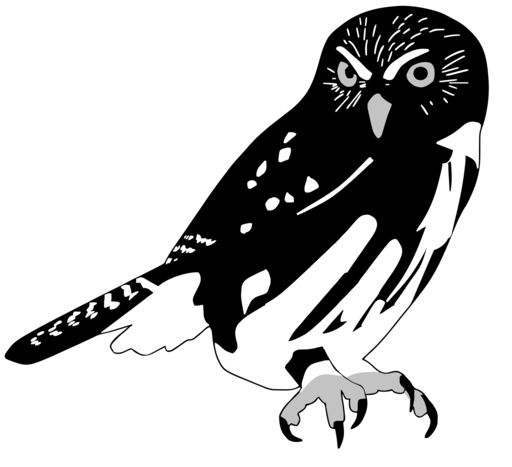
Andean Pygmy-Owl

Andean Pygmy-Owl

Glaucidium jardinii

Silhouette: Edwin Price · PhyloPic

LCLeast ConcernNTVUENCR
Daily sighting probability <5% · Rare
at Podocarpus National Park

In 3 days <5% in a week ~10%

23 Verified sightings at Podocarpus National Park From 2019 to 2026
233 In all 4 parks
May Best month
☀️ Diurnal When it's spotted

About the Andean Pygmy-Owl

The Andean pygmy owl (Glaucidium jardinii) is a species of owl in the family Strigidae. It is found in Colombia, Ecuador, Peru, and Venezuela. The Andean pygmy owl is monotypic. The Andean pygmy owl is 15 to 16 cm (5.9 to 6.3 in) long. Males weigh 54.9 to 77.4 g (1.9 to 2.7 oz) and females 54.6 to 75 g (1.9 to 2.6 oz). It has two distinct color morphs; in one the head, most of the body, wings, and tail are dull dark brown with white markings and in the other the same areas are dark chestnut with buff markings. In both the crown has small white dots. They have white "brows" over yellow eyes, white "moustaches", and a broad white throat. Their nape has a black and white face-like pattern. Their backs have spots and the tail bars, white or buff respectively. The sides of the breast are dark brown or chestnut with pale markings; the white breast and belly have heavy dark brown or chestnut streaks.

The Andean pygmy owl is found in far western Venezuela and the central and western Andes of Colombia south through Ecuador to central Peru. It inhabits a variety of mountain landscapes including cloudforest, elfin... Wikipedia →

Sounds

Call0:37

Ecuador · 2017

© Manuel Sánchez-Nivicela · XC1163101 · CC BY-NC-ND 4.0

Song0:49

Colombia · 2023

© David Monroy Rengifo · XC818068 · CC BY-NC-SA 4.0

Uncertain1:26

Colombia · 2021

© Andrés Mauricio López · XC635371 · CC BY-NC-SA 4.0

Global Distribution

Parks Where Found

# Park Country Daily sighting probability
1 Chingaza National Natural Park 🇨🇴 Colombia
~10%
2 Podocarpus National Park 🇪🇨 Ecuador
<5%
3 Los Nevados National Natural Park 🇨🇴 Colombia
<5%
4 Farallones de Cali National Natural Park 🇨🇴 Colombia
<5%

Cities Where Found

# City Country Daily sighting probability
1 Quito 🇪🇨 Ecuador
<5%

Before you go

What are the chances of seeing an Andean Pygmy-Owl in Podocarpus National Park?

Rare

Under 5% of wildlife watchers report an Andean Pygmy-Owl sighting in Podocarpus National Park on a given day, based on 23 verified sightings from GBIF citizen-science data from 2019 to 2026. It is the 298th most-seen of the 446 birds we can rate there. Over three days the chance rises to under 5%, and over a week to about 10%, if each day is a fresh chance.

When is the best time to see an Andean Pygmy-Owl in Podocarpus National Park?

May

In that month about 10% of wildlife watchers report an Andean Pygmy-Owl in Podocarpus National Park on a given day, against under 5% in June to April, the lowest months.

What time of day is best to see an Andean Pygmy-Owl?

Between 8 and 11 am

Across all the parks we cover, that three-hour window holds the most Andean Pygmy-Owl sightings with a recorded time, and about 8 in 10 of them come between 6 am and 6 pm: it is a daytime animal.

Is Podocarpus National Park the best place to see an Andean Pygmy-Owl?

2nd of 4

Of the 4 parks where we can rate Andean Pygmy-Owl sightings, Podocarpus National Park ranks 2nd at under 5%. The best odds are in Chingaza National Natural Park (Colombia, about 10%).

Where does the Andean Pygmy-Owl sighting chance come from?

GBIF citizen-science records

It is estimated from how often the Andean Pygmy-Owl is recorded against all the birds logged in Podocarpus National Park (23 verified sightings from 2019 to 2026), calibrated against known sighting rates. Figures are rounded to the nearest 10% because citizen-science data supports honest approximations, not decimals, and months with records from fewer than five people show "—". How it works.

← Back to Podocarpus National Park