
Green-tailed Trainbearer

Green-tailed Trainbearer

Lesbia nuna

Silhouette: Ferran Sayol · PhyloPic

LCLeast ConcernNTVUENCR
Daily sighting probability <5% · Rare
at Podocarpus National Park

In 3 days ~10%

31 Verified sightings at Podocarpus National Park From 2019 to 2026
65 In all 2 parks
December Best month
☀️ Diurnal When it's spotted

About the Green-tailed Trainbearer

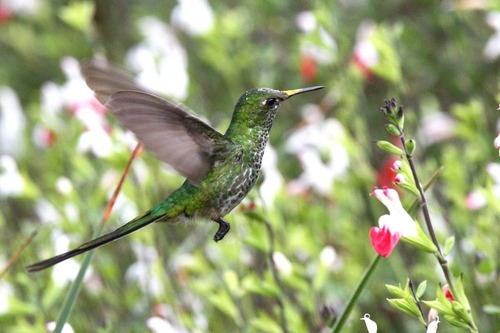
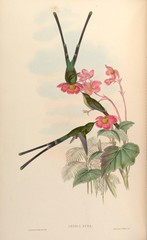
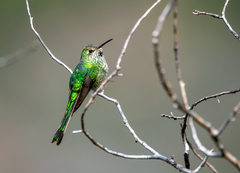
The green-tailed trainbearer (Lesbia nuna) is a species of hummingbird in the "coquettes", tribe Lesbiini of subfamily Lesbiinae. It is found in Bolivia, Colombia, Ecuador, Peru, and possibly Venezuela. The taxonomy of the green-tailed trainbearer is not settled. The International Ornithological Committee (IOC) recognizes these six subspecies:

Though the green-tailed trainbearer shares its genus with the black-tailed trainbearer (L. victoriae), they might not be especially closely related. All of the subspecies except the nominate (and boliviana) have at various times been suggested as separate species. Two additional subspecies have been proposed as well, but the weight of evidence is that they are hybrids of the two trainbearers.

The... Wikipedia →

Sounds

Song0:19

Ecuador · 2023

© Manuel Sanchez-Nivicela · XC937247 · CC BY-NC-ND 4.0

Call0:05

Colombia · 2022

© Mauricio Cuellar Ramirez (@Birding.travel) · XC697622 · CC BY-NC-SA 4.0

Alarm call0:04

Colombia · 2020

© Fernando Castro · XC582123 · CC BY-NC-SA 4.0

Global Distribution

Parks Where Found

# Park Country Daily sighting probability
1 Chingaza National Natural Park 🇨🇴 Colombia
<5%
2 Podocarpus National Park 🇪🇨 Ecuador
<5%

Cities Where Found

# City Country Daily sighting probability
1 Quito 🇪🇨 Ecuador
~10%
2 Bogota 🇨🇴 Colombia
~10%

Before you go

What are the chances of seeing a Green-tailed Trainbearer in Podocarpus National Park?

Rare

Under 5% of wildlife watchers report a Green-tailed Trainbearer sighting in Podocarpus National Park on a given day, based on 31 verified sightings from GBIF citizen-science data from 2019 to 2026. It is the 264th most-seen of the 446 birds we can rate there. Over three days the chance rises to about 10%, if each day is a fresh chance.

When is the best time to see a Green-tailed Trainbearer in Podocarpus National Park?

Any time of year

In every month with enough records, under 5% of wildlife watchers report a Green-tailed Trainbearer in Podocarpus National Park on a given day, so our monthly data shows no clear season.

What time of day is best to see a Green-tailed Trainbearer?

Between 8 and 11 am

Across all the parks we cover, that three-hour window holds the most Green-tailed Trainbearer sightings with a recorded time, and about 9 in 10 of them come between 6 am and 6 pm: it is a daytime animal.

Is Podocarpus National Park the best place to see a Green-tailed Trainbearer?

Among the best

Of the 2 parks where we can rate Green-tailed Trainbearer sightings, Podocarpus National Park ranks 2nd at under 5%, level with the leaders once rounded. The best odds are in Chingaza National Natural Park (Colombia, under 5%).

Which relatives of the Green-tailed Trainbearer live in Podocarpus National Park?

Same family: Trochilidae

The closest relatives of the Green-tailed Trainbearer that you can see in Podocarpus National Park (family Trochilidae, Hummingbirds) are Collared Inca (about 40%), Amethyst-throated Sunangel (about 40%) and Chestnut-breasted Coronet (about 40%), with each one's daily chance of a sighting.

Where does the Green-tailed Trainbearer sighting chance come from?

GBIF citizen-science records

It is estimated from how often the Green-tailed Trainbearer is recorded against all the birds logged in Podocarpus National Park (31 verified sightings from 2019 to 2026), calibrated against known sighting rates. Figures are rounded to the nearest 10% because citizen-science data supports honest approximations, not decimals, and months with records from fewer than five people show "—". How it works.

← Back to Podocarpus National Park