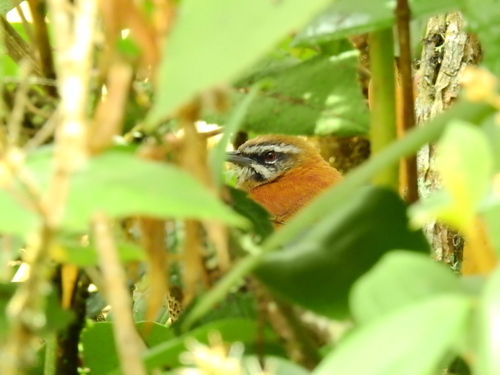
Long-tailed Tapaculo

Long-tailed Tapaculo

Scytalopus micropterus

Silhouette: Ferran Sayol · PhyloPic

LCLeast ConcernNTVUENCR
Daily sighting probability <5% · Rare
at Podocarpus National Park

In 3 days <5% in a week ~10%

12 Verified sightings at Podocarpus National Park From 2019 to 2026
19 In all 2 parks
December Best month
☀️ Diurnal When it's spotted

About the Long-tailed Tapaculo

The long-tailed tapaculo (Scytalopus micropterus) is a species of bird in the family Rhinocryptidae. It is found in the eastern Andes of Colombia, Ecuador and far northern Peru. The long-tailed tapaculo was formerly considered a subspecies of rufous-vented tapaculo (Scytalopus femoralis) but was separated based principally on differences in their vocalizations. They are now classed as sister species.

The long-tailed tapaculo is one of the larger species of genus Scytalopus, and, compared to other Scytalopus species, its tail is relatively long. It is 13.5 cm (5.3 in) long overall and males weigh from 27 to 32.5 g (0.95 to 1.15 oz). Otherwise the long-tailed tapaculo has few distinctive morphological features: The male's plumage is drab, primarily dark gray with russet brown flanks that are barred with black. The female is similar but even drabber.

The long-tailed tapaculo's song typically begins with a series of single notes, but quickly turns into a series of couplets [1]. Its alarm call is a descending series. The long-tailed tapaculo occurs along the east slopes of the Andes from Colombia south to northern... Wikipedia →

Sounds

Song0:22

Ecuador · 2026

© Daan van der Hoeven · XC1155233 · CC BY-NC-SA 4.0

Call0:15

Ecuador · 2002

© Brian Cox · XC731652 · CC BY-NC-SA 4.0

Song0:23

Colombia · 2021

© Peter Boesman · XC693834 · CC BY-NC-ND 4.0

Global Distribution

Parks Where Found

# Park Country Daily sighting probability
1 Podocarpus National Park 🇪🇨 Ecuador
<5%
2 Chingaza National Natural Park 🇨🇴 Colombia
<5%

Before you go

What are the chances of seeing a Long-tailed Tapaculo in Podocarpus National Park?

Rare

Under 5% of wildlife watchers report a Long-tailed Tapaculo sighting in Podocarpus National Park on a given day, based on 12 verified sightings from GBIF citizen-science data from 2019 to 2026. It is the 355th most-seen of the 446 birds we can rate there. Over three days the chance rises to under 5%, and over a week to about 10%, if each day is a fresh chance.

When is the best time to see a Long-tailed Tapaculo in Podocarpus National Park?

Any time of year

In every month with enough records, under 5% of wildlife watchers report a Long-tailed Tapaculo in Podocarpus National Park on a given day, so our monthly data shows no clear season.

What time of day is best to see a Long-tailed Tapaculo?

Between 3 and 6 pm

Across all the parks we cover, that three-hour window holds the most Long-tailed Tapaculo sightings with a recorded time, and about 9 in 10 of them come between 6 am and 6 pm: it is a daytime animal.

Is Podocarpus National Park the best place to see a Long-tailed Tapaculo?

Yes

Of the 2 parks where we can rate Long-tailed Tapaculo sightings, Podocarpus National Park has the highest daily chance: under 5%. Next come Chingaza National Natural Park (Colombia, under 5%).

Which relatives of the Long-tailed Tapaculo live in Podocarpus National Park?

Same genus: Scytalopus

The closest relatives of the Long-tailed Tapaculo that you can see in Podocarpus National Park (genus Scytalopus, Scytalopus Tapaculos) are Chusquea Tapaculo (about 30%), White-crowned Tapaculo (about 10%) and Blackish Tapaculo (about 10%), with each one's daily chance of a sighting.

Where does the Long-tailed Tapaculo sighting chance come from?

GBIF citizen-science records

It is estimated from how often the Long-tailed Tapaculo is recorded against all the birds logged in Podocarpus National Park (12 verified sightings from 2019 to 2026), calibrated against known sighting rates. Figures are rounded to the nearest 10% because citizen-science data supports honest approximations, not decimals, and months with records from fewer than five people show "—". How it works.

← Back to Podocarpus National Park