Ocellated Tapaculo

Ocellated Tapaculo

Acropternis orthonyx

Silhouette: Ferran Sayol · PhyloPic

LCLeast ConcernNTVUENCR
Daily sighting probability <5% · Rare
at Podocarpus National Park

In 3 days <5% in a week ~10%

19 Verified sightings at Podocarpus National Park From 2019 to 2026
867 In all 3 parks
May Best month
☀️ Diurnal When it's spotted

About the Ocellated Tapaculo

The ocellated tapaculo (Acropternis orthonyx) is a large bird found in the northern Andes in South America. It is a highly distinctive tapaculo; traditionally united with its closest relatives in the Rhinocryptidae, this family is paraphyletic with the Formicariidae (ground-antbirds) but instead of merging the tapaculos with the ground-antbird family, recent sources tend to split the antpittas from the Formicariidae.

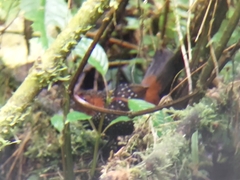
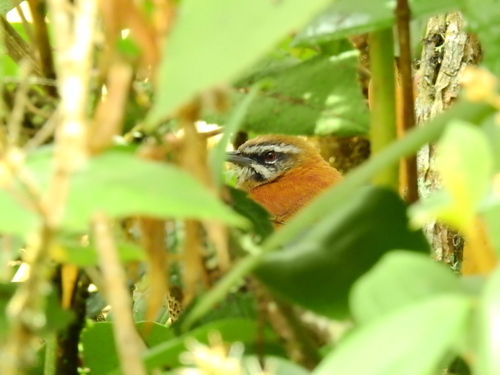
This passerine averages 8.3-8.7 in (21–22 cm) in length and between 2.8 and 3.5 oz (80 and 100 gram). The bird is mostly black with large white spots, a brown flank, and a reddish head and throat. A call, apparently given by birds to announce their presence to conspecifics, is described as "loud, emphatic WHEEUW! whistle" which as it seems can be heard from a long distance.

It is usually encountered in pairs or alone, hopping through bamboo along the forest floor. Preferring to stay close to the ground, it is more often heard than seen. It is possible to attract ocellated tapaculos with recorded or imitated calls, which they will approach to investigate from several kilometers away.

It is sometimes divided into two subspecies... Wikipedia →

Sounds

Song1:07

Ecuador · 2023

© Juan Freile · XC1172501 · CC BY-NC-SA 4.0

Call0:16

Colombia · 2021

© Mauricio Cuellar Ramirez (@Birding.travel) · XC682446 · CC BY-NC-SA 4.0

Alarm call0:38

Ecuador · 2018

© Edison Ocaña · XC416281 · CC BY-NC-SA 4.0

Global Distribution

Parks Where Found

# Park Country Daily sighting probability
1 Los Nevados National Natural Park 🇨🇴 Colombia
~10%
2 Chingaza National Natural Park 🇨🇴 Colombia
<5%
3 Podocarpus National Park 🇪🇨 Ecuador
<5%

Cities Where Found

# City Country Daily sighting probability
1 Quito 🇪🇨 Ecuador
<5%

Before you go

What are the chances of seeing an Ocellated Tapaculo in Podocarpus National Park?

Rare

Under 5% of wildlife watchers report an Ocellated Tapaculo sighting in Podocarpus National Park on a given day, based on 19 verified sightings from GBIF citizen-science data from 2019 to 2026. It is the 313th most-seen of the 446 birds we can rate there. Over three days the chance rises to under 5%, and over a week to about 10%, if each day is a fresh chance.

When is the best time to see an Ocellated Tapaculo in Podocarpus National Park?

May

In that month about 10% of wildlife watchers report an Ocellated Tapaculo in Podocarpus National Park on a given day, against under 5% in June to April, the lowest months.

What time of day is best to see an Ocellated Tapaculo?

Between 7 and 10 am

Across all the parks we cover, that three-hour window holds the most Ocellated Tapaculo sightings with a recorded time, and about 9 in 10 of them come between 6 am and 6 pm: it is a daytime animal.

Is Podocarpus National Park the best place to see an Ocellated Tapaculo?

3rd of 3

Of the 3 parks where we can rate Ocellated Tapaculo sightings, Podocarpus National Park ranks 3rd at under 5%. The best odds are in Los Nevados National Natural Park (Colombia, about 10%) and Chingaza National Natural Park (Colombia, under 5%).

Which relatives of the Ocellated Tapaculo live in Podocarpus National Park?

Same family: Rhinocryptidae

The closest relatives of the Ocellated Tapaculo that you can see in Podocarpus National Park (family Rhinocryptidae, Tapaculos) are Chusquea Tapaculo (about 30%), White-crowned Tapaculo (about 10%) and Blackish Tapaculo (about 10%), with each one's daily chance of a sighting.

Where does the Ocellated Tapaculo sighting chance come from?

GBIF citizen-science records

It is estimated from how often the Ocellated Tapaculo is recorded against all the birds logged in Podocarpus National Park (19 verified sightings from 2019 to 2026), calibrated against known sighting rates. Figures are rounded to the nearest 10% because citizen-science data supports honest approximations, not decimals, and months with records from fewer than five people show "—". How it works.

← Back to Podocarpus National Park