
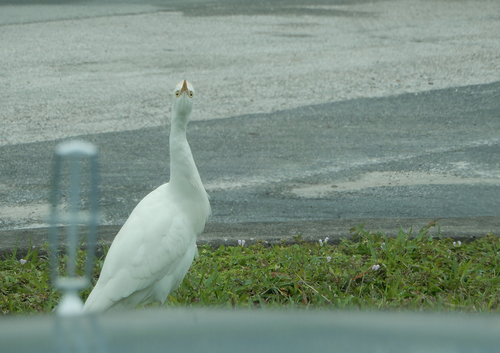


American Bittern

American Bittern

Botaurus lentiginosus

Silhouette: Sheatherius · PhyloPic

LCLeast ConcernNTVUENCR
Daily sighting probability <5% · Rare
at Point Pelee National Park

In 3 days ~10%

258 Verified sightings at Point Pelee National Park From 2019 to 2026
1,117 In all 11 parks
May Best month
☀️ Diurnal When it's spotted

About the American Bittern

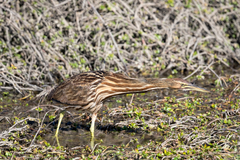
The American bittern (Botaurus lentiginosus) is a species of wading bird in the heron family. It has a Nearctic distribution, breeding in Canada and the northern and central parts of the United States, and wintering in the U.S. Gulf Coast states, all of Florida into the Everglades, the Caribbean islands and parts of Central America.

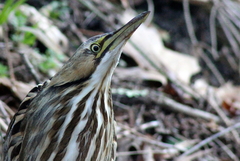
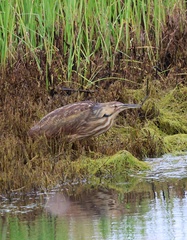
It is a well-camouflaged, solitary brown bird that unobtrusively inhabits marshes and the coarse vegetation at the edge of lakes and ponds. In the breeding season it is chiefly noticeable by the loud, booming call of the male. The nest is built just above the water, usually among bulrushes and cattails, where the female incubates the clutch of olive-colored eggs for about four weeks. The young leave the nest after two weeks and are fully fledged at six or seven weeks.

The American bittern feeds mostly on fish but also eats other small vertebrates as well as crustaceans and insects. It is fairly common over its wide range, but its numbers are thought to be decreasing, especially in the south, because of habitat degradation. However the total population is large, and the International Union for Conservation of Nature has assessed its conservation status as being of "Least Concern". Wikipedia →

Sounds

Call0:29

Canada · 1984

© Peter Ward and Ken Hall · XC601776 · CC BY-NC-SA 4.0

Song0:48

Canada · 2018

© Jeff Dyck · XC419704 · CC BY-NC-SA 4.0

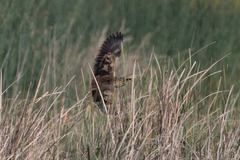
Flight call0:12

United States · 2016

© Paul Marvin · XC338164 · CC BY-NC-SA 4.0

Global Distribution

Parks Where Found

# Park Country Daily sighting probability
1 Riding Mountain National Park 🇨🇦 Canada
~10%
2 Big Cypress National Preserve 🇺🇸 United States
<5%
3 Everglades National Park 🇺🇸 United States
<5%
4 Voyageurs National Park 🇺🇸 United States
<5%
5 Isle Royale National Park 🇺🇸 United States
<5%
6 Point Pelee National Park 🇨🇦 Canada
<5%
7 Merritt Island National Wildlife Refuge 🇺🇸 United States
<5%
8 Acadia National Park 🇺🇸 United States
<5%
9 Ría Lagartos Biosphere Reserve 🇲🇽 Mexico
<5%
10 Big Bend National Park 🇺🇸 United States
<5%
11 Redwood National Park 🇺🇸 United States
<5%

Cities Where Found

# City Country Daily sighting probability
1 Vancouver 🇨🇦 Canada
<5%
2 Miami 🇺🇸 United States
<5%
3 Seattle 🇺🇸 United States
<5%
4 Chicago 🇺🇸 United States
<5%
5 Montreal 🇨🇦 Canada
<5%
6 Washington 🇺🇸 United States
<5%
7 Edmonton 🇨🇦 Canada
<5%
8 Mexico City 🇲🇽 México
<5%
9 New York City 🇺🇸 United States
<5%
10 Los Angeles 🇺🇸 United States
<5%

Zoos & Centres Where Found

# Zoo / Centre Country
1 California Academy of Sciences 🇺🇸 United States In captivity
2 Cameron Park Zoo 🇺🇸 United States In captivity
3 Montreal Biodome 🇨🇦 Canada In captivity
4 Wild Bird Fund 🇺🇸 United States In captivity

Before you go

What are the chances of seeing an American Bittern in Point Pelee National Park?

Rare

Under 5% of wildlife watchers report an American Bittern sighting in Point Pelee National Park on a given day, based on 258 verified sightings from GBIF citizen-science data from 2019 to 2026. It is the 189th most-seen of the 278 birds we can rate there. Over three days the chance rises to about 10%, if each day is a fresh chance.

When is the best time to see an American Bittern in Point Pelee National Park?

Any time of year

In every month with enough records, under 5% of wildlife watchers report an American Bittern in Point Pelee National Park on a given day, so our monthly data shows no clear season.

What time of day is best to see an American Bittern?

Between 8 and 11 am

Across all the parks we cover, that three-hour window holds the most American Bittern sightings with a recorded time, and about 9 in 10 of them come between 6 am and 6 pm: it is a daytime animal.

Which relatives of the American Bittern live in Point Pelee National Park?

Same family: Ardeidae

The closest relatives of the American Bittern that you can see in Point Pelee National Park (family Ardeidae, Herons, Egrets, and Bitterns) are Great Blue Heron (about 50%), Green Heron (about 10%) and Great Egret (about 10%), with each one's daily chance of a sighting.

Where does the American Bittern sighting chance come from?

GBIF citizen-science records

It is estimated from how often the American Bittern is recorded against all the birds logged in Point Pelee National Park (258 verified sightings from 2019 to 2026), calibrated against known sighting rates. Figures are rounded to the nearest 10% because citizen-science data supports honest approximations, not decimals, and months with records from fewer than five people show "—". How it works.

← Back to Point Pelee National Park