Connecticut Warbler

Connecticut Warbler

Oporornis agilis

Silhouette: Andy Wilson · PhyloPic

LCLeast ConcernNTVUENCR
Daily sighting probability <5% · Rare
at Point Pelee National Park

In 3 days <5%

32 Verified sightings at Point Pelee National Park From 2019 to 2026
96 In all 4 parks
September Best month
☀️ Diurnal When it's spotted

About the Connecticut Warbler

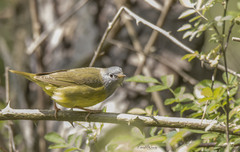
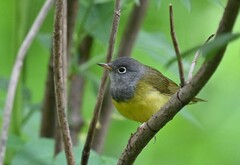
The Connecticut warbler (Oporornis agilis) is a small songbird of the New World warbler family. These medium-sized warblers measure 13–15 cm (5.1–5.9 in) in length, with a 22–23 cm (8.7–9.1 in) wingspan. Connecticut warblers weigh 10 g (0.35 oz) when they fledge, attaining an average weight of around 15 g (0.53 oz) as adults. However, birds preparing for migration pack on more weight to survive the strenuous journey and can weigh up to 25 g (0.88 oz). This species has light yellow underparts and olive upperparts; they have a light eye-ring, pink legs, a long tail, and a thin pointed bill. Males have a grey hood; females and immatures are more brown and have a whitish throat.

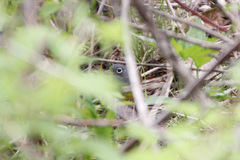
They forage on the ground, picking among dead leaves, or hop along branches. Like most warblers, these birds mainly eat insects and similar small invertebrates. They will also supplement their diet occasionally with seeds and berries. They are "skulking" birds that usually spend their time foraging within dense, low vegetation. Such behavior often renders them difficult to see well.

Despite its name, this bird only rarely visits Connecticut during migration. It was named by Alexander Wilson who... Wikipedia →

Sounds

Song1:24

Canada · 2026

© Michael Collins · XC1145408 · CC BY-NC-SA 4.0

Call0:53

United States · 2019

© Matt Wistrand · XC476133 · CC BY-NC-SA 4.0

Song1:23

United States · 2021

© Paul Driver · XC658529 · CC BY-NC-SA 4.0

Global Distribution

Parks Where Found

# Park Country Daily sighting probability
1 Isla del Coco National Park 🇨🇷 Costa Rica
~10%
2 Henri Pittier National Park 🇻🇪 Venezuela
~10%
3 Riding Mountain National Park 🇨🇦 Canada
<5%
4 Point Pelee National Park 🇨🇦 Canada
<5%

Cities Where Found

# City Country Daily sighting probability
1 Chicago 🇺🇸 United States
<5%
2 Baltimore 🇺🇸 United States
<5%
3 Toronto 🇨🇦 Canada
<5%
4 Philadelphia 🇺🇸 United States
<5%
5 New York City 🇺🇸 United States
<5%
6 Detroit 🇺🇸 United States
<5%
7 Minneapolis [Saint Paul] 🇺🇸 United States
<5%
8 Miami 🇺🇸 United States
<5%
9 Washington 🇺🇸 United States
<5%
10 Boston 🇺🇸 United States
<5%

Before you go

What are the chances of seeing a Connecticut Warbler in Point Pelee National Park?

Rare

Under 5% of wildlife watchers report a Connecticut Warbler sighting in Point Pelee National Park on a given day, based on 32 verified sightings from GBIF citizen-science data from 2019 to 2026. It is the 250th most-seen of the 278 birds we can rate there. Over three days the chance rises to under 5%, if each day is a fresh chance.

When is the best time to see a Connecticut Warbler in Point Pelee National Park?

Any time of year

In every month with enough records, under 5% of wildlife watchers report a Connecticut Warbler in Point Pelee National Park on a given day, so our monthly data shows no clear season.

What time of day is best to see a Connecticut Warbler?

Between 8 and 11 am

Across all the parks we cover, that three-hour window holds the most Connecticut Warbler sightings with a recorded time, and about 9 in 10 of them come between 6 am and 6 pm: it is a daytime animal.

Which relatives of the Connecticut Warbler live in Point Pelee National Park?

Same family: Parulidae

The closest relatives of the Connecticut Warbler that you can see in Point Pelee National Park (family Parulidae, New World Warblers) are Yellow Warbler (about 70%), Common Yellowthroat (about 60%) and Northern Yellow Warbler (about 60%), with each one's daily chance of a sighting.

Where does the Connecticut Warbler sighting chance come from?

GBIF citizen-science records

It is estimated from how often the Connecticut Warbler is recorded against all the birds logged in Point Pelee National Park (32 verified sightings from 2019 to 2026), calibrated against known sighting rates. Figures are rounded to the nearest 10% because citizen-science data supports honest approximations, not decimals, and months with records from fewer than five people show "—". How it works.

← Back to Point Pelee National Park