Silver-haired Bat

Silver-haired Bat

Lasionycteris noctivagans

Silhouette: CJ Campbell · PhyloPic

LCLeast ConcernNTVUENCR
Daily sighting probability ~10% · With luck
at Point Pelee National Park

In 3 days ~30% in a week ~60%

15 Verified sightings at Point Pelee National Park From 2019 to 2026
15 In 1 park
December Best month
☀️ Diurnal When it's spotted

About the Silver-haired Bat

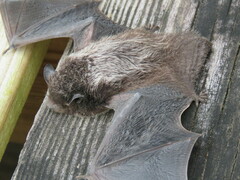
The silver-haired bat (Lasionycteris noctivagans) is a solitary migratory species of vesper bat in the family Vespertilionidae and the only member of the genus Lasionycteris. The species name translates as night-wandering, referring to the nocturnal behavior of bats.

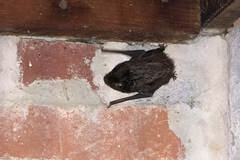
This medium-sized bat is predominantly black (including the wings, ears, interfemoral membrane, and fur) with white-tipped hairs. The basal upper half of its tail membrane is densely furred. This gives the bat a frosted appearance and its common namesake. This species has a flattened skull with a broad rostrum. This species weighs around 8–12 g, has a total length of ~100 mm, a tail length of 40 mm, and a forearm length of 37–44 mm.

Lasionycteris noctivagans is found in Bermuda, Canada, Mexico, and the United States. This forest inhabitant is known to occur from southeastern Alaska in summer to northeastern Mexico in winter and is found in arid habitats at low elevations during seasonal migrations. In Missouri, reproduction occurs in the northern dissected plains region, but reproductive females are believed to be absent from the southern Ozark highlands... Wikipedia →
Global Distribution

Parks Where Found

# Park Country Daily sighting probability
1 Point Pelee National Park 🇨🇦 Canada
~10%

More parks will be added in future updates.

Cities Where Found

# City Country Daily sighting probability
1 Chicago 🇺🇸 United States
~10%
2 Baltimore 🇺🇸 United States
<5%
3 Calgary 🇨🇦 Canada
<5%
4 New York City 🇺🇸 United States
<5%
5 Minneapolis [Saint Paul] 🇺🇸 United States
<5%
6 Washington 🇺🇸 United States
<5%
7 Toronto 🇨🇦 Canada
<5%
8 San Diego 🇺🇸 United States
<5%

Zoos & Centres Where Found

# Zoo / Centre Country
1 National Aquarium 🇺🇸 United States In captivity
2 Mountainaire Avian Rescue Society 🇨🇦 Canada In captivity

Before you go

What are the chances of seeing a Silver-haired Bat in Point Pelee National Park?

With luck

About 10% of wildlife watchers report a Silver-haired Bat sighting in Point Pelee National Park on a given day, based on 15 verified sightings from GBIF citizen-science data from 2019 to 2026. It is the 10th most-seen of the 17 mammals we can rate there. Over three days the chance rises to about 30%, and over a week to about 60%, if each day is a fresh chance.

When is the best time to see a Silver-haired Bat in Point Pelee National Park?

December

In that month about 50% of wildlife watchers report a Silver-haired Bat in Point Pelee National Park on a given day, against under 5% in February–April, June–July and September–November, the lowest months.

What time of day is best to see a Silver-haired Bat?

Between 2 and 5 pm

Across all the parks we cover, that three-hour window holds the most Silver-haired Bat sightings with a recorded time, and about 7 in 10 of them come between 6 am and 6 pm: it is a daytime animal.

Where else can you see a Silver-haired Bat?

Only Point Pelee National Park, in our data

Point Pelee National Park is the only park on Wallace's Line with enough records to rate Silver-haired Bat sightings: about 10% of wildlife watchers there report one on a given day.

Which relatives of the Silver-haired Bat live in Point Pelee National Park?

Same family: Vespertilionidae

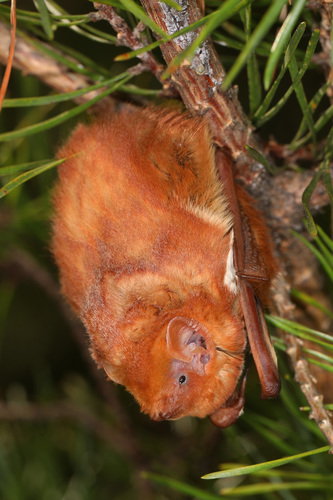
The closest relatives of the Silver-haired Bat that you can see in Point Pelee National Park (family Vespertilionidae, Evening Bats) are Eastern Red Bat (about 20%), Tricolored Bat (about 10%) and Big Brown Bat (about 10%), with each one's daily chance of a sighting.

Where does the Silver-haired Bat sighting chance come from?

GBIF citizen-science records

It is estimated from how often the Silver-haired Bat is recorded against all the mammals logged in Point Pelee National Park (15 verified sightings from 2019 to 2026), calibrated against known sighting rates. Figures are rounded to the nearest 10% because citizen-science data supports honest approximations, not decimals, and months with records from fewer than five people show "—". How it works.

← Back to Point Pelee National Park