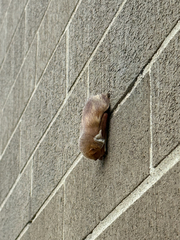

Eastern Red Bat

Eastern Red Bat

Lasiurus borealis

Silhouette: CJ Campbell · PhyloPic

LCLeast ConcernNTVUENCR
Daily sighting probability ~20% · Possible
at Point Pelee National Park

In 3 days ~40% in a week ~70%

26 Verified sightings at Point Pelee National Park From 2019 to 2026
38 In all 2 parks
March Best month
☀️ Diurnal When it's spotted

About the Eastern Red Bat

The eastern red bat (Lasiurus borealis) is a species of microbat in the family Vespertilionidae. Eastern red bats are widespread across eastern North America, with additional records in Bermuda. It was described in 1776 by German zoologist Philipp Ludwig Statius Müller. He initially placed it in the genus Vespertilio, with the name Vespertilio borealis. It was not placed into its current genus Lasiurus until the creation of the genus in 1831 by John Edward Gray. The generic name "Lasiurus" is derived from the Greek lasios ("hairy") and oura ("tail"); its species name "borealis" is Latin in origin, meaning "northern." Of the species in its genus, the eastern red bat is most closely related to other red bats, with which they form a monophyly. Its closest relatives are the Pfeiffer's red bat (Lasiurus pfeifferi), Seminole bat (L. seminolus), cinnamon red bat (L. varius), desert red bat (L. blossevillii), saline red bat (L. salinae), and the greater red bat (L. atratus).

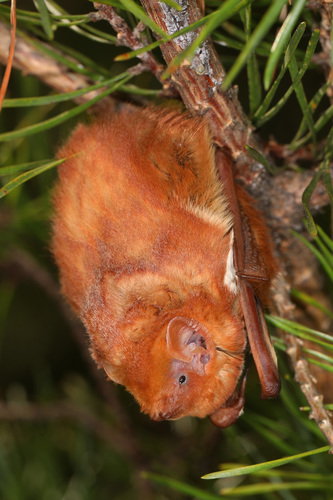
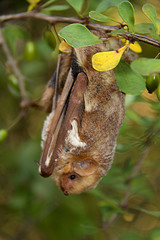
The eastern red bat has distinctive fur, with males being brick or rusty red, and females being a slightly more frosted shade of red. Both male and female eastern red bats... Wikipedia →

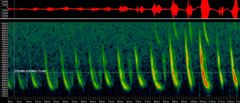
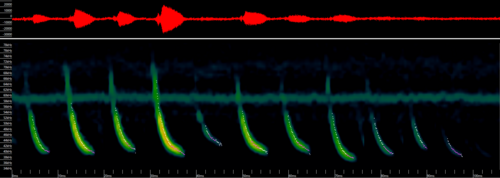
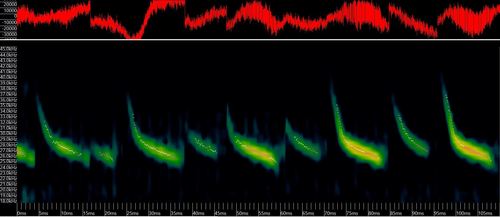
Sounds

Recording0:16

United States · 2021

© Ty Smith · iNaturalist · CC BY-NC 4.0

Global Distribution

Parks Where Found

# Park Country Daily sighting probability
1 Point Pelee National Park 🇨🇦 Canada
~20%
2 Great Smoky Mountains National Park 🇺🇸 United States
~10%

Cities Where Found

# City Country Daily sighting probability
1 Baltimore 🇺🇸 United States
~10%
2 Philadelphia 🇺🇸 United States
~10%
3 Chicago 🇺🇸 United States
~10%
4 New York City 🇺🇸 United States
~10%
5 Dallas 🇺🇸 United States
<5%
6 Washington 🇺🇸 United States
<5%
7 Boston 🇺🇸 United States
<5%
8 Austin 🇺🇸 United States
<5%

Zoos & Centres Where Found

# Zoo / Centre Country
1 Ralph Perkins II Wildlife Center and Woods Garden 🇺🇸 United States In captivity

Before you go

What are the chances of seeing an Eastern Red Bat in Point Pelee National Park?

Possible

About 20% of wildlife watchers report an Eastern Red Bat sighting in Point Pelee National Park on a given day, based on 26 verified sightings from GBIF citizen-science data from 2019 to 2026. It is the 8th most-seen of the 17 mammals we can rate there. Over three days the chance rises to about 40%, and over a week to about 70%, if each day is a fresh chance.

When is the best time to see an Eastern Red Bat in Point Pelee National Park?

March, May and October

In those months about 20% of wildlife watchers report an Eastern Red Bat in Point Pelee National Park on a given day, against under 5% in June–July, September and November–February, the lowest months.

What time of day is best to see an Eastern Red Bat?

Between 9 am and noon

Across all the parks we cover, that three-hour window holds the most Eastern Red Bat sightings with a recorded time, and about 7 in 10 of them come between 6 am and 6 pm: it is a daytime animal.

Is Point Pelee National Park the best place to see an Eastern Red Bat?

Yes

Of the 2 parks where we can rate Eastern Red Bat sightings, Point Pelee National Park has the highest daily chance: about 20%. Next come Great Smoky Mountains National Park (United States, about 10%).

Which relatives of the Eastern Red Bat live in Point Pelee National Park?

Same family: Vespertilionidae

The closest relatives of the Eastern Red Bat that you can see in Point Pelee National Park (family Vespertilionidae, Evening Bats) are Tricolored Bat (about 10%), Silver-haired Bat (about 10%) and Big Brown Bat (about 10%), with each one's daily chance of a sighting.

Where does the Eastern Red Bat sighting chance come from?

GBIF citizen-science records

It is estimated from how often the Eastern Red Bat is recorded against all the mammals logged in Point Pelee National Park (26 verified sightings from 2019 to 2026), calibrated against known sighting rates. Figures are rounded to the nearest 10% because citizen-science data supports honest approximations, not decimals, and months with records from fewer than five people show "—". How it works.

← Back to Point Pelee National Park