
European Free-tailed Bat

European Free-tailed Bat

Tadarida teniotis

Silhouette: T. Michael Keesey · PhyloPic

LCLeast ConcernNTVUENCR
Daily sighting probability <5% · Rare
at Pyrénées National Park

In 3 days ~10% in a week ~20%

6 Verified sightings at Pyrénées National Park From 2019 to 2026
18 In all 2 parks
March Best month
🌙 Nocturnal When it's spotted

About the European Free-tailed Bat

The European free-tailed bat (Tadarida teniotis, sometimes given as Tadarida insignis) is a species of free-tailed bat found in the Old World. Other common names include the bulldog bat and the mastiff bat because of the presence of wrinkling on the snout. This bat is found in the Mediterranean region of Europe and in scattered locations across Asia at altitudes from sea level to 3100 m. The range of distribution is from the Canary Islands and Madeira through the whole Mediterranean area, Asia Minor, the Caucasus and the Middle East. In the north to southern France, southern Germany, Switzerland, Croatia and Bulgaria. It was reported from Korea in 1931, but has not been sighted on the Korean Peninsula since then. Populations in Japan, Taiwan and Korea are now considered to be a separate species Tadarida insignis.

The European free-tailed bat has large, broad ears, each with a very small tragus, a backward-pointing projection which helps direct sound into the ear. Its muzzle has wrinkled lips, which gives its face a similarity to a dog's face and is the origin for its common names of bulldog or mastiff bat. Its tail is fleshy and robust, and the rear third is not connected... Wikipedia →

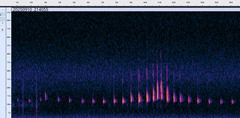
Sounds

Social call0:44

France · 2017

© Olivier SWIFT, Ludivine DELAMARE · XC1104194 · CC BY-NC-SA 4.0

Recording0:16

France · 2023

© jeannehaninmarchioni · iNaturalist · CC BY-NC 4.0

Recording0:20

Italy · 2023

© Jessica Peruzzo · iNaturalist · CC BY-NC-ND 4.0

Global Distribution

Parks Where Found

# Park Country Daily sighting probability
1 Cévennes National Park 🇫🇷 France
~10%
2 Pyrénées National Park 🇫🇷 France
<5%

Before you go

What are the chances of seeing a European Free-tailed Bat in Pyrénées National Park?

Rare

Under 5% of wildlife watchers report a European Free-tailed Bat sighting in Pyrénées National Park on a given day, based on 6 verified sightings from GBIF citizen-science data from 2019 to 2026. It is the 29th most-seen of the 30 mammals we can rate there. Over three days the chance rises to about 10%, and over a week to about 20%, if each day is a fresh chance.

When is the best time to see a European Free-tailed Bat in Pyrénées National Park?

March and October

In those months about 10% of wildlife watchers report a European Free-tailed Bat in Pyrénées National Park on a given day, against under 5% in April–September and November–February, the lowest months.

What time of day is best to see a European Free-tailed Bat?

Between 9 pm and midnight

Across all the parks we cover, that three-hour window holds the most European Free-tailed Bat sightings with a recorded time, and about 8 in 10 of them come between 6 pm and 6 am: it is mostly seen at night.

Is Pyrénées National Park the best place to see a European Free-tailed Bat?

2nd of 2

Of the 2 parks where we can rate European Free-tailed Bat sightings, Pyrénées National Park ranks 2nd at under 5%. The best odds are in Cévennes National Park (France, about 10%).

Which relatives of the European Free-tailed Bat live in Pyrénées National Park?

Same order: Chiroptera

The closest relatives of the European Free-tailed Bat that you can see in Pyrénées National Park (order Chiroptera, Bats) are Lesser Horseshoe Bat (about 10%), Greater Horseshoe Bat (about 10%) and Geoffroy's Bat (about 10%), with each one's daily chance of a sighting.

Where does the European Free-tailed Bat sighting chance come from?

GBIF citizen-science records

It is estimated from how often the European Free-tailed Bat is recorded against all the mammals logged in Pyrénées National Park (6 verified sightings from 2019 to 2026), calibrated against known sighting rates. Figures are rounded to the nearest 10% because citizen-science data supports honest approximations, not decimals, and months with records from fewer than five people show "—". How it works.

← Back to Pyrénées National Park