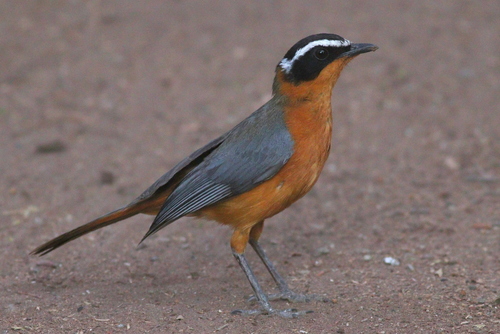
Black-lored Babbler

Black-lored Babbler

Turdoides sharpei

Silhouette: Sheatherius · PhyloPic

LCLeast ConcernNTVUENCR
Daily sighting probability ~30% · Possible
at Queen Elizabeth National Park

In 3 days ~60% in a week ~90%

449 Verified sightings at Queen Elizabeth National Park From 2019 to 2026
2,629 In all 12 parks
December Best month
☀️ Diurnal When it's spotted

About the Black-lored Babbler

The black-lored babbler or Sharpe's pied-babbler (Turdoides sharpei) is a species of bird in the family Leiothrichidae. It is found in southwestern Kenya, Tanzania, Uganda, Burundi, Rwanda, and the part of the Democratic Republic of the Congo immediately adjacent to the three last-named countries. This bird was formerly considered the same species as Turdoides melanops of southern Africa, now known as the black-faced babbler.

These birds are mostly grey-brown with white mottling, especially on the underparts, that varies according to location and the individual. The population near Nanyuki, Kenya, is darker but can have a pure white chin or entire throat. The combination of pale yellow or white eyes and black lores (the areas between the eye and the bill) separates adults of this species from similar babblers except melanops, though all juvenile babblers have brown eyes.

In Kenya, single birds give repeated single or double harsh notes such as waaach or a muffled kurr-ack; pairs or groups give longer phrases in chorus. The tempo is frequently slow for a babbler. They are most vocal in the early morning and late afternoon.

Like other Turdoides, it is found low or on the ground in or near dense woody vegetation, including in cultivated areas. Kenyan birds forage in bushes and tall grass. They are "restless, noisy, and suspicious" and "typical gregarious babblers".

Single birds give repeated single or double harsh notes such as waaach or a muffled kurr-ack; pairs or groups give longer phrases in chorus. The tempo is frequently slow for a babbler. They are most vocal in the early morning and late afternoon. Wikipedia →

Sounds

Song0:28

Tanzania · 2025

© isaac kilusu · XC982342 · CC BY-NC-SA 4.0

Call0:41

Kenya · 2022

© Lars Lachmann · XC750369 · CC BY-NC-SA 4.0

Call0:11

Tanzania · 2017

© Frank Lambert · XC429974 · CC BY-NC-ND 4.0

Global Distribution

Parks Where Found

# Park Country Daily sighting probability
1 Akagera National Park 🇷🇼 Rwanda
~30%
2 Queen Elizabeth National Park 🇺🇬 Uganda
~30%
3 Serengeti National Park 🇹🇿 Tanzania
~30%
4 Ngorongoro Conservation Area 🇹🇿 Tanzania
~20%
5 Lake Mburo National Park 🇺🇬 Uganda
~10%
6 Masai Mara National Reserve 🇰🇪 Kenya
~10%
7 Lake Nakuru National Park 🇰🇪 Kenya
~10%
8 Kibale National Park 🇺🇬 Uganda
<5%
9 Ruaha National Park 🇹🇿 Tanzania
<5%
10 Virunga National Park 🇨🇩 Democratic Republic of the Congo
<5%
11 Tarangire National Park 🇹🇿 Tanzania
<5%
12 Bwindi Impenetrable National Park 🇺🇬 Uganda
<5%

Cities Where Found

# City Country Daily sighting probability
1 Kigali 🇷🇼 Rwanda
~30%
2 Kampala 🇺🇬 Uganda
<5%

Before you go

What are the chances of seeing a Black-lored Babbler in Queen Elizabeth National Park?

Possible

About 30% of wildlife watchers report a Black-lored Babbler sighting in Queen Elizabeth National Park on a given day, based on 449 verified sightings from GBIF citizen-science data from 2019 to 2026. It is the 69th most-seen of the 434 birds we can rate there. Over three days the chance rises to about 60%, and over a week to about 90%, if each day is a fresh chance.

When is the best time to see a Black-lored Babbler in Queen Elizabeth National Park?

November and December

In those months about 40% of wildlife watchers report a Black-lored Babbler in Queen Elizabeth National Park on a given day, against about 10% in April and October, the lowest months.

What time of day is best to see a Black-lored Babbler?

Between 7 and 10 am

Across all the parks we cover, that three-hour window holds the most Black-lored Babbler sightings with a recorded time, and about 9 in 10 of them come between 6 am and 6 pm: it is a daytime animal.

Is Queen Elizabeth National Park the best place to see a Black-lored Babbler?

Among the best

Of the 12 parks where we can rate Black-lored Babbler sightings, Queen Elizabeth National Park ranks 2nd at about 30%, level with the leaders once rounded. The best odds are in Akagera National Park (Rwanda, about 30%).

Where does the Black-lored Babbler sighting chance come from?

GBIF citizen-science records

It is estimated from how often the Black-lored Babbler is recorded against all the birds logged in Queen Elizabeth National Park (449 verified sightings from 2019 to 2026), calibrated against known sighting rates. Figures are rounded to the nearest 10% because citizen-science data supports honest approximations, not decimals, and months with records from fewer than five people show "—". How it works.

← Back to Queen Elizabeth National Park