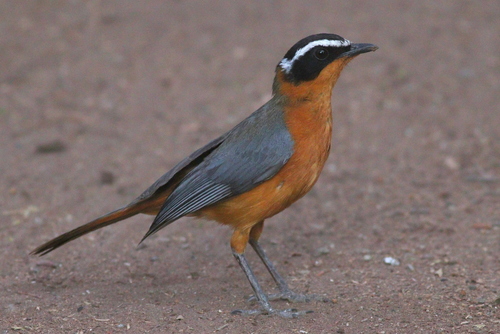
Arrow-marked Babbler

Arrow-marked Babbler

Turdoides jardineii

Silhouette: Sheatherius · PhyloPic

LCLeast ConcernNTVUENCR
Daily sighting probability ~20% · Possible
at Queen Elizabeth National Park

In 3 days ~50% in a week ~80%

359 Verified sightings at Queen Elizabeth National Park From 2019 to 2026
8,606 In all 30 parks
July Best month
☀️ Diurnal When it's spotted

About the Arrow-marked Babbler

The arrow-marked babbler (Turdoides jardineii) is a species of bird in the family Leiothrichidae. It is native to woodlands in the southern Afrotropics. It is found in Angola, Botswana, Burundi, Republic of the Congo, DRC, Eswatini, Gabon, Kenya, Malawi, Mozambique, Namibia, Rwanda, South Africa, Tanzania, Uganda, Zambia, and Zimbabwe.

Its natural habitats are subtropical or tropical dry forest, dry savanna, and subtropical or tropical moist shrubland. The arrow-marked babbler is a medium-sized babbler, 22 to 25 cm (8.7–9.8 in) in length and weighing 56 to 85 g (2.0–3.0 oz). The common name for the species is derived from its plumage, which is brownish-grey above and lighter below, with white tips to the feathers on the throat, neck and head. The outer iris is bright red and the inner bright yellow or orange. Males and females are identical in appearance. Juveniles have brown eyes and less arrow-shaped streaking on the breast.

The arrow-marked babbler lives in social groups of between 3 and 15 birds (six being the average) that defend large territories, with the size of the territory being dependent upon the number of... Wikipedia →

Sounds

Song0:28

Zimbabwe · 2024

© Dries Van de Loock · XC963023 · CC BY-NC-ND 4.0

Call0:08

South Africa · 2024

© Nick Talbot · XC949229 · CC BY-NC-SA 4.0

Begging call0:56

Kenya · 2023

© isaac kilusu · XC819164 · CC BY-NC-SA 4.0

Global Distribution

Parks Where Found

# Park Country Daily sighting probability
1 Gonarezhou National Park 🇿🇼 Zimbabwe
~60%
2 Hwange National Park 🇿🇼 Zimbabwe
~40%
3 Kruger National Park 🇿🇦 South Africa
~40%
4 Mana Pools National Park 🇿🇼 Zimbabwe
~40%
5 Pilanesberg National Park 🇿🇦 South Africa
~40%
6 Lower Zambezi National Park 🇿🇲 Zambia
~40%
7 Ruaha National Park 🇹🇿 Tanzania
~40%
8 Moremi Game Reserve 🇧🇼 Botswana
~30%
9 Chobe National Park 🇧🇼 Botswana
~30%
10 Queen Elizabeth National Park 🇺🇬 Uganda
~20%
11 Lake Nakuru National Park 🇰🇪 Kenya
~20%
12 Akagera National Park 🇷🇼 Rwanda
~20%
13 Lake Mburo National Park 🇺🇬 Uganda
~20%
14 Tarangire National Park 🇹🇿 Tanzania
~20%
15 South Luangwa National Park 🇿🇲 Zambia
~20%
16 Gorongosa National Park 🇲🇿 Mozambique
~20%
17 Masai Mara National Reserve 🇰🇪 Kenya
~20%
18 Liwonde National Park 🇲🇼 Malawi
~20%
19 Virunga National Park 🇨🇩 Democratic Republic of the Congo
~10%
20 Kafue National Park 🇿🇲 Zambia
~10%
21 Mikumi National Park 🇹🇿 Tanzania
~10%
22 Serengeti National Park 🇹🇿 Tanzania
~10%
23 Lake Manyara National Park 🇹🇿 Tanzania
~10%
24 Ngorongoro Conservation Area 🇹🇿 Tanzania
~10%
25 Kibale National Park 🇺🇬 Uganda
~10%
26 uMkhuze Game Reserve 🇿🇦 South Africa
<5%
27 Bwindi Impenetrable National Park 🇺🇬 Uganda
<5%
28 Hluhluwe-Imfolozi Park 🇿🇦 South Africa
<5%
29 Arusha National Park 🇹🇿 Tanzania
<5%
30 Murchison Falls National Park 🇺🇬 Uganda
<5%

Cities Where Found

# City Country Daily sighting probability
1 Harare 🇿🇼 Zimbabwe
~70%
2 Pretoria 🇿🇦 South Africa
~20%
3 Kigali 🇷🇼 Rwanda
~10%
4 Johannesburg 🇿🇦 South Africa
<5%

Before you go

What are the chances of seeing an Arrow-marked Babbler in Queen Elizabeth National Park?

Possible

About 20% of wildlife watchers report an Arrow-marked Babbler sighting in Queen Elizabeth National Park on a given day, based on 359 verified sightings from GBIF citizen-science data from 2019 to 2026. It is the 82nd most-seen of the 434 birds we can rate there. Over three days the chance rises to about 50%, and over a week to about 80%, if each day is a fresh chance.

When is the best time to see an Arrow-marked Babbler in Queen Elizabeth National Park?

July

In that month about 40% of wildlife watchers report an Arrow-marked Babbler in Queen Elizabeth National Park on a given day, against about 10% in April and August, the lowest months. That is one of Queen Elizabeth National Park's driest months, with about 25 mm of rain against 150 mm in April.

What time of day is best to see an Arrow-marked Babbler?

Between 8 and 11 am

Across all the parks we cover, that three-hour window holds the most Arrow-marked Babbler sightings with a recorded time, and about 9 in 10 of them come between 6 am and 6 pm: it is a daytime animal.

Where does the Arrow-marked Babbler sighting chance come from?

GBIF citizen-science records

It is estimated from how often the Arrow-marked Babbler is recorded against all the birds logged in Queen Elizabeth National Park (359 verified sightings from 2019 to 2026), calibrated against known sighting rates. Figures are rounded to the nearest 10% because citizen-science data supports honest approximations, not decimals, and months with records from fewer than five people show "—". How it works.

← Back to Queen Elizabeth National Park