Northern Double-collared Sunbird

Northern Double-collared Sunbird

Cinnyris reichenowi

Silhouette: Sheatherius · PhyloPic

LCLeast ConcernNTVUENCR
Daily sighting probability <5% · Rare
at Queen Elizabeth National Park

In 3 days <5%

6 Verified sightings at Queen Elizabeth National Park From 2019 to 2026
2,442 In all 8 parks
April Best month
☀️ Diurnal When it's spotted

About the Northern Double-collared Sunbird

The northern double-collared sunbird (Cinnyris reichenowi), is a species of bird in the family Nectariniidae. It is found in Burundi, Cameroon, Central African Republic, Democratic Republic of the Congo, Equatorial Guinea, Kenya, Nigeria, Rwanda, South Sudan, and Uganda.

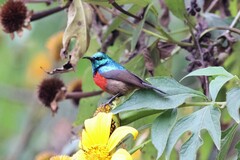
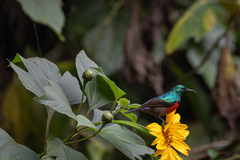
The northern double-collared sunbird is a medium-sized species. The adult male's head and back is a metallic green that has a steely-blue sheen in some lights. The rump is greyish-brown, the uppertail coverts metallic purple and the tail black, glossed blue. The main flight feathers are dark brown. There is a narrow purple collar beneath the metallic green throat, above a scarlet breast and pale brown belly. There are pale yellow pectoral tufts that are not always visible. The eye is black or dark brown, and the beak and legs are black. The adult female is more drab with upper parts dark olive green and a dark brown tail. The underparts are greyish-olive, the belly being tinged with yellow. The juvenile is similar to the adult female.

The northern double-collared sunbird Cinnyris reichenowi is part of a large complex of 'double-collared sunbirds' of the genus Cinnyris found throughout... Wikipedia →

Sounds

Call0:19

Uganda · 2022

© Peter Boesman · XC739539 · CC BY-NC-ND 4.0

Song1:04

Burundi · 2025

© Bram Piot · XC973655 · CC BY-NC-SA 4.0

Call0:19

Kenya · 2017

© James Bradley · XC505816 · CC BY-NC-SA 4.0

Global Distribution

Parks Where Found

# Park Country Daily sighting probability
1 Bwindi Impenetrable National Park 🇺🇬 Uganda
~60%
2 Nyungwe National Park 🇷🇼 Rwanda
~30%
3 Aberdare National Park 🇰🇪 Kenya
~20%
4 Volcanoes National Park 🇷🇼 Rwanda
~20%
5 Virunga National Park 🇨🇩 Democratic Republic of the Congo
~10%
6 Nairobi National Park 🇰🇪 Kenya
~10%
7 Kibale National Park 🇺🇬 Uganda
<5%
8 Queen Elizabeth National Park 🇺🇬 Uganda
<5%

Cities Where Found

# City Country Daily sighting probability
1 Yaoundé 🇨🇲 Cameroon
~20%
2 Nairobi 🇰🇪 Kenya
~10%

Before you go

What are the chances of seeing a Northern Double-collared Sunbird in Queen Elizabeth National Park?

Rare

Under 5% of wildlife watchers report a Northern Double-collared Sunbird sighting in Queen Elizabeth National Park on a given day, based on 6 verified sightings from GBIF citizen-science data from 2019 to 2026. It is the 395th most-seen of the 434 birds we can rate there. Over three days the chance rises to under 5%, if each day is a fresh chance.

When is the best time to see a Northern Double-collared Sunbird in Queen Elizabeth National Park?

Any time of year

In every month with enough records, under 5% of wildlife watchers report a Northern Double-collared Sunbird in Queen Elizabeth National Park on a given day, so our monthly data shows no clear season.

What time of day is best to see a Northern Double-collared Sunbird?

Between 3 and 6 pm

Across all the parks we cover, that three-hour window holds the most Northern Double-collared Sunbird sightings with a recorded time, and about 8 in 10 of them come between 6 am and 6 pm: it is a daytime animal.

Which relatives of the Northern Double-collared Sunbird live in Queen Elizabeth National Park?

Same genus: Cinnyris

The closest relatives of the Northern Double-collared Sunbird that you can see in Queen Elizabeth National Park (genus Cinnyris, Cinnyris Sunbirds) are Red-chested Sunbird (about 30%), Copper Sunbird (about 20%) and Mariqua Sunbird (about 10%), with each one's daily chance of a sighting.

Where does the Northern Double-collared Sunbird sighting chance come from?

GBIF citizen-science records

It is estimated from how often the Northern Double-collared Sunbird is recorded against all the birds logged in Queen Elizabeth National Park (6 verified sightings from 2019 to 2026), calibrated against known sighting rates. Figures are rounded to the nearest 10% because citizen-science data supports honest approximations, not decimals, and months with records from fewer than five people show "—". How it works.

← Back to Queen Elizabeth National Park