Black-capped Lory

Black-capped Lory

Lorius lory

Silhouette: Farelli (photo), John E. McCormack, Michael G. Harvey, Brant C. Faircloth, Nicholas G. Crawford, Travis C. Glenn, Robb T. Brumfield & T. Michael Keesey · PhyloPic

LCLeast ConcernNTVUENCR
Daily sighting probability ~20% · Possible
at Raja Ampat

In 3 days ~50% in a week ~80%

13 Verified sightings at Raja Ampat From 2019 to 2026
13 In 1 park
June Best month
☀️ Diurnal When it's spotted

About the Black-capped Lory

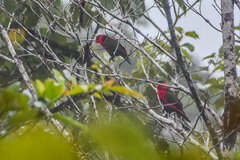
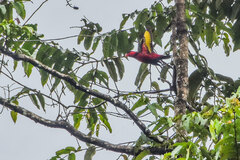
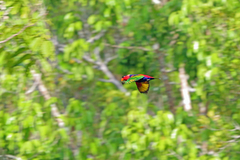
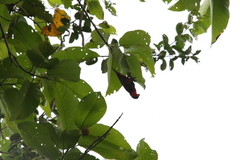
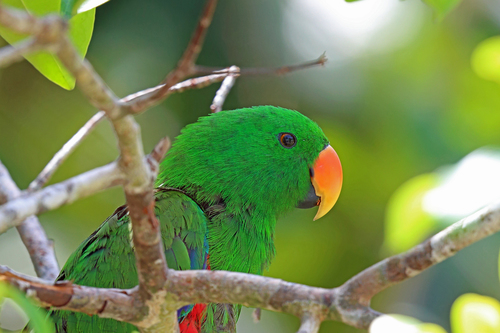
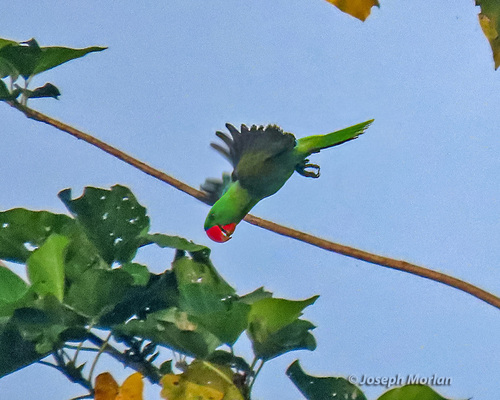
The black-capped lory (Lorius lory) also known as western black-capped lory or the tricolored lory, is a parrot found in New Guinea and adjacent smaller islands. It is a colourful and relatively robust lory (31 cm (12 in)). There are seven subspecies, all with green wings, red heads and body around the wing, a black cap, grey-black cere, yellow underwings, and blue legs and belly. Most also have a blue nape and mantle (area between wings on the back). It remains overall widespread and common, but the subspecies cyanuchen is relatively rare, with fewer than 5,000 individuals remaining.

The black-capped lory was formally described by the Swedish naturalist Carl Linnaeus in 1758 in the tenth edition of his Systema Naturae under the binomial name Psittacus lory. Linnaeus based his description of "The first Black Capped Lory" that had been described and illustrated in 1751 by the English naturalist George Edwards in his A Natural History of Uncommon Birds. The name lory is from the Malay word for these brightly coloured parrots. The black-capped lory is now placed in the genus Lorius that was introduced in 1825 by the Irish zoologist Nicholas Aylward Vigors. Wikipedia →

Sounds

Flight call0:10

Indonesia · 2026

© Ding Li Yong · XC1165915 · CC BY-NC-ND 4.0

Song0:54

Indonesia · 2019

© Marc Anderson · XC499609 · CC BY-NC-ND 4.0

Call0:17

Papua New Guinea · 2009

© Frank Lambert · XC38251 · CC BY-NC-ND 4.0

Global Distribution

Parks Where Found

# Park Country Daily sighting probability
1 Raja Ampat 🇮🇩 Indonesia
~20%

More parks will be added in future updates.

Zoos & Centres Where Found

# Zoo / Centre Country
1 Ostrava Zoo 🇨🇿 Czechia In captivity
2 Taman Safari Indonesia 🇮🇩 Indonesia In captivity
3 Košice Zoo 🇸🇰 Slovakia In captivity
4 Oklahoma City Zoo and Botanical Garden 🇺🇸 United States In captivity
5 Berlin Zoological Garden 🇩🇪 Germany In captivity
6 Indianapolis Zoo 🇺🇸 United States In captivity
7 Singapore Zoo 🇸🇬 Singapore In captivity
8 Dudley Zoo 🇬🇧 United Kingdom In captivity
9 Philadelphia Zoo 🇺🇸 United States In captivity
10 Bandung Zoo 🇮🇩 Indonesia In captivity
11 Bird Paradise 🇸🇬 Singapore In captivity
12 Rainforest Wild Asia 🇸🇬 Singapore In captivity
13 Loro Parque 🇪🇸 Spain In captivity
14 Adelaide Zoo 🇦🇺 Australia In captivity
15 North Carolina Aquarium at Fort Fisher 🇺🇸 United States In captivity
16 Hong Kong Zoological and Botanical Gardens 🇨🇳 China In captivity
17 Palmitos Park 🇪🇸 Spain In captivity
18 Birdland Park and Gardens 🇬🇧 United Kingdom In captivity
19 El Nispero Zoo 🇵🇦 Panama In captivity
20 Featherdale Sydney Wildlife Park 🇦🇺 Australia In captivity
21 Bali Bird Park 🇮🇩 Indonesia In captivity
22 Cebu Ocean Park 🇵🇭 Philippines In captivity
23 Maritime Aquarium at Norwalk 🇺🇸 United States In captivity
24 Cairns Aquarium 🇦🇺 Australia In captivity
25 Edward Youde Aviary 🇭🇰 Hong Kong SAR China In captivity
26 Aquarium Berlin 🇩🇪 Germany In captivity
27 Birdworld Kuranda 🇦🇺 Australia In captivity
28 Kuranda Koala Gardens 🇦🇺 Australia In captivity
29 The Green Planet 🇦🇪 United Arab Emirates In captivity

Before you go

What are the chances of seeing a Black-capped Lory in Raja Ampat?

Possible

About 20% of wildlife watchers report a Black-capped Lory sighting in Raja Ampat on a given day, based on 13 verified sightings from GBIF citizen-science data from 2019 to 2026. It is the 55th most-seen of the 200 birds we can rate there. Over three days the chance rises to about 50%, and over a week to about 80%, if each day is a fresh chance.

When is the best time to see a Black-capped Lory in Raja Ampat?

June

In that month about 50% of wildlife watchers report a Black-capped Lory in Raja Ampat on a given day, against under 5% in February, April, July, September and December, the lowest months.

What time of day is best to see a Black-capped Lory?

Between 8 and 11 am

Across all the parks we cover, that three-hour window holds the most Black-capped Lory sightings with a recorded time, and about 8 in 10 of them come between 6 am and 6 pm: it is a daytime animal.

Where else can you see a Black-capped Lory?

Only Raja Ampat, in our data

Raja Ampat is the only park on Wallace's Line with enough records to rate Black-capped Lory sightings: about 20% of wildlife watchers there report one on a given day.

Which relatives of the Black-capped Lory live in Raja Ampat?

Same family: Psittacidae

The closest relatives of the Black-capped Lory that you can see in Raja Ampat (family Psittacidae, New World and African Parrots) are Red-sided Eclectus (about 70%), Red-cheeked Parrot (about 50%) and Palm Cockatoo (about 50%), with each one's daily chance of a sighting.

Where does the Black-capped Lory sighting chance come from?

GBIF citizen-science records

It is estimated from how often the Black-capped Lory is recorded against all the birds logged in Raja Ampat (13 verified sightings from 2019 to 2026), calibrated against known sighting rates. Figures are rounded to the nearest 10% because citizen-science data supports honest approximations, not decimals, and months with records from fewer than five people show "—". How it works.

← Back to Raja Ampat