Great-billed Parrot

Great-billed Parrot

Tanygnathus megalorynchos

Silhouette: Farelli (photo), John E. McCormack, Michael G. Harvey, Brant C. Faircloth, Nicholas G. Crawford, Travis C. Glenn, Robb T. Brumfield & T. Michael Keesey · PhyloPic

LCLeast ConcernNTVUENCR
Daily sighting probability ~10% · With luck
at Raja Ampat

In 3 days ~30% in a week ~60%

10 Verified sightings at Raja Ampat From 2019 to 2026
10 In 1 park
October Best month
☀️ Diurnal When it's spotted

About the Great-billed Parrot

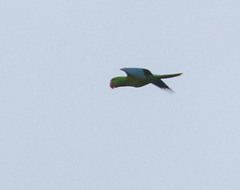
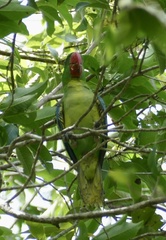
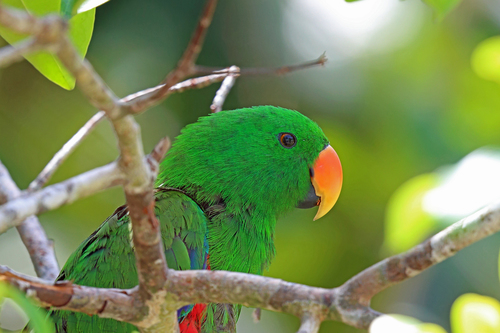
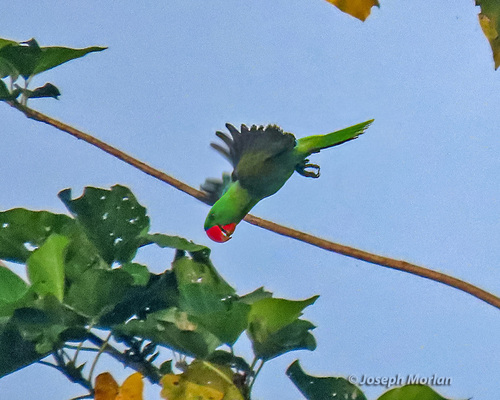
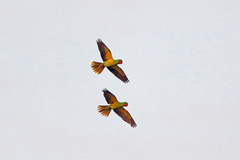
The great-billed parrot (Tanygnathus megalorynchos) also known as Moluccan parrot or island parrot, is a medium-sized, approximately 38 cm long, green parrot with a massive red bill, cream iris, blackish shoulders, olive green back, pale blue rump and yellowish green underparts. The female is typically smaller than the male, but otherwise the sexes are similar.

The great-billed parrot is found in forest, woodland and mangrove in the south-east Asian islands of Maluku, Raja Ampat, Talaud, Sangir, Sarangani, the Lesser Sundas, and nearby small islands. The diet consists mainly of fruits.

It remains widespread and locally fairly common, and consequently has been rated as least concern on the IUCN Red List of Threatened Species. The great-billed parrot was described by the French polymath Georges-Louis Leclerc, Comte de Buffon in 1780 in his Histoire Naturelle des Oiseaux from a specimen collected in New Guinea. The bird was also illustrated in a hand-coloured plate engraved by François-Nicolas Martinet in the Planches Enluminées D'Histoire Naturelle which was produced under the supervision of Edme-Louis Daubenton to accompany Buffon's text. Neither the plate caption nor... Wikipedia →
Global Distribution

Parks Where Found

# Park Country Daily sighting probability
1 Raja Ampat 🇮🇩 Indonesia
~10%

More parks will be added in future updates.

Zoos & Centres Where Found

# Zoo / Centre Country
1 Loro Parque 🇪🇸 Spain In captivity
2 Dubai Crocodile Park 🇦🇪 United Arab Emirates In captivity

Before you go

What are the chances of seeing a Great-billed Parrot in Raja Ampat?

With luck

About 10% of wildlife watchers report a Great-billed Parrot sighting in Raja Ampat on a given day, based on 10 verified sightings from GBIF citizen-science data from 2019 to 2026. It is the 84th most-seen of the 200 birds we can rate there. Over three days the chance rises to about 30%, and over a week to about 60%, if each day is a fresh chance.

When is the best time to see a Great-billed Parrot in Raja Ampat?

October

In that month about 30% of wildlife watchers report a Great-billed Parrot in Raja Ampat on a given day, against under 5% in February, May–September and November–December, the lowest months.

What time of day is best to see a Great-billed Parrot?

Between 3 and 6 pm

Across all the parks we cover, that three-hour window holds the most Great-billed Parrot sightings with a recorded time, and about 8 in 10 of them come between 6 am and 6 pm: it is a daytime animal.

Where else can you see a Great-billed Parrot?

Only Raja Ampat, in our data

Raja Ampat is the only park on Wallace's Line with enough records to rate Great-billed Parrot sightings: about 10% of wildlife watchers there report one on a given day.

Which relatives of the Great-billed Parrot live in Raja Ampat?

Same family: Psittacidae

The closest relatives of the Great-billed Parrot that you can see in Raja Ampat (family Psittacidae, New World and African Parrots) are Red-sided Eclectus (about 70%), Red-cheeked Parrot (about 50%) and Palm Cockatoo (about 50%), with each one's daily chance of a sighting.

Where does the Great-billed Parrot sighting chance come from?

GBIF citizen-science records

It is estimated from how often the Great-billed Parrot is recorded against all the birds logged in Raja Ampat (10 verified sightings from 2019 to 2026), calibrated against known sighting rates. Figures are rounded to the nearest 10% because citizen-science data supports honest approximations, not decimals, and months with records from fewer than five people show "—". How it works.

← Back to Raja Ampat