Dusky Scrubfowl

Dusky Scrubfowl

Megapodius freycinet

Silhouette: Rachel T Mason · PhyloPic

LCLeast ConcernNTVUENCR
Daily sighting probability ~40% · Likely
at Raja Ampat

In 3 days ~80% in a week >90%

477 Verified sightings at Raja Ampat From 2019 to 2026
477 In 1 park
November Best month
🌅 Crepuscular When it's spotted

About the Dusky Scrubfowl

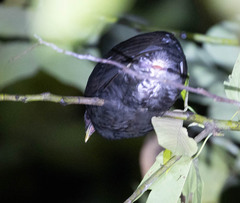
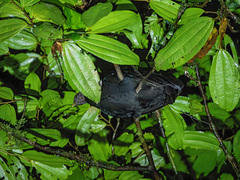
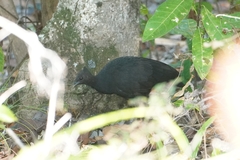
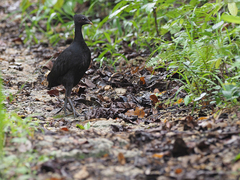
The dusky megapode (Megapodius freycinet), also known as dusky scrubfowl or common megapode, is a medium-sized, approximately 41 cm (16 in) long, blackish bird with a short pointed crest, bare red facial skin, dark legs, brown irises, and a dark brown and yellow bill. The male and female are similar. This terrestrial species lives in forests and swamps, including mangroves, of the Maluku and Raja Ampat Islands in Indonesia. Like other megapodes, it lays its eggs in a mound made from earth mixed with leaves, sand, gravel, and sticks, which can be as large as 11 m (36 ft) in diameter and stand nearly 5 m (16 ft) tall.

Many authorities include the Biak scrubfowl as a subspecies of this species, but the two are increasingly treated as separate species. At the same time, many authorities consider the taxon M. forsteni a separate species, Forsten's megapode, but measurements and molecular evidence suggest the two are very close, and arguably better considered conspecific. Traditionally, most members of the genus Megapodius have been listed as subspecies of M. freycinet, but today, all major authorities consider this to be incorrect.

The specific name commemorates the French explorer Louis Claude Desaulses de Freycinet. A fairly common species throughout a large part of its range, the dusky scrubfowl is evaluated as least concern on the IUCN Red List of Threatened Species. Wikipedia →

Sounds

Call1:11

Indonesia · 2026

© Ding Li Yong · XC1164991 · CC BY-NC-ND 4.0

Song1:11

Indonesia · 2025

© Kelle Moreau · XC1059986 · CC BY-NC-SA 4.0

Call1:28

Indonesia · 2022

© Barry Edmonston · XC820476 · CC BY-NC-SA 4.0

Global Distribution

Parks Where Found

# Park Country Daily sighting probability
1 Raja Ampat 🇮🇩 Indonesia
~40%

More parks will be added in future updates.

Before you go

What are the chances of seeing a Dusky Scrubfowl in Raja Ampat?

Likely

About 40% of wildlife watchers report a Dusky Scrubfowl sighting in Raja Ampat on a given day, based on 477 verified sightings from GBIF citizen-science data from 2019 to 2026. It is the 25th most-seen of the 200 birds we can rate there. Over three days the chance rises to about 80%, and over a week to over 90%, if each day is a fresh chance.

When is the best time to see a Dusky Scrubfowl in Raja Ampat?

October and November

In those months about 50% of wildlife watchers report a Dusky Scrubfowl in Raja Ampat on a given day, against about 30% in April, June–September and December–January, the lowest months.

What time of day is best to see a Dusky Scrubfowl?

Between 6 and 9 am

Across all the parks we cover, that three-hour window holds the most Dusky Scrubfowl sightings with a recorded time, and about half of them come between 6 am and 6 pm: it is most active around dawn and dusk.

Where else can you see a Dusky Scrubfowl?

Only Raja Ampat, in our data

Raja Ampat is the only park on Wallace's Line with enough records to rate Dusky Scrubfowl sightings: about 40% of wildlife watchers there report one on a given day.

Where does the Dusky Scrubfowl sighting chance come from?

GBIF citizen-science records

It is estimated from how often the Dusky Scrubfowl is recorded against all the birds logged in Raja Ampat (477 verified sightings from 2019 to 2026), calibrated against known sighting rates. Figures are rounded to the nearest 10% because citizen-science data supports honest approximations, not decimals, and months with records from fewer than five people show "—". How it works.

← Back to Raja Ampat