Papuan Hornbill

Papuan Hornbill

Rhyticeros plicatus

Silhouette: Charles J. Sharp and T. Michael Keesey · PhyloPic

LCLeast ConcernNTVUENCR
Daily sighting probability ~60% · Likely
at Raja Ampat

In 3 days ~90% in a week >90%

983 Verified sightings at Raja Ampat From 2019 to 2026
983 In 1 park
August Best month
☀️ Diurnal When it's spotted

About the Papuan Hornbill

Blyth's hornbill (Rhyticeros plicatus), also known as the Papuan hornbill, is a large hornbill inhabiting the forest canopy in Wallacea and Melanesia. Its local name in Tok Pisin is kokomo. Previously, this hornbill was placed in the genus Aceros. It has often been lumped with the plain-pouched hornbill (R. subruficollis), and sometimes considered to include the Narcondam hornbill (R. narcondami) and the wreathed hornbill (R. undulatus) as subspecies.

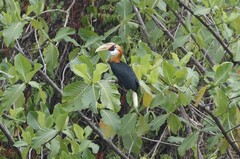
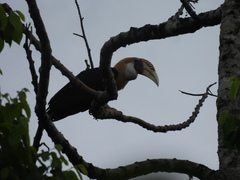
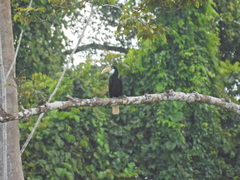
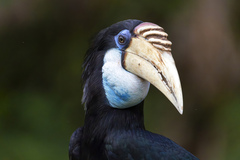
The common name commemorates Edward Blyth (1810–1873), English zoologist and curator of the museum of the Asiatic Society of Bengal. Up to 91 cm (36 in) in length, the adult male has mainly black plumage with a golden or orange-buff head, white throat and a white tail. Its irises are reddish brown, and the eye is surrounded by naked pale blue skin. The female is a smaller, mainly black bird with a white throat and tail. Both sexes have a very large horn-coloured bill and casque. Young birds of both sexes resemble the male. Adults have up to eight folds on the pale casque, depending on age, while young birds have none.

In flight, the sound of its wings is loud and distinctive, a rushing noise that has been compared to... Wikipedia →

Sounds

Call0:25

Indonesia · 2026

© Ding Li Yong · XC1166572 · CC BY-NC-ND 4.0

Wing noise0:18

Solomon Islands · 2026

© Marc Anderson · XC1146374 · CC BY-NC-ND 4.0

Wing sounds0:21

Indonesia · 2025

© Richard E. Webster · XC1074512 · CC BY-NC-SA 4.0

Global Distribution

Parks Where Found

# Park Country Daily sighting probability
1 Raja Ampat 🇮🇩 Indonesia
~60%

More parks will be added in future updates.

Zoos & Centres Where Found

# Zoo / Centre Country
1 San Diego Zoo 🇺🇸 United States In captivity
2 Moscow Zoo 🇷🇺 Russia In captivity
3 Pairi Daiza 🇧🇪 Belgium In captivity
4 Parc des oiseaux 🇫🇷 France In captivity
5 Hellabrunn Zoo 🇩🇪 Germany In captivity
6 Kyiv Zoo 🇺🇦 Ukraine In captivity
7 Fonghuanggu Bird and Ecology Park 🇹🇼 Taiwan In captivity
8 Lisbon Zoo 🇵🇹 Portugal In captivity
9 JOJOZOO PARK 🇹🇼 Taiwan In captivity
10 Singapore Zoo 🇸🇬 Singapore In captivity
11 Łódź Zoo 🇵🇱 Poland In captivity
12 Bird Paradise 🇸🇬 Singapore In captivity
13 Plock Zoo 🇵🇱 Poland In captivity
14 Rainforest Wild Asia 🇸🇬 Singapore In captivity
15 Birdworld 🇬🇧 United Kingdom In captivity
16 Vogelpark Avifauna 🇳🇱 Netherlands In captivity
17 Paphos Zoo 🇨🇾 Cyprus In captivity
18 Jardin zoologique tropical 🇫🇷 France In captivity
19 Zoo Lagos 🇵🇹 Portugal In captivity
20 BestZoo 🇳🇱 Netherlands In captivity
21 Bioparc Fuengirola 🇪🇸 Spain In captivity
22 Davao Crocodile Park & Zoo 🇵🇭 Philippines In captivity
23 Sea World Indonesia 🇮🇩 Indonesia In captivity
24 Dallas World Aquarium 🇺🇸 United States In captivity
25 Mondo Verde, Landgraaf 🇳🇱 Netherlands In captivity
26 Port Moresby Nature Park 🇵🇬 Papua New Guinea In captivity
27 Snakeroom Serpentarium 🇪🇸 Spain In captivity
28 Tierpark Schlichtweg 15 in München 🇩🇪 Germany In captivity
29 Zoo Schlichtweg 11 in München 🇩🇪 Germany In captivity
30 Zoo Siebenbrunner Straße 6 in München 🇩🇪 Germany In captivity

Before you go

What are the chances of seeing a Papuan Hornbill in Raja Ampat?

Likely

About 60% of wildlife watchers report a Papuan Hornbill sighting in Raja Ampat on a given day, based on 983 verified sightings from GBIF citizen-science data from 2019 to 2026. It is the 4th most-seen of the 200 birds we can rate there. Over three days the chance rises to about 90%, and over a week to over 90%, if each day is a fresh chance.

When is the best time to see a Papuan Hornbill in Raja Ampat?

August

In that month about 70% of wildlife watchers report a Papuan Hornbill in Raja Ampat on a given day, against about 50% in February–March, September and December, the lowest months.

What time of day is best to see a Papuan Hornbill?

Between 8 and 11 am

Across all the parks we cover, that three-hour window holds the most Papuan Hornbill sightings with a recorded time, and about 7 in 10 of them come between 6 am and 6 pm: it is a daytime animal.

Where else can you see a Papuan Hornbill?

Only Raja Ampat, in our data

Raja Ampat is the only park on Wallace's Line with enough records to rate Papuan Hornbill sightings: about 60% of wildlife watchers there report one on a given day.

Where does the Papuan Hornbill sighting chance come from?

GBIF citizen-science records

It is estimated from how often the Papuan Hornbill is recorded against all the birds logged in Raja Ampat (983 verified sightings from 2019 to 2026), calibrated against known sighting rates. Figures are rounded to the nearest 10% because citizen-science data supports honest approximations, not decimals, and months with records from fewer than five people show "—". How it works.

← Back to Raja Ampat