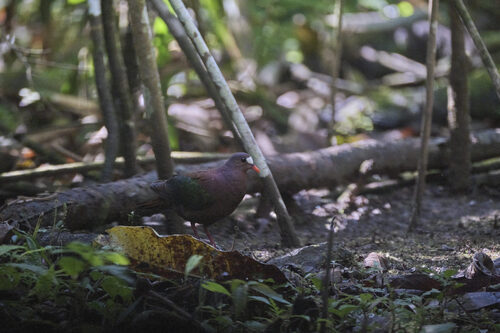
Elegant Imperial-Pigeon

Elegant Imperial-Pigeon

Ducula concinna

Silhouette: Sheatherius · PhyloPic

LCLeast ConcernNTVUENCR Endemic
Daily sighting probability <5% · Rare
at Raja Ampat

In 3 days <5%

7 Verified sightings at Raja Ampat From 2019 to 2026
7 In 1 park
November Best month
☀️ Diurnal When it's spotted

About the Elegant Imperial-Pigeon

The elegant imperial pigeon (Ducula concinna), also known as blue-tailed imperial-pigeon, is a large pigeon, with upperparts mainly dark blue-green in colour with an iridescent sheen. Head, neck and underparts are mostly pale grey, with red-brown undertail coverts.

The elegant imperial pigeon was originally described as Carpophaga concinna by Alfred Russel Wallace in 1865 based on specimens from the Watubela Islands. The elegant imperial pigeon is a large pigeon, measuring 43 cm (17 in) in length. The head, neck, and upper back are pale grey, with a pink tinge on the nape and back of the crown. The rest of the upperparts are shimmering dark green, while the top of the tail is purplish-blue, sometimes appearing black. The underparts are pale grey with a pink tinge, while the undertail coverts are reddish-brown. The undersides of the tail and wing are black. The bill is black or bluish-grey, with a ring of white feathers at its base, the iris is golden, and the feet are pinkish-red to crimson. Both sexes are similar, but females have darker grey and pink colours. Juveniles are duller than adults.

The elegant imperial... Wikipedia →

Sounds

Call0:27

Indonesia · 2017

© Ross Gallardy · XC417493 · CC BY-NC-SA 4.0

Song0:11

Indonesia · 2013

© Frank Lambert · XC153449 · CC BY-NC-ND 4.0

Call1:04

Indonesia · 2001

© Colin Trainor · XC66884 · CC BY-NC-ND 2.5

Global Distribution

Parks Where Found

# Park Country Daily sighting probability
1 Raja Ampat 🇮🇩 Indonesia
<5%

More parks will be added in future updates.

Zoos & Centres Where Found

# Zoo / Centre Country
1 Bird Paradise 🇸🇬 Singapore In captivity
2 Rainforest Wild Asia 🇸🇬 Singapore In captivity

Before you go

What are the chances of seeing an Elegant Imperial-Pigeon in Raja Ampat?

Rare

Under 5% of wildlife watchers report an Elegant Imperial-Pigeon sighting in Raja Ampat on a given day, based on 7 verified sightings from GBIF citizen-science data from 2019 to 2026. It is the 191st most-seen of the 200 birds we can rate there. Over three days the chance rises to under 5%, if each day is a fresh chance.

When is the best time to see an Elegant Imperial-Pigeon in Raja Ampat?

Any time of year

In every month with enough records, under 5% of wildlife watchers report an Elegant Imperial-Pigeon in Raja Ampat on a given day, so our monthly data shows no clear season.

What time of day is best to see an Elegant Imperial-Pigeon?

Between 4 and 7 pm

Across all the parks we cover, that three-hour window holds the most Elegant Imperial-Pigeon sightings with a recorded time, and about 9 in 10 of them come between 6 am and 6 pm: it is a daytime animal.

Where else can you see an Elegant Imperial-Pigeon?

Only Raja Ampat, in our data

Raja Ampat is the only park on Wallace's Line with enough records to rate Elegant Imperial-Pigeon sightings: under 5% of wildlife watchers there report one on a given day.

Which relatives of the Elegant Imperial-Pigeon live in Raja Ampat?

Same genus: Ducula

The closest relatives of the Elegant Imperial-Pigeon that you can see in Raja Ampat (genus Ducula, Imperial Pigeons) are Pinon Imperial-Pigeon (about 60%), Spice Imperial-Pigeon (about 40%) and Pied Imperial Pigeon (about 30%), with each one's daily chance of a sighting.

Where does the Elegant Imperial-Pigeon sighting chance come from?

GBIF citizen-science records

It is estimated from how often the Elegant Imperial-Pigeon is recorded against all the birds logged in Raja Ampat (7 verified sightings from 2019 to 2026), calibrated against known sighting rates. Figures are rounded to the nearest 10% because citizen-science data supports honest approximations, not decimals, and months with records from fewer than five people show "—". How it works.

← Back to Raja Ampat