New Guinea ground boa

New Guinea ground boa

Candoia aspera

Silhouette: Alex Slavenko · PhyloPic

LCLeast ConcernNTVUENCR
Daily sighting probability ~20% · Possible
at Raja Ampat

In 3 days ~50% in a week ~80%

13 Verified sightings at Raja Ampat From 2019 to 2026
13 In 1 park
August Best month
☀️🌙 Day & Night When it's spotted

About the New Guinea ground boa

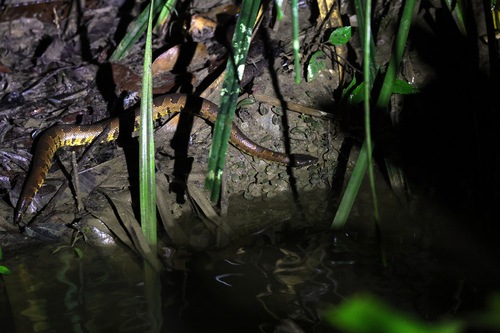
Candoia aspera, known commonly as the Papuan ground boa, New Guinea ground boa, or viper boa, is a species of snake in the family Boidae. As its common name suggests, it is found in New Guinea (in the Papua province of Indonesia and in Papua New Guinea). It is a terrestrial species, living in the undergrowth. It is smaller than some other members of the Boidae family. The Papuan ground boa grows to 2 to 3 feet (0.61 to 0.91 m) in length. It is known to be primarily nocturnal. The Papuan ground boa is known to be slightly more defensive than other Candoia species. In recent years, it has become increasingly scarce in the pet industry due to restrictions on import/export trading. Though it was more common in the past, there is still very little known about it, in particular its behaviour in the wild; for example, its lifespan is still undetermined. It got the nickname viper boa from its appearance. It looks extremely similar to the elapid species Acanthophis laevis, more commonly known as the "Papuan death adder." The Papuan death adder itself only resembles a viper, but is actually an elapid. However, because of the resemblance to the highly venomous Papuan death adder, many Papuan ground boas are killed out of fear, although the latter is harmless. Wikipedia →
Global Distribution

Parks Where Found

# Park Country Daily sighting probability
1 Raja Ampat 🇮🇩 Indonesia
~20%

More parks will be added in future updates.

Zoos & Centres Where Found

# Zoo / Centre Country
1 Yaroslavl Zoo 🇷🇺 Russia In captivity
2 Gembira Loka Zoo 🇮🇩 Indonesia In captivity

Before you go

What are the chances of seeing a New Guinea ground boa in Raja Ampat?

Possible

About 20% of wildlife watchers report a New Guinea ground boa sighting in Raja Ampat on a given day, based on 13 verified sightings from GBIF citizen-science data from 2019 to 2026. It is the 21st most-seen of the 33 reptiles we can rate there. Over three days the chance rises to about 50%, and over a week to about 80%, if each day is a fresh chance.

When is the best time to see a New Guinea ground boa in Raja Ampat?

August

In that month about 40% of wildlife watchers report a New Guinea ground boa in Raja Ampat on a given day, against under 5% in February, May–June, October and December, the lowest months.

What time of day is best to see a New Guinea ground boa?

Between 10 am and 1 pm

Across all the parks we cover, that three-hour window holds the most New Guinea ground boa sightings with a recorded time, and about 6 in 10 of them come between 6 am and 6 pm: it is seen both by day and at night.

Where else can you see a New Guinea ground boa?

Only Raja Ampat, in our data

Raja Ampat is the only park on Wallace's Line with enough records to rate New Guinea ground boa sightings: about 20% of wildlife watchers there report one on a given day.

Where does the New Guinea ground boa sighting chance come from?

GBIF citizen-science records

It is estimated from how often the New Guinea ground boa is recorded against all the reptiles logged in Raja Ampat (13 verified sightings from 2019 to 2026), calibrated against known sighting rates. Figures are rounded to the nearest 10% because citizen-science data supports honest approximations, not decimals, and months with records from fewer than five people show "—". How it works.

← Back to Raja Ampat
