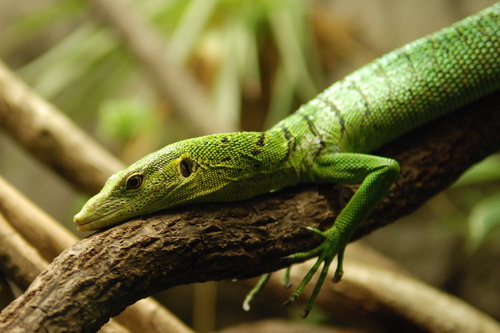
Blue-spotted Tree Monitor

Blue-spotted Tree Monitor

Varanus macraei

Silhouette: Steven Traver · PhyloPic

LCNTVUENEndangeredCR
Daily sighting probability ~30% · Possible
at Raja Ampat

In 3 days ~70% in a week ~90%

39 Verified sightings at Raja Ampat From 2019 to 2026
39 In 1 park
November Best month
☀️ Diurnal When it's spotted

About the Blue-spotted Tree Monitor

Varanus macraei, also known commonly as the blue-spotted tree monitor and the blue tree monitor, is a species of monitor lizard endemic to the island of Batanta in Indonesia. The species is named after herpetologist Duncan Malcolm MacRae.

The distribution of Varanus macraei is restricted to the island of Batanta, on the northwestern tip of the Vogelkop peninsula of Irian Jaya of Indonesia. Like the other members of the prasinus-group, it is a tree climber, with a prehensile tail. This may be the smallest distribution of any tree monitor, as this island has a size of only 450 km2, comparable with Lake Constance of Central Europe.

The blue-spotted tree monitor inhabits tropical forests that average 28–38 °C (83–100 °F). In the dry season the humidity is around 65%, but it spikes to 100% in the wet season. Reports of a large blue arboreal lizard on Batanta, an island off the northwestern tip of the Bird's Head Peninsula of West Papua, reached Duncan MacRae, founder of the reptile park "Rimba" on Bali, in 2000. MacRae travelled to Sorong and continued by boat to Batanta, where local residents confirmed their familiarity with the animal... Wikipedia →

Global Distribution

Parks Where Found

# Park Country Daily sighting probability
1 Raja Ampat 🇮🇩 Indonesia
~30%

More parks will be added in future updates.

Zoos & Centres Where Found

# Zoo / Centre Country
1 San Diego Zoo 🇺🇸 United States In captivity
2 Tierpark Berlin 🇩🇪 Germany In captivity
3 Cincinnati Zoo and Botanical Garden 🇺🇸 United States In captivity
4 Aquarium of Genoa 🇮🇹 Italy In captivity
5 Cabarceno Natural Park 🇪🇸 Spain In captivity
6 Ostrava Zoo 🇨🇿 Czechia In captivity
7 Jihlava Zoo 🇨🇿 Czechia In captivity
8 Bronx Zoo 🇺🇸 United States In captivity
9 Cheyenne Mountain Zoo 🇺🇸 United States In captivity
10 Cotswold Wildlife Park 🇬🇧 United Kingdom In captivity
11 Out of Africa Wildlife Park 🇺🇸 United States In captivity
12 Bear Country USA 🇺🇸 United States In captivity
13 Woodland Park Zoo 🇺🇸 United States In captivity
14 Bristol Zoo Project 🇬🇧 United Kingdom In captivity
15 Virginia Zoological Park 🇺🇸 United States In captivity
16 Zoo Opole 🇵🇱 Poland In captivity
17 Langenberg Wildlife Park 🇨🇭 Switzerland In captivity
18 Riverbanks Zoo 🇺🇸 United States In captivity
19 Biotropica 🇫🇷 France In captivity
20 Touroparc Zoo 🇫🇷 France In captivity
21 Sacramento Zoo 🇺🇸 United States In captivity
22 Zoo de Córdoba 🇪🇸 Spain In captivity
23 Cherkasy Zoo 🇺🇦 Ukraine In captivity
24 Bioparc Fuengirola 🇪🇸 Spain In captivity
25 Davao Crocodile Park & Zoo 🇵🇭 Philippines In captivity
26 Johor Zoo 🇲🇾 Malaysia In captivity
27 Aquarium River of Zaragoza 🇪🇸 Spain In captivity
28 Naturum Öresund 🇸🇪 Sweden In captivity
29 Aquarium and Natural History Museum in Kraków 🇵🇱 Poland In captivity
30 Kung Fu Corals 🇺🇸 United States In captivity
31 Sea Life London Aquarium 🇬🇧 United Kingdom In captivity
32 Snakeroom Serpentarium 🇪🇸 Spain In captivity
33 Zooparque Itatiba 🇧🇷 Brazil In captivity

Before you go

What are the chances of seeing a Blue-spotted Tree Monitor in Raja Ampat?

Possible

About 30% of wildlife watchers report a Blue-spotted Tree Monitor sighting in Raja Ampat on a given day, based on 39 verified sightings from GBIF citizen-science data from 2019 to 2026. It is the 12th most-seen of the 33 reptiles we can rate there. Over three days the chance rises to about 70%, and over a week to about 90%, if each day is a fresh chance.

When is the best time to see a Blue-spotted Tree Monitor in Raja Ampat?

July, September and November

In those months about 40% of wildlife watchers report a Blue-spotted Tree Monitor in Raja Ampat on a given day, against under 5% in February, June and December, the lowest months.

What time of day is best to see a Blue-spotted Tree Monitor?

Between 11 am and 2 pm

Across all the parks we cover, that three-hour window holds the most Blue-spotted Tree Monitor sightings with a recorded time, and about 9 in 10 of them come between 6 am and 6 pm: it is a daytime animal.

Where else can you see a Blue-spotted Tree Monitor?

Only Raja Ampat, in our data

Raja Ampat is the only park on Wallace's Line with enough records to rate Blue-spotted Tree Monitor sightings: about 30% of wildlife watchers there report one on a given day.

Which relatives of the Blue-spotted Tree Monitor live in Raja Ampat?

Same genus: Varanus

The closest relatives of the Blue-spotted Tree Monitor that you can see in Raja Ampat (genus Varanus, Monitor Lizards) are Mangrove Monitor (about 50%), Peach-throated Monitor (about 20%) and Emerald Monitor (about 20%), with each one's daily chance of a sighting.

Where does the Blue-spotted Tree Monitor sighting chance come from?

GBIF citizen-science records

It is estimated from how often the Blue-spotted Tree Monitor is recorded against all the reptiles logged in Raja Ampat (39 verified sightings from 2019 to 2026), calibrated against known sighting rates. Figures are rounded to the nearest 10% because citizen-science data supports honest approximations, not decimals, and months with records from fewer than five people show "—". How it works.

← Back to Raja Ampat