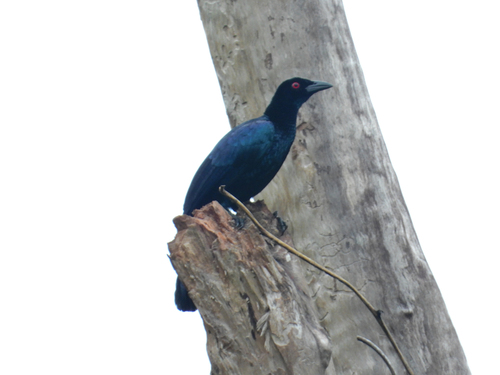
Singing Starling

Singing Starling

Aplonis cantoroides

Silhouette: Rafael Maia · PhyloPic

LCLeast ConcernNTVUENCR
Daily sighting probability ~20% · Possible
at Raja Ampat

In 3 days ~60% in a week ~90%

354 Verified sightings at Raja Ampat From 2019 to 2026
354 In 1 park
August Best month
🌅 Crepuscular When it's spotted

About the Singing Starling

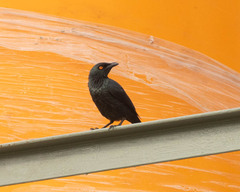
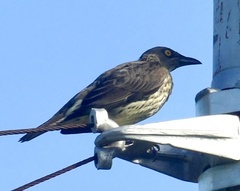
The singing starling (Aplonis cantoroides) is a medium-sized (20 cm in length) starling. Adult singing starlings have glossy black plumage and bright red irises. Immature birds are paler, with streaked underparts and brown irises. They are distinguished from metallic starlings by shorter, square tails and thicker bills.

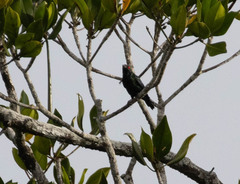
Singing starlings are found in New Guinea and some adjacent islands, the Bismarck Archipelago, Admiralty Islands and Solomon Islands. They have been recorded from Boigu and Saibai Islands, Queensland, Australian territory in north-western Torres Strait. They inhabit forest edges, gardens and cultivated areas with trees, urban areas and coconut groves.

They eat figs and other soft fruits, and sometimes insects. They nest in tree-hollows, cliffs and buildings, often colonially, laying 2-3 pale blue eggs. The call is a repeated, high-pitched, down-slurred whistle. As a species with a large range and no evidence of population decline, it is assessed as being of Least Concern.

Beehler, Bruce M.; & Finch, Brian W. (1985). Species Checklist... Wikipedia →

Sounds

Call0:46

Indonesia · 2026

© Ding Li Yong · XC1166497 · CC BY-NC-ND 4.0

C.100 individuals in a tree chattering0:45

Papua New Guinea · 2024

© Jan-Uwe Schmidt · XC911648 · CC BY-NC-SA 4.0

Song0:48

Papua New Guinea · 2019

© Iain Woxvold · XC543520 · CC BY-NC-SA 4.0

Global Distribution

Parks Where Found

# Park Country Daily sighting probability
1 Raja Ampat 🇮🇩 Indonesia
~20%

More parks will be added in future updates.

Before you go

What are the chances of seeing a Singing Starling in Raja Ampat?

Possible

About 20% of wildlife watchers report a Singing Starling sighting in Raja Ampat on a given day, based on 354 verified sightings from GBIF citizen-science data from 2019 to 2026. It is the 51st most-seen of the 200 birds we can rate there. Over three days the chance rises to about 60%, and over a week to about 90%, if each day is a fresh chance.

When is the best time to see a Singing Starling in Raja Ampat?

August

In that month about 50% of wildlife watchers report a Singing Starling in Raja Ampat on a given day, against about 10% in April and November, the lowest months.

What time of day is best to see a Singing Starling?

Between midnight and 3 am

Across all the parks we cover, that three-hour window holds the most Singing Starling sightings with a recorded time, and about 6 in 10 of them come between 6 pm and 6 am: it is most active around dawn and dusk.

Where else can you see a Singing Starling?

Only Raja Ampat, in our data

Raja Ampat is the only park on Wallace's Line with enough records to rate Singing Starling sightings: about 20% of wildlife watchers there report one on a given day.

Which relatives of the Singing Starling live in Raja Ampat?

Same genus: Aplonis

The closest relatives of the Singing Starling that you can see in Raja Ampat (genus Aplonis, Pacific Starlings) are Moluccan Starling (about 10%) and Metallic Starling (about 10%), with each one's daily chance of a sighting.

Where does the Singing Starling sighting chance come from?

GBIF citizen-science records

It is estimated from how often the Singing Starling is recorded against all the birds logged in Raja Ampat (354 verified sightings from 2019 to 2026), calibrated against known sighting rates. Figures are rounded to the nearest 10% because citizen-science data supports honest approximations, not decimals, and months with records from fewer than five people show "—". How it works.

← Back to Raja Ampat