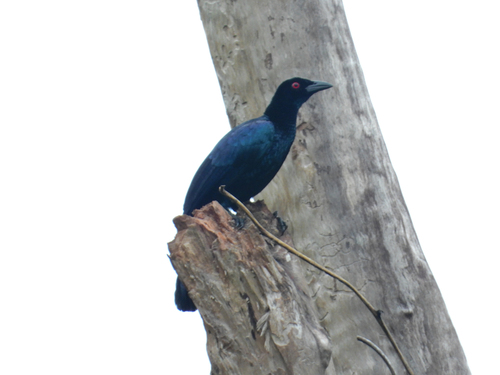
Metallic Starling

Metallic Starling

Aplonis metallica

Silhouette: Rafael Maia · PhyloPic

LCLeast ConcernNTVUENCR
Daily sighting probability ~10% · With luck
at Raja Ampat

In 3 days ~30% in a week ~60%

131 Verified sightings at Raja Ampat From 2019 to 2026
1,281 In all 2 parks
October Best month
🌅 Crepuscular When it's spotted

About the Metallic Starling

The metallic starling (Aplonis metallica), also known as the shining starling, is a bird in the starling family native to the Moluccas, New Guinea, Queensland and the Solomon Islands. The metallic starling was formally described and illustrated as Lamprotornis metallicus in 1824 by the Dutch zoologist Coenraad Jacob Temminck. He mistakenly specified the locality as Timor and Celebres but this has been corrected to the island of Ambon in the Maluku Islands of Indonesia. The metallic starling is now one of 24 starlings placed in the genus Aplonis that was introduced in 1836 by the English ornithologist John Gould.

Five subspecies are recognised: Wikipedia →

Sounds

Call0:25

Australia · 2025

© Étienne Leroy · XC1074074 · CC BY-NC-SA 4.0

Uncertain0:25

Australia · 2022

© nick talbot · XC753224 · CC BY-NC-SA 4.0

Song0:07

Australia · 2020

© Marc Anderson · XC529168 · CC BY-NC-ND 4.0

Global Distribution

Parks Where Found

# Park Country Daily sighting probability
1 Daintree National Park 🇦🇺 Australia
~50%
2 Raja Ampat 🇮🇩 Indonesia
~10%

Zoos & Centres Where Found

# Zoo / Centre Country
1 Disney's Animal Kingdom 🇺🇸 United States In captivity
2 San Diego Zoo 🇺🇸 United States In captivity
3 Abilene Zoological Gardens 🇺🇸 United States In captivity
4 Zoo Miami 🇺🇸 United States In captivity
5 San Diego Zoo Safari Park 🇺🇸 United States In captivity
6 Columbus Zoo and Aquarium 🇺🇸 United States In captivity
7 Phoenix Zoo 🇺🇸 United States In captivity
8 ZooTampa 🇺🇸 United States In captivity
9 Taronga Zoo 🇦🇺 Australia In captivity
10 Philadelphia Zoo 🇺🇸 United States In captivity
11 Bird Paradise 🇸🇬 Singapore In captivity
12 El Paso Zoo 🇺🇸 United States In captivity
13 Rainforest Wild Asia 🇸🇬 Singapore In captivity
14 The Abilene Zoo 🇺🇸 United States In captivity
15 Featherdale Sydney Wildlife Park 🇦🇺 Australia In captivity
16 Tracy Aviary 🇺🇸 United States In captivity

Before you go

What are the chances of seeing a Metallic Starling in Raja Ampat?

With luck

About 10% of wildlife watchers report a Metallic Starling sighting in Raja Ampat on a given day, based on 131 verified sightings from GBIF citizen-science data from 2019 to 2026. It is the 91st most-seen of the 200 birds we can rate there. Over three days the chance rises to about 30%, and over a week to about 60%, if each day is a fresh chance.

When is the best time to see a Metallic Starling in Raja Ampat?

October

In that month about 30% of wildlife watchers report a Metallic Starling in Raja Ampat on a given day, against under 5% in March–May and July, the lowest months.

What time of day is best to see a Metallic Starling?

Between 3 and 6 am

Across all the parks we cover, that three-hour window holds the most Metallic Starling sightings with a recorded time, and about 7 in 10 of them come between 6 pm and 6 am: it is most active around dawn and dusk.

Is Raja Ampat the best place to see a Metallic Starling?

2nd of 2

Of the 2 parks where we can rate Metallic Starling sightings, Raja Ampat ranks 2nd at about 10%. The best odds are in Daintree National Park (Australia, about 50%).

Which relatives of the Metallic Starling live in Raja Ampat?

Same genus: Aplonis

The closest relatives of the Metallic Starling that you can see in Raja Ampat (genus Aplonis, Pacific Starlings) are Singing Starling (about 20%) and Moluccan Starling (about 10%), with each one's daily chance of a sighting.

Where does the Metallic Starling sighting chance come from?

GBIF citizen-science records

It is estimated from how often the Metallic Starling is recorded against all the birds logged in Raja Ampat (131 verified sightings from 2019 to 2026), calibrated against known sighting rates. Figures are rounded to the nearest 10% because citizen-science data supports honest approximations, not decimals, and months with records from fewer than five people show "—". How it works.

← Back to Raja Ampat