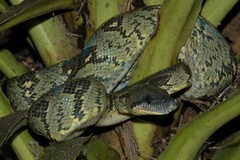
Madagascar tree boa

Madagascar tree boa

Sanzinia madagascariensis

Silhouette: Alex Slavenko · PhyloPic

LCLeast ConcernNTVUENCR Endemic
Daily sighting probability ~50% · Likely
at Ranomafana National Park

In 3 days ~90% in a week >90%

35 Verified sightings at Ranomafana National Park From 2019 to 2026
66 In all 2 parks
March Best month
☀️ Diurnal When it's spotted

About the Madagascar tree boa

Sanzinia madagascariensis, also known as the Madagascar tree boa or Malagasy tree boa, is a boa species endemic to the island of Madagascar. It was once considered conspecific with the Nosy Komba ground boa (Sanzinia volontany). Like all other boas, it is non-venomous.

Adults average 4–5 feet (122–152 cm) in length, although 6–7 foot (183–213 cm) specimens are not uncommon. Thermoreceptive pits are located between the labial scales. Females are larger than males. It is greenish in colour and is found on the eastern side of Madagascar.

Endemic to Madagascar. The type locality given is "Madagascar". Favors trees and shrubs near streams, rivers, ponds and swamps. This species was classified as Vulnerable (VU) on the IUCN Red List of Threatened Species in 2006 with the following criteria: A1cd (v2.3, 1994). This means that a population reduction of at least 20% has been observed, estimated, inferred or suspected over the last 10 years or three generations, whichever is the longer, based on a decline in area of occupancy, extent of occurrence and/or quality of habitat, and based on actual or potential levels of exploitation... Wikipedia →

Global Distribution

Parks Where Found

# Park Country Daily sighting probability
1 Ranomafana National Park 🇲🇬 Madagascar
~50%
2 Mantadia National Park 🇲🇬 Madagascar
~50%

Zoos & Centres Where Found

# Zoo / Centre Country
1 San Diego Zoo 🇺🇸 United States In captivity
2 Moscow Zoo 🇷🇺 Russia In captivity
3 ZooParc de Beauval 🇫🇷 France In captivity
4 Barcelona Zoo 🇪🇸 Spain In captivity
5 Paris Zoological Park 🇫🇷 France In captivity
6 Zoologic park de Lille 🇫🇷 France In captivity
7 Abilene Zoological Gardens 🇺🇸 United States In captivity
8 Aquarium du palais de la Porte Dorée 🇫🇷 France In captivity
9 San Diego Zoo Safari Park 🇺🇸 United States In captivity
10 Bronx Zoo 🇺🇸 United States In captivity
11 Marwell Zoo 🇬🇧 United Kingdom In captivity
12 Oklahoma City Zoo and Botanical Garden 🇺🇸 United States In captivity
13 Colchester Zoo 🇬🇧 United Kingdom In captivity
14 Wrocław Zoological Garden 🇵🇱 Poland In captivity
15 Calgary Zoo 🇨🇦 Canada In captivity
16 Fort Worth Zoo 🇺🇸 United States In captivity
17 Zoo Knoxville 🇺🇸 United States In captivity
18 Lisbon Zoo 🇵🇹 Portugal In captivity
19 Botanical and Zoological Garden of Tsimbazaza 🇲🇬 Madagascar In captivity
20 Philadelphia Zoo 🇺🇸 United States In captivity
21 Mesker Park Zoo and Botanic Garden 🇺🇸 United States In captivity
22 Łódź Zoo 🇵🇱 Poland In captivity
23 Aquarama Barcelona 🇪🇸 Spain In captivity
24 bioparco 🇮🇹 Italy In captivity
25 Valencia Bioparc 🇪🇸 Spain In captivity
26 Paphos Zoo 🇨🇾 Cyprus In captivity
27 The Abilene Zoo 🇺🇸 United States In captivity
28 Touroparc Zoo 🇫🇷 France In captivity
29 Reptile Gardens 🇺🇸 United States In captivity
30 Sacramento Zoo 🇺🇸 United States In captivity
31 Greenville Zoo 🇺🇸 United States In captivity
32 World of Birds Wildlife Sanctuary and Monkey Park 🇿🇦 South Africa In captivity
33 Mandraka Reptile Farm 🇲🇬 Madagascar In captivity
34 Florida Aquarium 🇺🇸 United States In captivity
35 Africarium 🇵🇱 Poland In captivity
36 Bristol Zoo 🇬🇧 United Kingdom In captivity
37 Snakeroom Serpentarium 🇪🇸 Spain In captivity
38 terrarium ogrodu zoologicznego we Wrocławiu 🇵🇱 Poland In captivity

Closest Relatives at Ranomafana National Park

No species of the same family or order lives in Ranomafana National Park, so these are its closest relatives here: other reptiles.

Before you go

What are the chances of seeing a Madagascar tree boa in Ranomafana National Park?

Likely

About 50% of wildlife watchers report a Madagascar tree boa sighting in Ranomafana National Park on a given day, based on 35 verified sightings from GBIF citizen-science data from 2019 to 2026. It is the 9th most-seen of the 29 reptiles we can rate there. Over three days the chance rises to about 90%, and over a week to over 90%, if each day is a fresh chance.

When is the best time to see a Madagascar tree boa in Ranomafana National Park?

March

In that month about 80% of wildlife watchers report a Madagascar tree boa in Ranomafana National Park on a given day, against under 5% in May and August, the lowest months. That is one of Ranomafana National Park's wettest months, with about 380 mm of rain against 80 mm in September.

What time of day is best to see a Madagascar tree boa?

Between 9 am and noon

Across all the parks we cover, that three-hour window holds the most Madagascar tree boa sightings with a recorded time, and about 7 in 10 of them come between 6 am and 6 pm: it is a daytime animal.

Is Ranomafana National Park the best place to see a Madagascar tree boa?

Yes

Of the 2 parks where we can rate Madagascar tree boa sightings, Ranomafana National Park has the highest daily chance: about 50%. Next come Mantadia National Park (Madagascar, about 50%).

Where does the Madagascar tree boa sighting chance come from?

GBIF citizen-science records

It is estimated from how often the Madagascar tree boa is recorded against all the reptiles logged in Ranomafana National Park (35 verified sightings from 2019 to 2026), calibrated against known sighting rates. Figures are rounded to the nearest 10% because citizen-science data supports honest approximations, not decimals, and months with records from fewer than five people show "—". How it works.

← Back to Ranomafana National Park