Gharial

Gharial

Gavialis gangeticus

Silhouette: Jagged Fang Designs · PhyloPic

LCNTVUENCRCritically Endangered
Daily sighting probability ~30% · Possible
at Ranthambore National Park

In 3 days ~70% in a week ~90%

35 Verified sightings at Ranthambore National Park From 2019 to 2026
261 In all 4 parks
June Best month
🌅 Crepuscular When it's spotted

About the Gharial

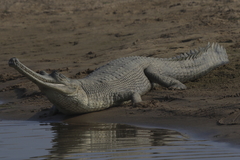
The gharial (Gavialis gangeticus), also known as gavial or fish-eating crocodile, is a crocodilian in the family Gavialidae and among the longest of all living crocodilians. Mature females are 2.6 to 4.5 m (8.5 to 14.8 ft) long, and males 3 to 6 m (9.8 to 19.7 ft). Adult males have a distinct boss at the end of the snout, which resembles an earthenware pot known as a ghara, hence the name "gharial". The gharial is well adapted to catching fish because of its long, narrow snout and 110 sharp, interlocking teeth.

The gharial probably evolved in the northern Indian subcontinent. Fossil gharial remains were excavated in Pliocene deposits in the Sivalik Hills and the Narmada River valley. It currently inhabits rivers in the plains of the northern part of the Indian subcontinent. It is the most thoroughly aquatic crocodilian, and leaves the water only for basking and building nests on moist sandbanks. Adults mate at the end of the cold season. Females congregate in spring to dig nests, in which they lay 20–95 eggs. They guard the nests and the young, which hatch before the onset of the monsoon. The hatchlings stay and forage in shallow water during their first year, but move to sites with deeper water as they grow.

The wild gharial population has declined drastically since the 1930s and is limited to only 2% of its historical range today. Conservation programmes initiated in India and Nepal focused on reintroducing captive-bred gharials since the early 1980s. Loss of habitat because of sand mining and conversion to agriculture, depletion of fish resources and detrimental fishing methods continue to threaten the population. It has been listed as critically endangered on the IUCN Red List since 2007.

The oldest known depictions of the gharial are about 4,000 years old and were found in the Indus Valley. Hindus regard it as the vehicle of the river deity Gaṅgā. Local people living near rivers attributed mystical and healing powers to the gharial, and used some of its body parts as ingredients of indigenous medicine. Wikipedia →

Global Distribution

Parks Where Found

# Park Country Daily sighting probability
1 Chitwan National Park 🇳🇵 Nepal
~80%
2 Royal Bardia National Park 🇳🇵 Nepal
~40%
3 Jim Corbett National Park 🇮🇳 India
~30%
4 Ranthambore National Park 🇮🇳 India
~30%

Zoos & Centres Where Found

# Zoo / Centre Country
1 Busch Gardens Tampa 🇺🇸 United States In captivity
2 San Diego Zoo 🇺🇸 United States In captivity
3 Pairi Daiza 🇧🇪 Belgium In captivity
4 výzkumný chov jelenů 🇨🇿 Czechia In captivity
5 Nandankanan Zoological Park 🇮🇳 India In captivity
6 Sri Venkateswara Zoological Park 🇮🇳 India In captivity
7 San Diego Zoo Safari Park 🇺🇸 United States In captivity
8 Assam State Zoo cum Botanical Garden 🇮🇳 India In captivity
9 Nehru Zoological Park 🇮🇳 India In captivity
10 Bronx Zoo 🇺🇸 United States In captivity
11 Bratislava Zoo 🇸🇰 Slovakia In captivity
12 National Zoological Park Delhi 🇮🇳 India In captivity
13 Los Angeles Zoo 🇺🇸 United States In captivity
14 Rajiv Gandhi Zoological Park 🇮🇳 India In captivity
15 Sanjay Gandhi Biological Park 🇮🇳 India In captivity
16 Bannerghatta Zoo 🇮🇳 India In captivity
17 ZooTampa 🇺🇸 United States In captivity
18 Fort Worth Zoo 🇺🇸 United States In captivity
19 Kamla Nehru Prani Sangrahalay 🇮🇳 India In captivity
20 Nahargarh Zoological Park 🇮🇳 India In captivity
21 Honolulu Zoo 🇺🇸 United States In captivity
22 Thiruvananthapuram Zoo 🇮🇳 India In captivity
23 Children's Park, Guindy 🇮🇳 India In captivity
24 Sayaji Baug Zoo 🇮🇳 India In captivity
25 Biotropica 🇫🇷 France In captivity
26 La Ferme aux crocodiles 🇫🇷 France In captivity
27 Kathmandu Zoo 🇳🇵 Nepal In captivity
28 Bhiwani Zoo 🇮🇳 India In captivity
29 Crocodile Bank 🇮🇳 India In captivity
30 Phillips Park Zoo 🇺🇸 United States In captivity
31 St. Augustine Alligator Farm Zoological Park 🇺🇸 United States In captivity
32 Johor Zoo 🇲🇾 Malaysia In captivity
33 St. Augustine Aquarium 🇺🇸 United States In captivity
34 Waikiki Aquarium 🇺🇸 United States In captivity
35 Divoká zahrada Hostivař 🇨🇿 Czechia In captivity
36 Tiergarten Teltow 🇩🇪 Germany In captivity
37 Zoopark Milíčov 🇨🇿 Czechia In captivity
38 Erlebniswelt Tier und Natur 🇩🇪 Germany In captivity
39 Thrissur Zoo 🇮🇳 India In captivity
40 Glen Echo Park Aquarium 🇺🇸 United States In captivity
41 Rákosův pavilon 🇨🇿 Czechia In captivity
42 Indraloka Animal Sanctuary 🇺🇸 United States In captivity
43 Kung Fu Corals 🇺🇸 United States In captivity
44 Mořský svět 🇨🇿 Czechia In captivity
45 Nawab Wajid Ali Shah Prani Udyan 🇮🇳 India In captivity
46 Primarily Primates Inc. 🇺🇸 United States In captivity
47 Punggol Zoo 🇸🇬 Singapore In captivity
48 Rohtak Zoo 🇮🇳 India In captivity
49 Selig Zoo 🇺🇸 United States In captivity
50 Svět medúz 🇨🇿 Czechia In captivity

Before you go

What are the chances of seeing a Gharial in Ranthambore National Park?

Possible

About 30% of wildlife watchers report a Gharial sighting in Ranthambore National Park on a given day, based on 35 verified sightings from GBIF citizen-science data from 2019 to 2026. It is the 4th most-seen of the 7 reptiles we can rate there. Over three days the chance rises to about 70%, and over a week to about 90%, if each day is a fresh chance.

When is the best time to see a Gharial in Ranthambore National Park?

June

In that month about 50% of wildlife watchers report a Gharial in Ranthambore National Park on a given day, against under 5% in March, July and October, the lowest months.

What time of day is best to see a Gharial?

Between 10 am and 1 pm

Across all the parks we cover, that three-hour window holds the most Gharial sightings with a recorded time, and about 7 in 10 of them come between 6 am and 6 pm: it is most active around dawn and dusk.

Where does the Gharial sighting chance come from?

GBIF citizen-science records

It is estimated from how often the Gharial is recorded against all the reptiles logged in Ranthambore National Park (35 verified sightings from 2019 to 2026), calibrated against known sighting rates. Figures are rounded to the nearest 10% because citizen-science data supports honest approximations, not decimals, and months with records from fewer than five people show "—". How it works.

← Back to Ranthambore National Park

