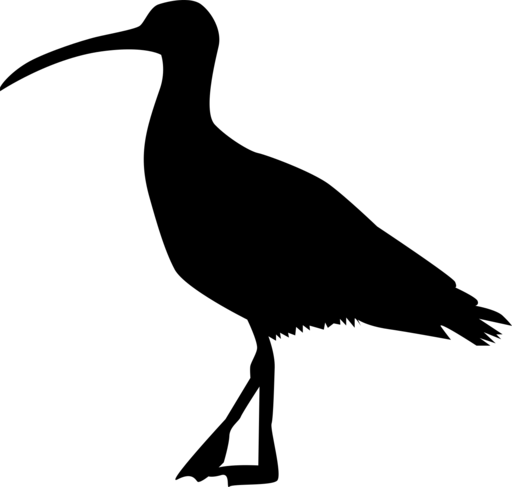
Long-billed Curlew

Long-billed Curlew

Numenius americanus

Silhouette: Rebecca Groom (based on Photo by Andreas Trepte) · PhyloPic

LCLeast ConcernNTVUENCR
Daily sighting probability <5% · Rare
at Redwood National Park

In 3 days <5%

11 Verified sightings at Redwood National Park From 2019 to 2026
2,373 In all 12 parks
April Best month
☀️ Diurnal When it's spotted

About the Long-billed Curlew

The long-billed curlew (Numenius americanus) is a large North American shorebird of the family Scolopacidae. This species was also called "sicklebird" and the "candlestick bird". The species breeds in central and western North America, migrating southward and coastward for the winter.

The long-billed curlew is the largest sandpiper of regular occurrence in North America. It is 50–65 cm (20–26 in) long, 62–90 cm (24+1⁄2–35+1⁄2 in) across the wing and weighs 490–950 g (1 lb 1+1⁄2 oz – 2 lb 1+1⁄2 oz). Its disproportionally long bill curves downward and measures 11.3–21.9 cm (4+1⁄2–8+5⁄8 in), and rivals the bill of the larger-bodied Far Eastern curlew as the longest bill of any shorebird. Individuals have a long neck and a small head. The neck and underparts are a light cinnamon in color, while the crown is streaked with brown. This species exhibits reversed sexual dimorphism, as in many sandpipers, the female being larger and having a much longer bill than the male's.

The breeding habitat is grasslands in west-central North America. The species displays an elaborate courtship dance, with fast and looping display flights also being common. A small hollow... Wikipedia →

Sounds

Call0:21

United States · 2021

© Bruce Lagerquist · XC636979 · CC BY-NC-SA 4.0

Alarm call0:05

Mexico · 2020

© Isain Contreras Rodríguez · XC572614 · CC BY-NC-SA 4.0

Song0:21

United States · 2015

© Jacob Saucier · XC500426 · CC BY-NC-SA 4.0

Global Distribution

Parks Where Found

# Park Country Daily sighting probability
1 Padre Island National Seashore 🇺🇸 United States
~60%
2 El Vizcaíno Biosphere Reserve 🇲🇽 Mexico
~40%
3 Channel Islands National Park 🇺🇸 United States
~10%
4 Ría Lagartos Biosphere Reserve 🇲🇽 Mexico
~10%
5 Grand Teton National Park 🇺🇸 United States
<5%
6 Bahía de Loreto National Park 🇲🇽 Mexico
<5%
7 Badlands National Park 🇺🇸 United States
<5%
8 Pacific Rim National Park Reserve 🇨🇦 Canada
<5%
9 Redwood National Park 🇺🇸 United States
<5%
10 Big Bend National Park 🇺🇸 United States
<5%
11 Joshua Tree National Park 🇺🇸 United States
<5%
12 Saguaro National Park 🇺🇸 United States
<5%

Cities Where Found

# City Country Daily sighting probability
1 San Diego 🇺🇸 United States
~20%
2 San Francisco 🇺🇸 United States
~10%
3 Tijuana 🇲🇽 México
~10%
4 Los Angeles 🇺🇸 United States
~10%
5 Mexico City 🇲🇽 México
<5%
6 Sacramento 🇺🇸 United States
<5%
7 Mesa 🇺🇸 United States
<5%
8 Salt Lake City 🇺🇸 United States
<5%
9 Denver 🇺🇸 United States
<5%

Zoos & Centres Where Found

# Zoo / Centre Country
1 Tracy Aviary 🇺🇸 United States In captivity
2 Seattle Aquarium 🇺🇸 United States In captivity
3 Seattle Marine Aquarium 🇺🇸 United States In captivity

Before you go

What are the chances of seeing a Long-billed Curlew in Redwood National Park?

Rare

Under 5% of wildlife watchers report a Long-billed Curlew sighting in Redwood National Park on a given day, based on 11 verified sightings from GBIF citizen-science data from 2019 to 2026. It is the 201st most-seen of the 226 birds we can rate there. Over three days the chance rises to under 5%, if each day is a fresh chance.

When is the best time to see a Long-billed Curlew in Redwood National Park?

Any time of year

In every month with enough records, under 5% of wildlife watchers report a Long-billed Curlew in Redwood National Park on a given day, so our monthly data shows no clear season.

What time of day is best to see a Long-billed Curlew?

Between 9 am and noon

Across all the parks we cover, that three-hour window holds the most Long-billed Curlew sightings with a recorded time, and about 9 in 10 of them come between 6 am and 6 pm: it is a daytime animal.

Which relatives of the Long-billed Curlew live in Redwood National Park?

Same genus: Numenius

The closest relatives of the Long-billed Curlew that you can see in Redwood National Park (genus Numenius, Curlews) are Hudsonian Whimbrel (about 10%) and Whimbrel (about 10%), with each one's daily chance of a sighting.

Where does the Long-billed Curlew sighting chance come from?

GBIF citizen-science records

It is estimated from how often the Long-billed Curlew is recorded against all the birds logged in Redwood National Park (11 verified sightings from 2019 to 2026), calibrated against known sighting rates. Figures are rounded to the nearest 10% because citizen-science data supports honest approximations, not decimals, and months with records from fewer than five people show "—". How it works.

← Back to Redwood National Park