LeConte's Sparrow

LeConte's Sparrow

Ammospiza leconteii

Silhouette: L. Shyamal · PhyloPic

LCLeast ConcernNTVUENCR
Daily sighting probability <5% · Rare
at Riding Mountain National Park

In 3 days ~10% in a week ~30%

28 Verified sightings at Riding Mountain National Park From 2019 to 2026
232 In all 5 parks
July Best month
☀️ Diurnal When it's spotted

About the LeConte's Sparrow

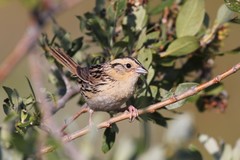
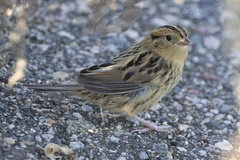
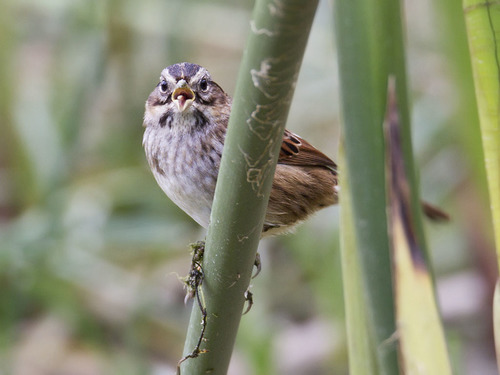
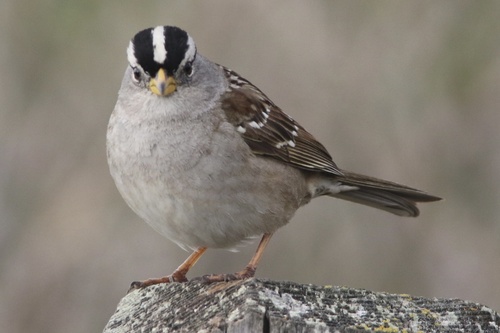
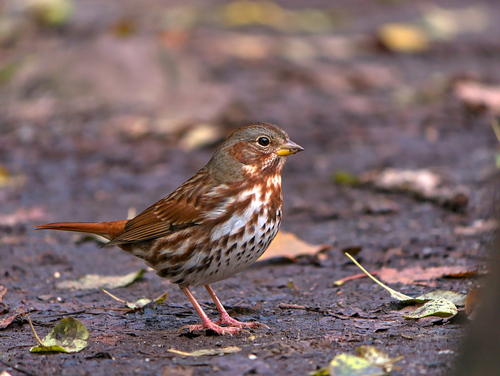
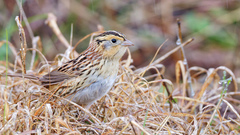
LeConte's sparrow (Ammospiza leconteii), also known as LeConte's bunting, is one of the smallest New World sparrow species in North America. LeConte's sparrow is a small sparrow with a relatively large head, short grey bill and short pointed tail. It has a buffy yellow-orange face with grey cheeks, and a dark brown crown with a white central stripe. The nape of the neck is lilac grey with chestnut streaks, and the back is streaked with brown and beige. Its belly is off white, while the breast and sides are a buffy orange-yellow with dark brown streaks. The feet and legs are a brownish-pink colour.

The measurements for both sexes are: Length: 4.7 in/ 12 cm Wingspan: 7.1 in/18 cm Weight: 0.4–0.6 oz/ 12–16 g LeConte's sparrow is commonly mistaken for other small sparrows, such as the Nelson's sparrow (Ammospiza nelsoni), grasshopper sparrow (Ammodramus savannarum), Henslow's sparrow (Centronyx henslowii), saltmarsh sparrow (Ammospiza caudacuta), and Baird's sparrow. (C. bairdii).

LeConte's sparrow is a member of the order Passerifomes, which are the perching birds, sometimes less accurately referred to as the songbirds... Wikipedia →

Sounds

Song1:15

Canada · 1992

© Peter Ward and Ken Hall · XC598435 · CC BY-NC-SA 4.0

Alarm call0:13

United States · 2019

© Matt Wistrand · XC504156 · CC BY-NC-SA 4.0

Call0:44

Canada · 2015

© Patrick Turgeon · XC296020 · CC BY-NC-SA 4.0

Global Distribution

Parks Where Found

# Park Country Daily sighting probability
1 Elk Island National Park 🇨🇦 Canada
~10%
2 Riding Mountain National Park 🇨🇦 Canada
<5%
3 Congaree National Park 🇺🇸 United States
<5%
4 Point Pelee National Park 🇨🇦 Canada
<5%
5 Great Bear Rainforest 🇨🇦 Canada
<5%

Cities Where Found

# City Country Daily sighting probability
1 Los Angeles 🇺🇸 United States
<5%
2 Philadelphia 🇺🇸 United States
<5%
3 Chicago 🇺🇸 United States
<5%
4 Minneapolis [Saint Paul] 🇺🇸 United States
<5%
5 Dallas 🇺🇸 United States
<5%
6 Edmonton 🇨🇦 Canada
<5%
7 Houston 🇺🇸 United States
<5%
8 Boston 🇺🇸 United States
<5%
9 Calgary 🇨🇦 Canada
<5%
10 Austin 🇺🇸 United States
<5%

Before you go

What are the chances of seeing a LeConte's Sparrow in Riding Mountain National Park?

Rare

Under 5% of wildlife watchers report a LeConte's Sparrow sighting in Riding Mountain National Park on a given day, based on 28 verified sightings from GBIF citizen-science data from 2019 to 2026. It is the 124th most-seen of the 181 birds we can rate there. Over three days the chance rises to about 10%, and over a week to about 30%, if each day is a fresh chance.

When is the best time to see a LeConte's Sparrow in Riding Mountain National Park?

July

In that month about 20% of wildlife watchers report a LeConte's Sparrow in Riding Mountain National Park on a given day, against under 5% in August to May, the lowest months. That is one of Riding Mountain National Park's wettest months, with about 70 mm of rain against 20 mm in February.

What time of day is best to see a LeConte's Sparrow?

Between 7 and 10 am

Across all the parks we cover, that three-hour window holds the most LeConte's Sparrow sightings with a recorded time, and about 9 in 10 of them come between 6 am and 6 pm: it is a daytime animal.

Is Riding Mountain National Park the best place to see a LeConte's Sparrow?

2nd of 5

Of the 5 parks where we can rate LeConte's Sparrow sightings, Riding Mountain National Park ranks 2nd at under 5%. The best odds are in Elk Island National Park (Canada, about 10%).

Where does the LeConte's Sparrow sighting chance come from?

GBIF citizen-science records

It is estimated from how often the LeConte's Sparrow is recorded against all the birds logged in Riding Mountain National Park (28 verified sightings from 2019 to 2026), calibrated against known sighting rates. Figures are rounded to the nearest 10% because citizen-science data supports honest approximations, not decimals, and months with records from fewer than five people show "—". How it works.

← Back to Riding Mountain National Park