


Completed
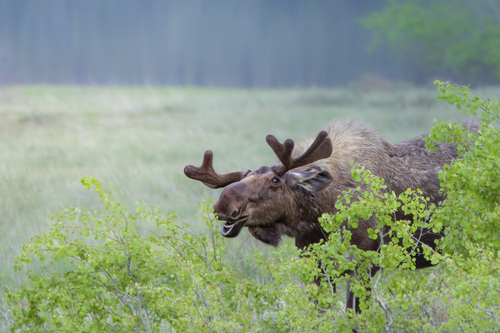
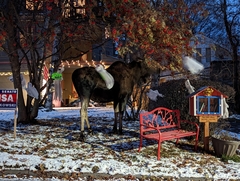
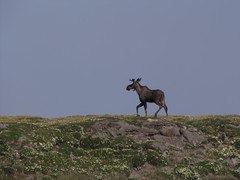


Moose
Alces americanus
Silhouette: Rebecca Collins · PhyloPic
- KingdomAnimalia (Animals)
- PhylumChordata (Chordates)
- ClassMammalia (Mammals)
- OrderArtiodactyla (Even-toed Ungulates and Cetaceans)
- FamilyCervidae (Deer)
- GenusAlces (True Moose)
- SpeciesAlces americanus (Moose)
In 3 days ~70% in a week ~90%
54 Verified sightings at Riding Mountain National Park From 2019 to 2026
4,862 In all 20 parks
September Best month
☀️ Diurnal When it's spotted


Completed



Completed


Completed
About the Moose
The moose (pl.: moose; used in North America) or elk (pl.: elk or elks; used in Eurasia) (Alces alces) is the world's tallest, largest and heaviest extant species of deer and the only extant species in the genus Alces. It is also the tallest, and the second-largest, land animal in North America, falling short only to the American bison in body mass. Most adult male moose have broad, palmate ("open-hand shaped") antlers; other members of the deer family have pointed antlers with a dendritic ("twig-like") configuration. Moose inhabit the circumpolar boreal forests or temperate broadleaf and mixed forests of the Northern Hemisphere, thriving in cooler, temperate areas as well as subarctic climates.
Hunting shaped the relationship between moose and humans, both in Eurasia and North America. Prior to the early modern period (around 1600–1700), moose were one of many valuable sources of sustenance for certain North American Indians. Hunting and habitat loss have reduced the moose's range; this fragmentation has led to sightings of "urban moose" in some areas. The moose has been reintroduced to some of its former habitats. Currently, the greatest populations occur in Canada. Additionally, substantial numbers are found in Alaska, the northern states of the contiguous United States, Fennoscandia, the Baltic states, the Caucasus region, Poland, Eastern Europe, Mongolia, Kazakhstan, and Russia.
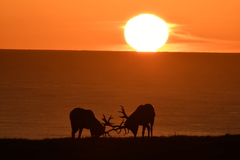
Predominantly a browser, the moose's diet consists of both terrestrial and aquatic vegetation, depending on the season, with branches, twigs and dead wood making up a large portion of their winter diet. Predators of moose include wolves, bears, humans, wolverines (rarely, though may take calves), and (rarely, if swimming in the ocean) orcas. Unlike most other deer species, moose do not form herds and are solitary animals, aside from calves who remain with their mother until the cow begins estrus again (typically 18 months after the birth of a calf). At this point, the cow chases her calf away. Although generally slow-moving and sedentary, moose can become defensively aggressive, and move very quickly if angered or startled. Their mating season in the autumn features energetic fights between males competing for a female.
Moose have played a prominent role in the culture of people in the Northern Hemisphere. Evidence suggests they were hunted by humans as far back as the most recent Ice Age. Wikipedia →
Sounds
Recording0:40
United States · 2023
© mayab2135 · iNaturalist · CC BY-NC 4.0
Recording0:54
Russia · 2025
© Дина Хромова · iNaturalist · CC BY-NC 4.0
Recording0:39
United States · 2025
© Ken Gross · iNaturalist · CC BY-NC 4.0
Recent sightings of Moose in Riding Mountain National Park
LIVEiNaturalistGlobal Distribution
Parks Where Found
| # | Park | Country | Daily sighting probability |
|---|---|---|---|
| 1 | Denali National Park | 🇺🇸 United States | |
| 2 | Isle Royale National Park | 🇺🇸 United States | |
| 3 | Grand Teton National Park | 🇺🇸 United States | |
| 4 | Nahanni National Park | 🇨🇦 Canada | |
| 5 | Rocky Mountain National Park | 🇺🇸 United States | |
| 6 | Cape Breton Highlands National Park | 🇨🇦 Canada | |
| 7 | Gros Morne National Park | 🇨🇦 Canada | |
| 8 | Glacier National Park | 🇺🇸 United States | |
| 9 | Jasper National Park | 🇨🇦 Canada | |
| 10 | Wrangell-St. Elias National Park | 🇺🇸 United States | |
| 11 | Kluane National Park | 🇨🇦 Canada | |
| 12 | Elk Island National Park | 🇨🇦 Canada | |
| 13 | Kenai Fjords National Park | 🇺🇸 United States | |
| 14 | Wood Buffalo National Park | 🇨🇦 Canada | |
| 15 | Yellowstone National Park | 🇺🇸 United States | |
| 16 | Katmai National Park | 🇺🇸 United States | |
| 17 | Riding Mountain National Park | 🇨🇦 Canada | |
| 18 | Banff National Park | 🇨🇦 Canada | |
| 19 | Great Bear Rainforest | 🇨🇦 Canada | |
| 20 | Acadia National Park | 🇺🇸 United States |
Zoos & Centres Where Found
| # | Zoo / Centre | Country | |
|---|---|---|---|
| 1 | Värmlands Moose Park | 🇸🇪 Sweden |
Closest Relatives at Riding Mountain National Park







Before you go
What are the chances of seeing a Moose in Riding Mountain National Park?
Possible
About 30% of wildlife watchers report a Moose sighting in Riding Mountain National Park on a given day, based on 54 verified sightings from GBIF citizen-science data from 2019 to 2026. It is the 5th most-seen of the 24 mammals we can rate there. Over three days the chance rises to about 70%, and over a week to about 90%, if each day is a fresh chance.
When is the best time to see a Moose in Riding Mountain National Park?
June–July, September and December
In those months about 40% of wildlife watchers report a Moose in Riding Mountain National Park on a given day, against under 5% in March, the lowest month.
What time of day is best to see a Moose?
Between 7 and 10 am
Across all the parks we cover, that three-hour window holds the most Moose sightings with a recorded time, and about 8 in 10 of them come between 6 am and 6 pm: it is a daytime animal.
Is Riding Mountain National Park the best place to see a Moose?
17th of 20
Of the 20 parks where we can rate Moose sightings, Riding Mountain National Park ranks 17th at about 30%. The best odds are in Denali National Park (United States, about 90%), Isle Royale National Park (United States, about 90%) and Grand Teton National Park (United States, about 80%). All parks ranked.
Which relatives of the Moose live in Riding Mountain National Park?
Same family: Cervidae
The closest relatives of the Moose that you can see in Riding Mountain National Park (family Cervidae, Deer) are White-tailed Deer (about 40%) and Elk (wapiti) (about 10%), with each one's daily chance of a sighting.
Where does the Moose sighting chance come from?
GBIF citizen-science records
It is estimated from how often the Moose is recorded against all the mammals logged in Riding Mountain National Park (54 verified sightings from 2019 to 2026), calibrated against known sighting rates. Figures are rounded to the nearest 10% because citizen-science data supports honest approximations, not decimals, and months with records from fewer than five people show "—". How it works.
