



Completed

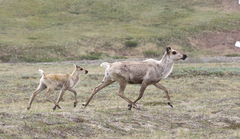


Caribou
Rangifer tarandus
Silhouette: mystica · PhyloPic
- KingdomAnimalia (Animals)
- PhylumChordata (Chordates)
- ClassMammalia (Mammals)
- OrderArtiodactyla (Even-toed Ungulates and Cetaceans)
- FamilyCervidae (Deer)
- GenusRangifer (Caribous/Reindeers)
- SpeciesRangifer tarandus (Caribou)
In 3 days >90%
991 Verified sightings at Svalbard From 2019 to 2026
1,676 In all 7 parks
October Best month
☀️ Diurnal When it's spotted
About the Caribou
The reindeer or caribou (Rangifer tarandus) is a species of deer with circumpolar distribution, native to Arctic, subarctic, tundra, boreal, and mountainous regions of Northern Europe, Siberia, and North America. It is the only representative of the genus Rangifer. More recent studies suggest the splitting of reindeer and caribou (North American terminology). "All caribou and reindeer throughout the world are considered to be the same species, but there are 7 subspecies."
Reindeer occur in both migratory and sedentary populations, and their herd sizes vary greatly in different regions. The tundra subspecies are adapted for extreme cold, and some are adapted for long-distance migration. Reindeer vary greatly in size and color from the smallest, the Svalbard reindeer (R. (t.) platyrhynchus), to the largest, Osborn's caribou (R. t. osborni). Although reindeer are quite numerous, some species and subspecies are in decline and considered vulnerable. They are unique among deer (Cervidae) in that females may have antlers, although the prevalence of antlered females varies by subspecies.
Reindeer are the only successfully semi-domesticated deer on a large scale in the world. Both wild and domestic reindeer have been an important source of food, clothing, and shelter for Arctic people from prehistorical times. They are still herded and hunted today. In some traditional Christmas legends, Santa Claus's reindeer pull a sleigh through the night sky to help Santa Claus deliver gifts to good children on Christmas Eve. Wikipedia →
Recent sightings of Caribou in Svalbard
LIVEiNaturalistGlobal Distribution
Parks Where Found
| # | Park | Country | Daily sighting probability |
|---|---|---|---|
| 1 | Svalbard | 🇳🇴 Norway | |
| 2 | Denali National Park | 🇺🇸 United States | |
| 3 | Gros Morne National Park | 🇨🇦 Canada | |
| 4 | Katmai National Park | 🇺🇸 United States | |
| 5 | Vatnajokull National Park | 🇮🇸 Iceland | |
| 6 | Cairngorms National Park | 🇬🇧 United Kingdom | |
| 7 | Jasper National Park | 🇨🇦 Canada |
Zoos & Centres Where Found
Closest Relatives at Svalbard
No species of the same family or order lives in Svalbard, so these are its closest relatives here: other mammals.


Before you go
What are the chances of seeing a Caribou in Svalbard?
Very likely
About 90% of wildlife watchers report a Caribou sighting in Svalbard on a given day, based on 991 verified sightings from GBIF citizen-science data from 2019 to 2026. It is the most-seen of the 14 mammals we can rate there. Over three days the chance rises to over 90%, if each day is a fresh chance.
When is the best time to see a Caribou in Svalbard?
Any time of year
In every month with enough records, about 90% of wildlife watchers report a Caribou in Svalbard on a given day, so our monthly data shows no clear season. December has too few records to rate.
What time of day is best to see a Caribou?
Between 1 and 4 pm
Across all the parks we cover, that three-hour window holds the most Caribou sightings with a recorded time, and about 8 in 10 of them come between 6 am and 6 pm: it is a daytime animal.
Is Svalbard the best place to see a Caribou?
Yes
Of the 7 parks where we can rate Caribou sightings, Svalbard has the highest daily chance: about 90%. Next come Denali National Park (United States, about 90%) and Gros Morne National Park (Canada, about 40%). All parks ranked.
Where does the Caribou sighting chance come from?
GBIF citizen-science records
It is estimated from how often the Caribou is recorded against all the mammals logged in Svalbard (991 verified sightings from 2019 to 2026), calibrated against known sighting rates. Figures are rounded to the nearest 10% because citizen-science data supports honest approximations, not decimals, and months with records from fewer than five people show "—". How it works.
