Red-tailed Tropicbird

Red-tailed Tropicbird

Phaethon rubricauda

Silhouette: Paul Baker (photo), John E. McCormack, Michael G. Harvey, Brant C. Faircloth, Nicholas G. Crawford, Travis C. Glenn, Robb T. Brumfield & T. Michael Keesey · PhyloPic

LCLeast ConcernNTVUENCR
Daily sighting probability <5% · Rare
at Rottnest Island

In 3 days ~10% in a week ~20%

10 Verified sightings at Rottnest Island From 2019 to 2026
10 In 1 park
January Best month
☀️ Diurnal When it's spotted

About the Red-tailed Tropicbird

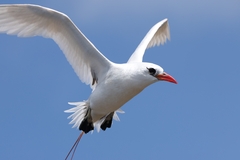
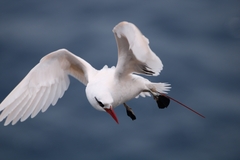
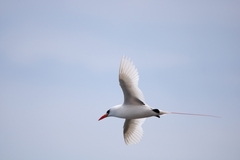
The red-tailed tropicbird (Phaethon rubricauda) is a seabird native to tropical parts of the Indian and Pacific Oceans. One of three closely related species of tropicbird (Phaethontidae), it was described by Pieter Boddaert in 1783. Superficially resembling a tern in appearance, it has almost all-white plumage with a black mask and a red bill. The sexes have similar plumage. As referenced in the common name, adults have red tail streamers that are about twice their body length. Four subspecies are recognised, but there is evidence of clinal variation in body size—with smaller birds in the north and larger in the south—and hence no grounds for subspecies.

The red-tailed tropicbird eats fish—mainly flying fish and squid—after catching them by plunge-diving into the ocean. Nesting takes place in loose colonies on oceanic islands; the nest itself is a scrape found on a cliff face, in a crevice, or on a sandy beach. A single egg is laid, then is incubated by both sexes for about six weeks. The parents make long food-foraging trips of about 150 hours during incubation, but once the chick has hatched, the parents specialize their foraging: one forages for the chick for a few hours at a time, while the other makes much longer trips to feed themselves.

This bird is considered to be a least-concern species according to the International Union for Conservation of Nature (IUCN), though it is adversely affected by human contact. Rats and feral cats prey on eggs and young at nesting sites. The bird's tail streamers were once prized by some Hawaiian and Māori peoples. Wikipedia →

Sounds

Call0:25

Madagascar · 2012

© Peter Boesman · XC762925 · CC BY-NC-ND 4.0

Recording1:17

France · 2021

© AUDEVARD Aurélien · XC620185 · CC BY-NC-SA 4.0

Alarm call0:14

Mauritius · 2013

© Johannes Fischer · XC148671 · CC BY-NC-SA 3.0

Global Distribution

Parks Where Found

# Park Country Daily sighting probability
1 Rottnest Island 🇦🇺 Australia
<5%

More parks will be added in future updates.

Before you go

What are the chances of seeing a Red-tailed Tropicbird in Rottnest Island?

Rare

Under 5% of wildlife watchers report a Red-tailed Tropicbird sighting in Rottnest Island on a given day, based on 10 verified sightings from GBIF citizen-science data from 2019 to 2026. It is the 63rd most-seen of the 81 birds we can rate there. Over three days the chance rises to about 10%, and over a week to about 20%, if each day is a fresh chance.

When is the best time to see a Red-tailed Tropicbird in Rottnest Island?

January and November

In those months about 10% of wildlife watchers report a Red-tailed Tropicbird in Rottnest Island on a given day, against under 5% in February–October and December, the lowest months. Those are among Rottnest Island's driest months, with about 15 mm of rain a month against 120 mm in June.

What time of day is best to see a Red-tailed Tropicbird?

Between 11 am and 2 pm

Across all the parks we cover, that three-hour window holds the most Red-tailed Tropicbird sightings with a recorded time, and about 9 in 10 of them come between 6 am and 6 pm: it is a daytime animal.

Where else can you see a Red-tailed Tropicbird?

Only Rottnest Island, in our data

Rottnest Island is the only park on Wallace's Line with enough records to rate Red-tailed Tropicbird sightings: under 5% of wildlife watchers there report one on a given day.

Where does the Red-tailed Tropicbird sighting chance come from?

GBIF citizen-science records

It is estimated from how often the Red-tailed Tropicbird is recorded against all the birds logged in Rottnest Island (10 verified sightings from 2019 to 2026), calibrated against known sighting rates. Figures are rounded to the nearest 10% because citizen-science data supports honest approximations, not decimals, and months with records from fewer than five people show "—". How it works.

← Back to Rottnest Island