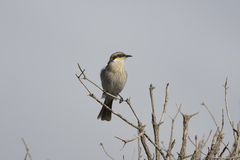
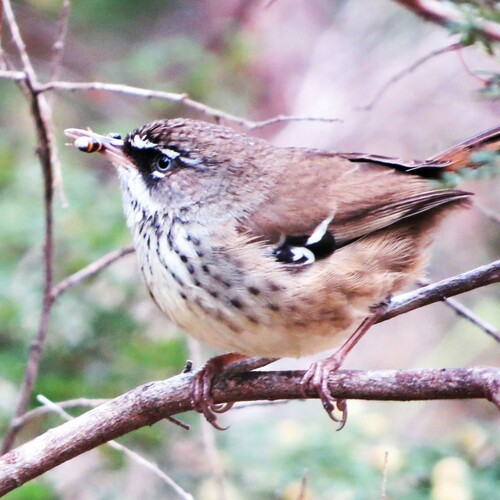
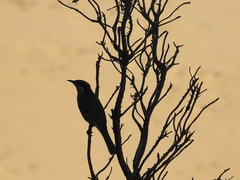
Singing Honeyeater

Singing Honeyeater

Gavicalis virescens

Silhouette: Rachael Joakim · PhyloPic

LCLeast ConcernNTVUENCR Endemic
Daily sighting probability ~70% · Very likely
at Rottnest Island

In 3 days >90%

448 Verified sightings at Rottnest Island From 2019 to 2026
2,405 In all 8 parks
April Best month
☀️ Diurnal When it's spotted

About the Singing Honeyeater

The singing honeyeater (Gavicalis virescens) is a small bird found in Australia, and is part of the honeyeater family Meliphagidae. The bird lives in a wide range of shrubland, woodland, and coastal habitat. It is relatively common and is widespread right across Australia west of the Great Dividing Range, through to the west coast and on Western Australian coastal islands. It does not occur in other countries.

The singing honeyeater was originally described as Meliphaga virescens lipferti. It was previously placed in the genus Lichenostomus, but was moved to Gavicalis after a molecular phylogenetic analysis, published in 2011, showed that the original genus was polyphyletic. The generic name is formed from an anagram of the sister genus Caligavis; the specific epithet is the Latin virescens meaning 'greenish'.

Singing honeyeaters can vary in length from 17–22 cm (6.7–8.7 in). Their overall appearance is grey-brown. The tail and wings are olive-green with flashes of yellow. There is a broad, black stripe running from the behind the beak to the back, and a yellow streak immediately below this from the eye. The bird's song ranges from scratchy to melodious... Wikipedia →

Sounds

Call0:29

Australia · 2023

© Peter Boesman · XC859882 · CC BY-NC-ND 4.0

Song1:03

Australia · 2021

© Marc Anderson · XC693212 · CC BY-NC-ND 4.0

Call0:26

Australia · 2017

© Christopher Watson · XC643095 · CC BY-NC-SA 4.0

Global Distribution

Parks Where Found

# Park Country Daily sighting probability
1 Rottnest Island 🇦🇺 Australia
~70%
2 Ningaloo Marine Park 🇦🇺 Australia
~70%
3 Uluru-Kata Tjuta National Park 🇦🇺 Australia
~70%
4 Cape Range 🇦🇺 Australia
~60%
5 Flinders Ranges National Park 🇦🇺 Australia
~30%
6 Hattah-Kulkyne National Park 🇦🇺 Australia
~20%
7 Great Otway National Park 🇦🇺 Australia
~20%
8 Grampians National Park 🇦🇺 Australia
<5%

Cities Where Found

# City Country Daily sighting probability
1 Perth 🇦🇺 Australia
~70%
2 Melbourne 🇦🇺 Australia
<5%

Before you go

What are the chances of seeing a Singing Honeyeater in Rottnest Island?

Very likely

About 70% of wildlife watchers report a Singing Honeyeater sighting in Rottnest Island on a given day, based on 448 verified sightings from GBIF citizen-science data from 2019 to 2026. It is the 7th most-seen of the 81 birds we can rate there. Over three days the chance rises to over 90%, if each day is a fresh chance.

When is the best time to see a Singing Honeyeater in Rottnest Island?

February–April, June–July, October and December

In those months about 80% of wildlife watchers report a Singing Honeyeater in Rottnest Island on a given day, against about 60% in May, the lowest month.

What time of day is best to see a Singing Honeyeater?

Between 2 and 5 pm

Across all the parks we cover, that three-hour window holds the most Singing Honeyeater sightings with a recorded time, and nearly all of them come between 6 am and 6 pm: it is a daytime animal.

Which relatives of the Singing Honeyeater live in Rottnest Island?

Same family: Meliphagidae

The closest relatives of the Singing Honeyeater that you can see in Rottnest Island (family Meliphagidae, Honeyeaters) are White-fronted Chat (about 40%) and Red Wattlebird (about 10%), with each one's daily chance of a sighting.

Where does the Singing Honeyeater sighting chance come from?

GBIF citizen-science records

It is estimated from how often the Singing Honeyeater is recorded against all the birds logged in Rottnest Island (448 verified sightings from 2019 to 2026), calibrated against known sighting rates. Figures are rounded to the nearest 10% because citizen-science data supports honest approximations, not decimals, and months with records from fewer than five people show "—". How it works.

← Back to Rottnest Island