
Grey Teal

Grey Teal

Anas gracilis

Silhouette: Sheatherius · PhyloPic

LCLeast ConcernNTVUENCR
Daily sighting probability ~70% · Very likely
at Rottnest Island

In 3 days >90%

350 Verified sightings at Rottnest Island From 2019 to 2026
1,914 In all 20 parks
February Best month
☀️ Diurnal When it's spotted

About the Grey Teal

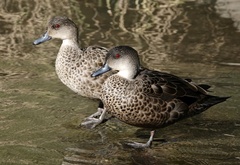
The grey teal (Anas gracilis) is a dabbling duck found in open wetlands in Australia and New Zealand. It is identified by the presence of a crimson coloured iris in its eyes, which is relatively more prominent in adult males.

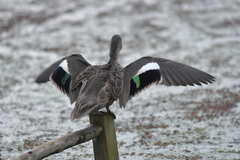
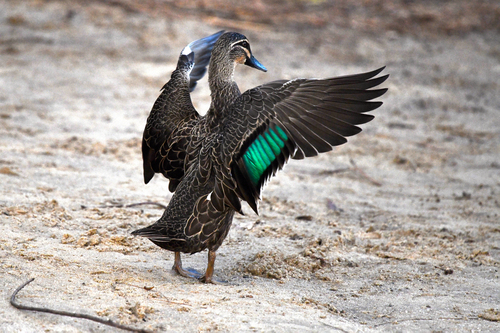
It is a mottled brown duck with white and green flashes on its wings. Males and females share the same colouration, in contrast to the related chestnut teal, male and female of which are strikingly different. The grey teal has almost identical colouration to the female chestnut teal and the grey can only be distinguished by its lighter coloured neck and paler face. Juveniles are paler than adults, especially on the head. However, they can be identified by having a dull brown eye until matured. The bill of the grey teal is a blue-grey colour with dark lining around the edges. Feet are a similar colour to that of the bill being grey. The head of the grey teal can be described as plain/slightly streaked, with a dark crown and cream coloured chin/throat and cheeks.

The eggs of the grey teal are creamy white and are not distinctly speckled. An average egg is 49.3 mm (1.94 in) in length and 35.6 mm (1.40 in) in width. The grey teal nests near its favoured... Wikipedia →

Sounds

Flight call0:13

Australia · 2026

© JJSUN · XC1088465 · CC BY-NC-SA 4.0

Call1:03

Australia · 2020

© Marc Anderson · XC1001928 · CC BY-NC-ND 4.0

Call0:15

Australia · 2021

© Greg McLachlan · XC658637 · CC BY-NC-SA 4.0

Global Distribution

Parks Where Found

# Park Country Daily sighting probability
1 Rottnest Island 🇦🇺 Australia
~70%
2 Hattah-Kulkyne National Park 🇦🇺 Australia
~30%
3 Cape Range 🇦🇺 Australia
~30%
4 Ningaloo Marine Park 🇦🇺 Australia
~20%
5 Uluru-Kata Tjuta National Park 🇦🇺 Australia
~20%
6 Great Otway National Park 🇦🇺 Australia
~10%
7 Fiordland National Park 🇳🇿 New Zealand
~10%
8 Litchfield National Park 🇦🇺 Australia
~10%
9 Flinders Ranges National Park 🇦🇺 Australia
~10%
10 Grampians National Park 🇦🇺 Australia
~10%
11 Kosciuszko National Park 🇦🇺 Australia
~10%
12 Wilsons Promontory National Park 🇦🇺 Australia
~10%
13 Royal National Park 🇦🇺 Australia
~10%
14 Maria Island National Park 🇦🇺 Australia
<5%
15 Booderee National Park 🇦🇺 Australia
<5%
16 Abel Tasman National Park 🇳🇿 New Zealand
<5%
17 Kakadu National Park 🇦🇺 Australia
<5%
18 Blue Mountains National Park 🇦🇺 Australia
<5%
19 Daintree National Park 🇦🇺 Australia
<5%
20 Lamington National Park 🇦🇺 Australia
<5%

Cities Where Found

# City Country Daily sighting probability
1 Perth 🇦🇺 Australia
~40%
2 Melbourne 🇦🇺 Australia
~30%
3 Sydney 🇦🇺 Australia
~20%
4 Brisbane 🇦🇺 Australia
~10%
5 Auckland 🇳🇿 New Zealand
~10%
6 Hobart 🇦🇺 Australia
<5%

Zoos & Centres Where Found

# Zoo / Centre Country
1 Alice Springs Desert Park 🇦🇺 Australia In captivity
2 Jacksonville Zoo and Gardens 🇺🇸 United States In captivity
3 Hamilton Zoo 🇳🇿 New Zealand In captivity
4 Auckland Zoo 🇳🇿 New Zealand In captivity
5 Willowbank Wildlife Reserve 🇳🇿 New Zealand In captivity
6 Paradise Valley Springs 🇳🇿 New Zealand In captivity
7 Australian Reptile Park 🇦🇺 Australia In captivity
8 Prospect Park Zoo 🇺🇸 United States In captivity
9 Ōtorohanga Kiwi House 🇳🇿 New Zealand In captivity

Before you go

What are the chances of seeing a Grey Teal in Rottnest Island?

Very likely

About 70% of wildlife watchers report a Grey Teal sighting in Rottnest Island on a given day, based on 350 verified sightings from GBIF citizen-science data from 2019 to 2026. It is the 11th most-seen of the 81 birds we can rate there. Over three days the chance rises to over 90%, if each day is a fresh chance.

When is the best time to see a Grey Teal in Rottnest Island?

February and November

In those months about 80% of wildlife watchers report a Grey Teal in Rottnest Island on a given day, against about 50% in April, the lowest month. Those are among Rottnest Island's driest months, with about 20 mm of rain a month against 120 mm in June.

What time of day is best to see a Grey Teal?

Between 11 am and 2 pm

Across all the parks we cover, that three-hour window holds the most Grey Teal sightings with a recorded time, and nearly all of them come between 6 am and 6 pm: it is a daytime animal.

Is Rottnest Island the best place to see a Grey Teal?

Yes

Of the 20 parks where we can rate Grey Teal sightings, Rottnest Island has the highest daily chance: about 70%. Next come Hattah-Kulkyne National Park (Australia, about 30%) and Cape Range (Australia, about 30%). All parks ranked.

Where does the Grey Teal sighting chance come from?

GBIF citizen-science records

It is estimated from how often the Grey Teal is recorded against all the birds logged in Rottnest Island (350 verified sightings from 2019 to 2026), calibrated against known sighting rates. Figures are rounded to the nearest 10% because citizen-science data supports honest approximations, not decimals, and months with records from fewer than five people show "—". How it works.

← Back to Rottnest Island