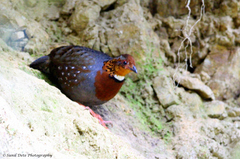
Chestnut-breasted Hill Partridge

Chestnut-breasted Hill Partridge

Arborophila mandellii

Silhouette: PhyloPic

LCNTNear ThreatenedVUENCR
Daily sighting probability <5% · Rare
at Royal Manas National Park

In 3 days <5% in a week ~10%

8 Verified sightings at Royal Manas National Park From 2019 to 2026
8 In 1 park
April Best month
☀️ Diurnal When it's spotted

About the Chestnut-breasted Hill Partridge

The chestnut-breasted partridge (Arborophila mandellii) is a partridge species endemic to the eastern Himalayas north of the Brahmaputra, and occurs in Bhutan, Darjeeling, Sikkim, Arunachal Pradesh and south-eastern Tibet at elevations from 350 to 2,500 m (1,150 to 8,200 ft). It is listed as near threatened on the IUCN Red List, as the estimated population comprises less than 10,000 individuals. It is threatened by forest degradation and by hunting. It is known from at least three protected areas, including Singalila National Park and Namdapha National Park.

The scientific name commemorates the Italian naturalist Louis Mandelli. It is a distinctive partridge with chestnut breast-band and grey belly. It is distinguished from the similar rufous-throated partridge A. rufogularis by more rufescent crown and head-sides, white gorget and entirely chestnut upper breast.

In 2015, the first photograph of this species in the wild was taken in Arunachal Pradesh. Wikipedia →

Sounds

Song0:27

India · 2017

© Jelle Scharringa · XC568802 · CC BY-NC-SA 4.0

Song0:34

Bhutan · 2014

© Tuomas Seimola · XC382654 · CC BY-NC-SA 4.0

Song0:18

India · 2009

© Arnold Meijer · XC35457 · CC BY-NC-ND 2.5

Global Distribution

Parks Where Found

# Park Country Daily sighting probability
1 Royal Manas National Park 🇧🇹 Bhutan
<5%

More parks will be added in future updates.

Before you go

What are the chances of seeing a Chestnut-breasted Hill Partridge in Royal Manas National Park?

Rare

Under 5% of wildlife watchers report a Chestnut-breasted Hill Partridge sighting in Royal Manas National Park on a given day, based on 8 verified sightings from GBIF citizen-science data from 2019 to 2026. It is the 339th most-seen of the 388 birds we can rate there. Over three days the chance rises to under 5%, and over a week to about 10%, if each day is a fresh chance.

When is the best time to see a Chestnut-breasted Hill Partridge in Royal Manas National Park?

Any time of year

In every month with enough records, under 5% of wildlife watchers report a Chestnut-breasted Hill Partridge in Royal Manas National Park on a given day, so our monthly data shows no clear season. August and September have too few records to rate.

What time of day is best to see a Chestnut-breasted Hill Partridge?

Between 6 and 9 am

Across all the parks we cover, that three-hour window holds the most Chestnut-breasted Hill Partridge sightings with a recorded time, and nearly all of them come between 6 am and 6 pm: it is a daytime animal.

Where else can you see a Chestnut-breasted Hill Partridge?

Only Royal Manas National Park, in our data

Royal Manas National Park is the only park on Wallace's Line with enough records to rate Chestnut-breasted Hill Partridge sightings: under 5% of wildlife watchers there report one on a given day.

Which relatives of the Chestnut-breasted Hill Partridge live in Royal Manas National Park?

Same genus: Arborophila

The closest relatives of the Chestnut-breasted Hill Partridge that you can see in Royal Manas National Park (genus Arborophila, Hill-Partridges) are Rufous-throated Hill Partridge (about 10%) and Common Hill Partridge (about 10%), with each one's daily chance of a sighting.

Where does the Chestnut-breasted Hill Partridge sighting chance come from?

GBIF citizen-science records

It is estimated from how often the Chestnut-breasted Hill Partridge is recorded against all the birds logged in Royal Manas National Park (8 verified sightings from 2019 to 2026), calibrated against known sighting rates. Figures are rounded to the nearest 10% because citizen-science data supports honest approximations, not decimals, and months with records from fewer than five people show "—". How it works.

← Back to Royal Manas National Park