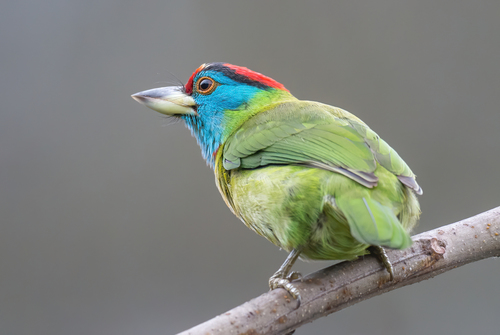
Himalayan Monal

Himalayan Monal

Lophophorus impejanus

Silhouette: Sheatherius · PhyloPic

LCLeast ConcernNTVUENCR
Daily sighting probability <5% · Rare
at Royal Manas National Park

In 3 days <5%

6 Verified sightings at Royal Manas National Park From 2019 to 2026
165 In all 2 parks
May Best month
🌅 Crepuscular When it's spotted

About the Himalayan Monal

The Himalayan monal (Lophophorus impejanus), also called Impeyan monal, is a landfowl native to Himalayan forests and shrublands at elevations of 2,100–4,500 m (6,900–14,800 ft). It is part of the family Phasianidae and is listed as Least Concern on the IUCN Red List.

It is the national bird of Nepal, where it is known as the danphe or danfe, and state bird of Uttarakhand, India, where it is known as a monal. The scientific name commemorates Lady Mary Impey, the wife of the British chief justice of Bengal, Sir Elijah Impey.

It is a relatively large-sized landfowl, 24–30 in (61–76 cm) long and weighing 3–5 pounds (1.4–2.3 kg). The adult male has multicoloured plumage throughout, while the female, as in other landfowl, is more subdued in colour. Notable features in the male include a long, metallic green crest, coppery feathers on the back and neck, and a prominent white rump that is most visible when the bird is in flight. The male's tail feathers are uniformly rufous, darkening towards the tips, whereas the female's lower tail coverts are white, barred with black and red. The female has a prominent white patch on the throat and a white stripe on the tail. The first... Wikipedia →

Sounds

Call0:13

India · 2019

© Andrew Spencer · XC547787 · CC BY-NC-ND 4.0

Alarm call0:27

India · 2012

© Lakshminarasimha R · XC114358 · CC BY-NC-SA 3.0

Call0:20

Bhutan · 2020

© Daniel Danckwerts · XC523178 · CC BY-NC-SA 4.0

Global Distribution

Parks Where Found

# Park Country Daily sighting probability
1 Langtang National Park 🇳🇵 Nepal
~30%
2 Royal Manas National Park 🇧🇹 Bhutan
<5%

Zoos & Centres Where Found

# Zoo / Centre Country
1 Moscow Zoo 🇷🇺 Russia In captivity
2 ZooParc de Beauval 🇫🇷 France In captivity
3 Leipzig Zoological Garden 🇩🇪 Germany In captivity
4 Tierpark Berlin 🇩🇪 Germany In captivity
5 Natura Artis Magistra 🇳🇱 Netherlands In captivity
6 Zoorasia 🇯🇵 Japan In captivity
7 Ostrava Zoo 🇨🇿 Czechia In captivity
8 Zoo Miami 🇺🇸 United States In captivity
9 Poznań Nowe Zoo 🇵🇱 Poland In captivity
10 Bronx Zoo 🇺🇸 United States In captivity
11 Tallinn Zoo 🇪🇪 Estonia In captivity
12 Highland Wildlife Park 🇬🇧 United Kingdom In captivity
13 Chester Zoo 🇬🇧 United Kingdom In captivity
14 Shubenacadie Wildlife Park 🇨🇦 Canada In captivity
15 Parque Zoológico de León - Zooleón 🇲🇽 Mexico In captivity
16 Wildlife World Zoo 🇺🇸 United States In captivity
17 Marwell Zoo 🇬🇧 United Kingdom In captivity
18 Parc animalier de Gramat 🇫🇷 France In captivity
19 Guadalajara Zoo 🇲🇽 Mexico In captivity
20 Dakota Zoo 🇺🇸 United States In captivity
21 Granby Zoo 🇨🇦 Canada In captivity
22 Oklahoma City Zoo and Botanical Garden 🇺🇸 United States In captivity
23 Calgary Zoo 🇨🇦 Canada In captivity
24 Zoologischer Garten Leipzig 🇩🇪 Germany In captivity
25 Zoo de La Flèche 🇫🇷 France In captivity
26 Europaradise Park 🇵🇹 Portugal In captivity
27 Opel-Zoo 🇩🇪 Germany In captivity
28 Nikolaev Zoo 🇺🇦 Ukraine In captivity
29 Wildpark Hochrieß 🇦🇹 Austria In captivity
30 Chapultepec Zoo 🇲🇽 Mexico In captivity
31 Łódź Zoo 🇵🇱 Poland In captivity
32 Auckland Zoo 🇳🇿 New Zealand In captivity
33 Dartmoor Zoological Park 🇬🇧 United Kingdom In captivity
34 Krakow Zoo 🇵🇱 Poland In captivity
35 Turtle Back Zoo 🇺🇸 United States In captivity
36 Buffalo Zoo 🇺🇸 United States In captivity
37 Motithang Takin Preserve 🇧🇹 Bhutan In captivity
38 Tennōji Zoo 🇯🇵 Japan In captivity
39 Vogelpark Avifauna 🇳🇱 Netherlands In captivity
40 Van Blanckendaell Park 🇳🇱 Netherlands In captivity
41 Ménagerie du Jardin des Plantes 🇫🇷 France In captivity
42 Willowbank Wildlife Reserve 🇳🇿 New Zealand In captivity
43 Zoopark Limpopo 🇷🇺 Russia In captivity
44 Kathmandu Zoo 🇳🇵 Nepal In captivity
45 Reptile Gardens 🇺🇸 United States In captivity
46 Sacramento Zoo 🇺🇸 United States In captivity
47 Santillana Zoo 🇪🇸 Spain In captivity
48 Elmwood Park Zoo 🇺🇸 United States In captivity
49 Small Breeds Farm Park 🇬🇧 United Kingdom In captivity
50 Zoo Balneário Camboriú 🇧🇷 Brazil In captivity

Before you go

What are the chances of seeing a Himalayan Monal in Royal Manas National Park?

Rare

Under 5% of wildlife watchers report a Himalayan Monal sighting in Royal Manas National Park on a given day, based on 6 verified sightings from GBIF citizen-science data from 2019 to 2026. It is the 362nd most-seen of the 388 birds we can rate there. Over three days the chance rises to under 5%, if each day is a fresh chance.

When is the best time to see a Himalayan Monal in Royal Manas National Park?

Any time of year

In every month with enough records, under 5% of wildlife watchers report a Himalayan Monal in Royal Manas National Park on a given day, so our monthly data shows no clear season. August and September have too few records to rate.

What time of day is best to see a Himalayan Monal?

Between 2 and 5 am

Across all the parks we cover, that three-hour window holds the most Himalayan Monal sightings with a recorded time, and about 6 in 10 of them come between 6 pm and 6 am: it is most active around dawn and dusk.

Is Royal Manas National Park the best place to see a Himalayan Monal?

2nd of 2

Of the 2 parks where we can rate Himalayan Monal sightings, Royal Manas National Park ranks 2nd at under 5%. The best odds are in Langtang National Park (Nepal, about 30%).

Which relatives of the Himalayan Monal live in Royal Manas National Park?

Same family: Phasianidae

The closest relatives of the Himalayan Monal that you can see in Royal Manas National Park (family Phasianidae, Pheasants, Grouse, and Allies) are Red Junglefowl (about 30%), Kalij Pheasant (about 30%) and Rufous-throated Hill Partridge (about 10%), with each one's daily chance of a sighting.

Where does the Himalayan Monal sighting chance come from?

GBIF citizen-science records

It is estimated from how often the Himalayan Monal is recorded against all the birds logged in Royal Manas National Park (6 verified sightings from 2019 to 2026), calibrated against known sighting rates. Figures are rounded to the nearest 10% because citizen-science data supports honest approximations, not decimals, and months with records from fewer than five people show "—". How it works.

← Back to Royal Manas National Park