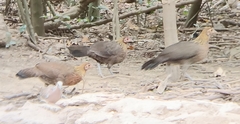
Red Junglefowl

Red Junglefowl

Gallus gallus

Silhouette: Steven Traver · PhyloPic

LCLeast ConcernNTVUENCR
Daily sighting probability ~30% · Possible
at Royal Manas National Park

In 3 days ~70% in a week ~90%

357 Verified sightings at Royal Manas National Park From 2019 to 2026
18,548 In all 25 parks
December Best month
☀️ Diurnal When it's spotted

About the Red Junglefowl

The red junglefowl (Gallus gallus), also known as the Indian red junglefowl (and formerly the bankiva or bankiva-fowl), is a species of tropical, galliform bird in the phasianid family, found across much of Southeast Asia and parts of South Asia.

The red junglefowl was the primary species to give rise to today's many breeds of chicken (G. g. domesticus). Lesser contributions came from the grey junglefowl (G. sonneratii), Sri Lankan junglefowl (G. lafayettii) and the Javanese green junglefowl (G. varius). Whole genome sequencing has revealed that the chicken was first domesticated from red junglefowl ca. 8,000 years ago, with this domestication event involving multiple maternal origins.

The domesticated variant is raised worldwide by humans in their tens of billions for their meat, eggs, colourful plumage and companionship. The wild form of G. gallus is sometimes used in zoos, parks or botanical gardens as a form of pest control, similarly to—and often kept with—the Indian peafowl (Pavo cristatus) or the helmeted guinea fowl (Numida meleagris).

The red junglefowl was formally described in 1758 by the Swedish naturalist Carl Linnaeus in the tenth edition of his Systema... Wikipedia →

Sounds

Song0:36

Singapore · 2025

© Ding Li Yong · XC1067414 · CC BY-NC-ND 4.0

Call0:27

Malaysia · 2025

© Lim Ying Hien · XC1009091 · CC BY-NC-ND 4.0

Song0:21

Malaysia · 2025

© Michael John O Mahony · XC1048462 · CC BY-NC-SA 4.0

Global Distribution

Parks Where Found

# Park Country Daily sighting probability
1 Kaziranga National Park 🇮🇳 India
~70%
2 Jim Corbett National Park 🇮🇳 India
~60%
3 Kaeng Krachan National Park 🇹🇭 Thailand
~60%
4 Bandhavgarh National Park 🇮🇳 India
~50%
5 Khao Yai National Park 🇹🇭 Thailand
~50%
6 Cat Tien National Park 🇻🇳 Vietnam
~50%
7 Manas National Park 🇮🇳 India
~50%
8 Chitwan National Park 🇳🇵 Nepal
~50%
9 Sundarbans National Park 🇮🇳 India
~50%
10 Royal Bardia National Park 🇳🇵 Nepal
~50%
11 Kanha National Park 🇮🇳 India
~40%
12 Way Kambas National Park 🇮🇩 Indonesia
~40%
13 Royal Manas National Park 🇧🇹 Bhutan
~30%
14 Cuc Phuong National Park 🇻🇳 Vietnam
~10%
15 Khao Sok National Park 🇹🇭 Thailand
~10%
16 Taman Negara National Park 🇲🇾 Malaysia
~10%
17 Doi Inthanon National Park 🇹🇭 Thailand
~10%
18 Komodo National Park 🇮🇩 Indonesia
<5%
19 Khao Luang National Park 🇹🇭 Thailand
<5%
20 Sepilok 🇲🇾 Malaysia
<5%
21 Tangkoko Nature Reserve 🇮🇩 Indonesia
<5%
22 Kinabatangan Wildlife Sanctuary 🇲🇾 Malaysia
<5%
23 Bali Barat National Park 🇮🇩 Indonesia
<5%
24 Namdapha National Park 🇮🇳 India
<5%
25 Danum Valley Conservation Area 🇲🇾 Malaysia
<5%

Cities Where Found

# City Country Daily sighting probability
1 Singapore 🇸🇬 Singapore
~60%
2 Nanchang 🇨🇳 China
~40%
3 Coimbatore 🇮🇳 India
~30%
4 Kuala Lumpur 🇲🇾 Malaysia
~20%
5 Tasikmalaya 🇮🇩 Indonesia
~20%
6 Dehradun 🇮🇳 India
~20%
7 Chandigarh 🇮🇳 India
~10%
8 Hyderabad 🇮🇳 India
~10%
9 Chennai 🇮🇳 India
~10%
10 Johannesburg 🇿🇦 South Africa
~10%

Zoos & Centres Where Found

# Zoo / Centre Country
1 Ragunan Zoo 🇮🇩 Indonesia In captivity
2 Moscow Zoo 🇷🇺 Russia In captivity
3 Pairi Daiza 🇧🇪 Belgium In captivity
4 Prague Zoo 🇨🇿 Czechia In captivity
5 Basel Zoo 🇨🇭 Switzerland In captivity
6 ZooParc de Beauval 🇫🇷 France In captivity
7 Copenhagen Zoo 🇩🇰 Denmark In captivity
8 Tierpark Berlin 🇩🇪 Germany In captivity
9 Skansen 🇸🇪 Sweden In captivity
10 Zürich Zoo 🇨🇭 Switzerland In captivity
11 Dresden Zoo 🇩🇪 Germany In captivity
12 Barcelona Zoo 🇪🇸 Spain In captivity
13 Le Pal 🇫🇷 France In captivity
14 Ostrava Zoo 🇨🇿 Czechia In captivity
15 Zoo Pilsen 🇨🇿 Czechia In captivity
16 Parc Phœnix 🇫🇷 France In captivity
17 Muséum de Besançon 🇫🇷 France In captivity
18 Parc des oiseaux 🇫🇷 France In captivity
19 Océarium Le Croisic 🇫🇷 France In captivity
20 Rostov Zoo 🇷🇺 Russia In captivity
21 Kaliningrad Zoo 🇷🇺 Russia In captivity
22 Museum–aquarium of Nancy 🇫🇷 France In captivity
23 Nordens Ark 🇸🇪 Sweden In captivity
24 Parc animalier de Merlet 🇫🇷 France In captivity
25 Gazipur Safari Park 🇧🇩 Bangladesh In captivity
26 Al Hefaiyah Reserve 🇦🇪 United Arab Emirates In captivity
27 Wildwald Voßwinkel 🇩🇪 Germany In captivity
28 Dalian forest zoo 🇨🇳 China In captivity
29 Cheetah Experience 🇿🇦 South Africa In captivity
30 Whipsnade Zoo 🇬🇧 United Kingdom In captivity
31 Beijing Wildlife Park 🇨🇳 China In captivity
32 Taman Safari Indonesia 🇮🇩 Indonesia In captivity
33 Taipei Zoo 🇹🇼 Taiwan In captivity
34 Nehru Zoological Park 🇮🇳 India In captivity
35 Poznań Nowe Zoo 🇵🇱 Poland In captivity
36 Khao Kheow Open Zoo 🇹🇭 Thailand In captivity
37 Chiang Mai Zoo 🇹🇭 Thailand In captivity
38 Wisentgehege Springe 🇩🇪 Germany In captivity
39 Planète Sauvage 🇫🇷 France In captivity
40 National Zoological Park Delhi 🇮🇳 India In captivity
41 Shenzhen Safari Park 🇨🇳 China In captivity
42 Chester Zoo 🇬🇧 United Kingdom In captivity
43 Nanjing Hongshan Forest Zoo 🇨🇳 China In captivity
44 Wow Safari Thoiry 🇫🇷 France In captivity
45 Ree Park – Ebeltoft Safari 🇩🇰 Denmark In captivity
46 Mogilyov Zoo 🇧🇾 Belarus In captivity
47 Cotswold Wildlife Park 🇬🇧 United Kingdom In captivity
48 Nuremberg Zoo 🇩🇪 Germany In captivity
49 Tiergarten Am Tiergarten 28 in Nürnberg 🇩🇪 Germany In captivity
50 National Zoological Garden of South Africa 🇿🇦 South Africa In captivity

Before you go

What are the chances of seeing a Red Junglefowl in Royal Manas National Park?

Possible

About 30% of wildlife watchers report a Red Junglefowl sighting in Royal Manas National Park on a given day, based on 357 verified sightings from GBIF citizen-science data from 2019 to 2026. It is the 29th most-seen of the 388 birds we can rate there. Over three days the chance rises to about 70%, and over a week to about 90%, if each day is a fresh chance.

When is the best time to see a Red Junglefowl in Royal Manas National Park?

December

In that month about 50% of wildlife watchers report a Red Junglefowl in Royal Manas National Park on a given day, against about 10% in October, the lowest month. That is one of Royal Manas National Park's driest months, with about 10 mm of rain against 930 mm in July. August and September have too few records to rate.

What time of day is best to see a Red Junglefowl?

Between 2 and 5 pm

Across all the parks we cover, that three-hour window holds the most Red Junglefowl sightings with a recorded time, and about 9 in 10 of them come between 6 am and 6 pm: it is a daytime animal.

Which relatives of the Red Junglefowl live in Royal Manas National Park?

Same family: Phasianidae

The closest relatives of the Red Junglefowl that you can see in Royal Manas National Park (family Phasianidae, Pheasants, Grouse, and Allies) are Kalij Pheasant (about 30%), Rufous-throated Hill Partridge (about 10%) and Grey Peacock-Pheasant (about 10%), with each one's daily chance of a sighting.

Where does the Red Junglefowl sighting chance come from?

GBIF citizen-science records

It is estimated from how often the Red Junglefowl is recorded against all the birds logged in Royal Manas National Park (357 verified sightings from 2019 to 2026), calibrated against known sighting rates. Figures are rounded to the nearest 10% because citizen-science data supports honest approximations, not decimals, and months with records from fewer than five people show "—". How it works.

← Back to Royal Manas National Park